Wall Chart
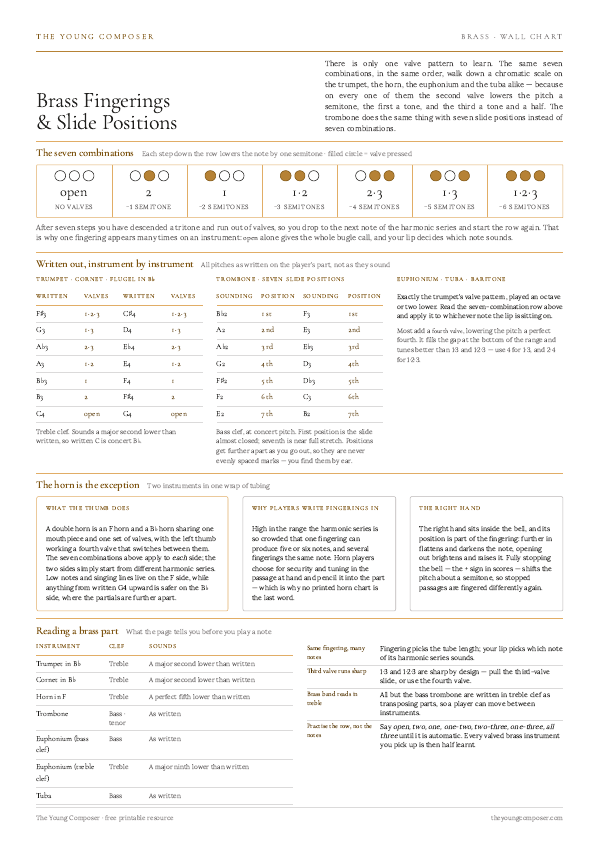
Brass Fingerings & Slide Positions
A wall chart of the one valve pattern shared by trumpet, horn, euphonium and tuba, the trombone's seven slide positions, and what every brass part tells you before you play a note.
Every sheet here is print-ready and free — no watermark, no account, nothing to sign up for. Charts and packs are A4 for a home or classroom printer; wall charts are A3 for a copy shop or a large-format printer.
A wall chart of the one valve pattern shared by trumpet, horn, euphonium and tuba, the trombone's seven slide positions, and what every brass part tells you before you play a note.
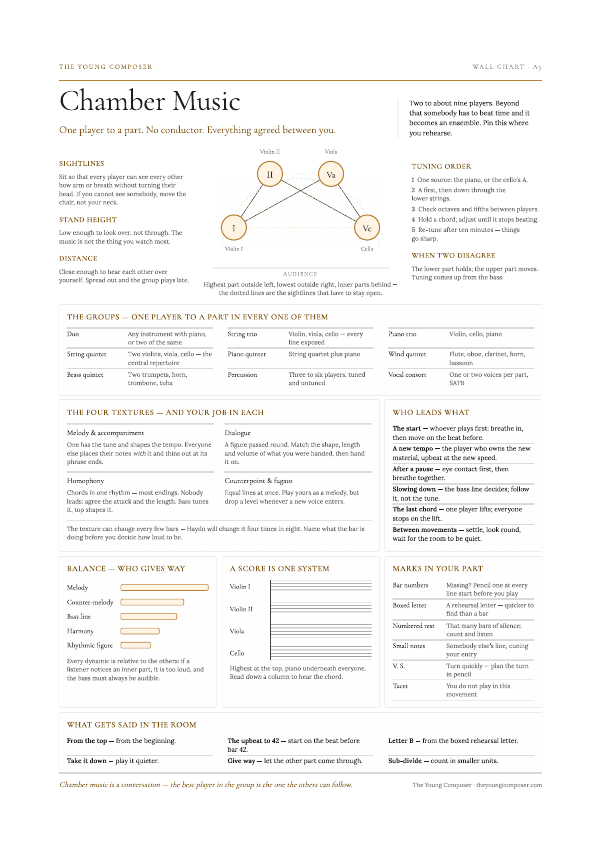
A one-page rehearsal-room reference for chamber ensembles — seating and sightlines, tuning order, the group types, the four textures, who leads what, balance, score reading, part markings and rehearsal-room vocabulary.
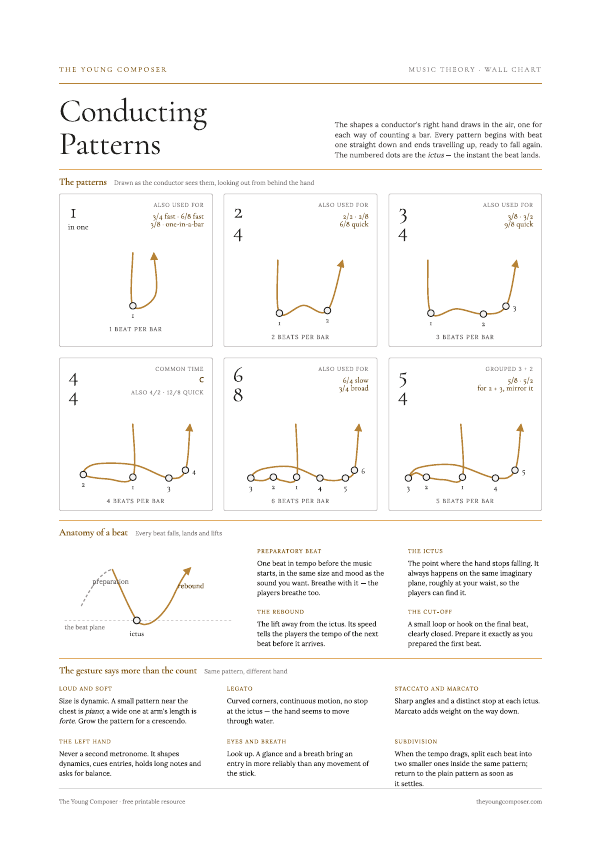
The six conducting shapes for 1 through 6 beats per bar as a wall chart, with the anatomy of a beat and how the gesture shapes dynamics and style.
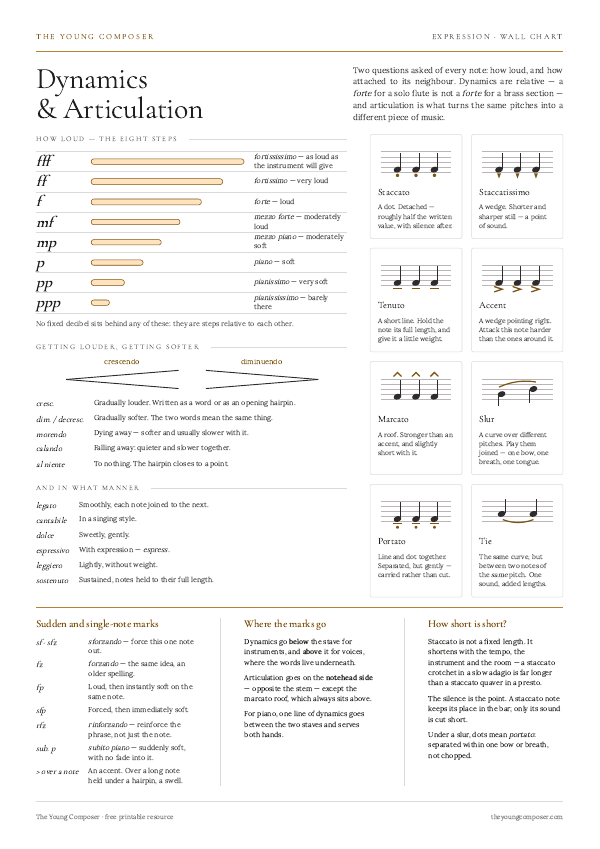
An A3 wall chart of the eight steps of loudness from fffff to ppp, the words for getting louder and softer, and ten articulation marks shown in notation with what each does to a note's length and weight.
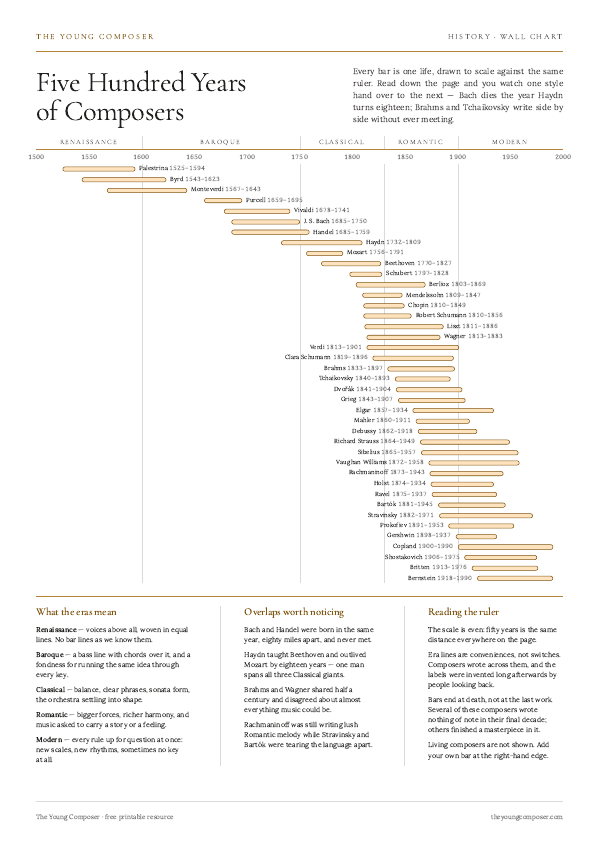
An A3 wall chart of 37 composers from Palestrina to Bernstein, each drawn as a lifespan bar to scale on one shared timeline, spanning the Renaissance through to the Modern era, with panels on what the eras mean and overlaps worth noticing.
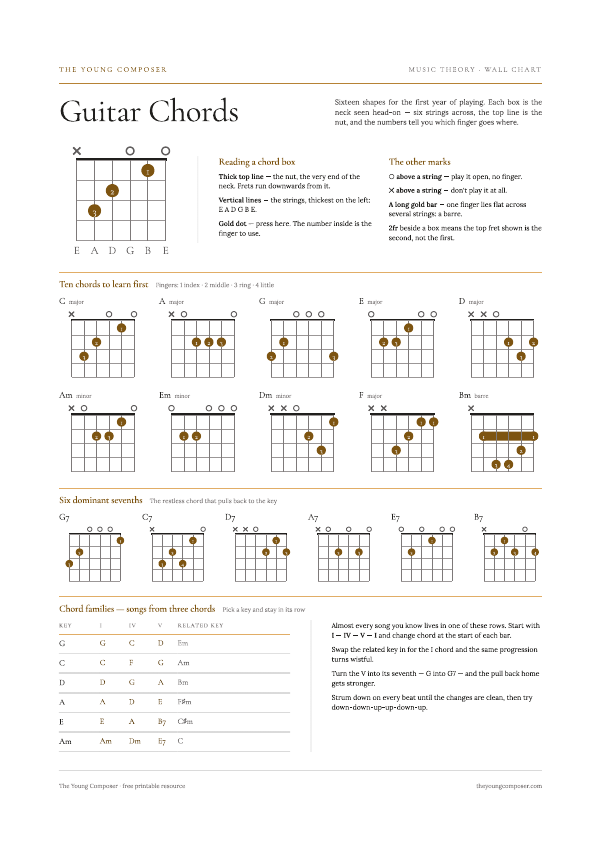
Sixteen essential guitar chord shapes for the first year of playing, plus chord families showing which chords stay in key together.
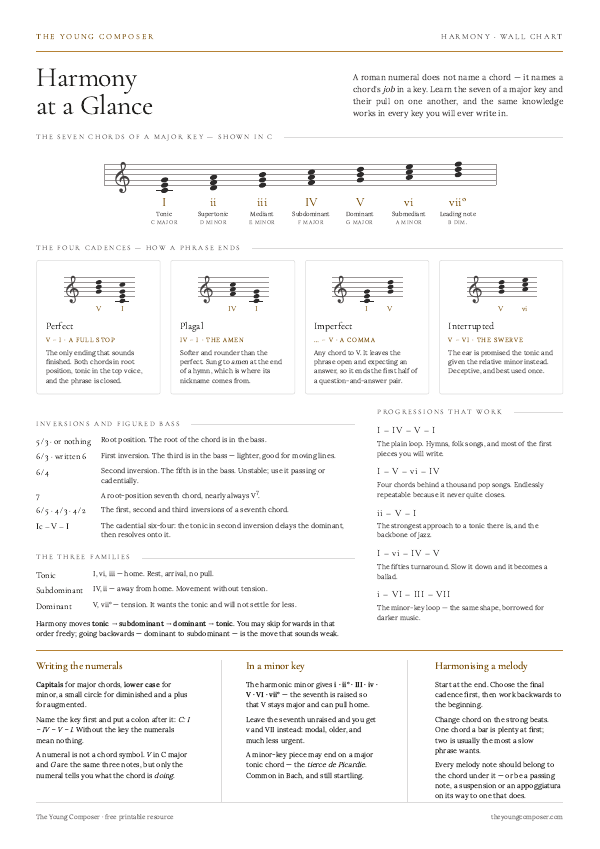
An A3 wall chart of the seven chords of a major key shown in C with roman numerals, the four cadences, chord inversions and figured bass, the three chord families, and six progressions that work.
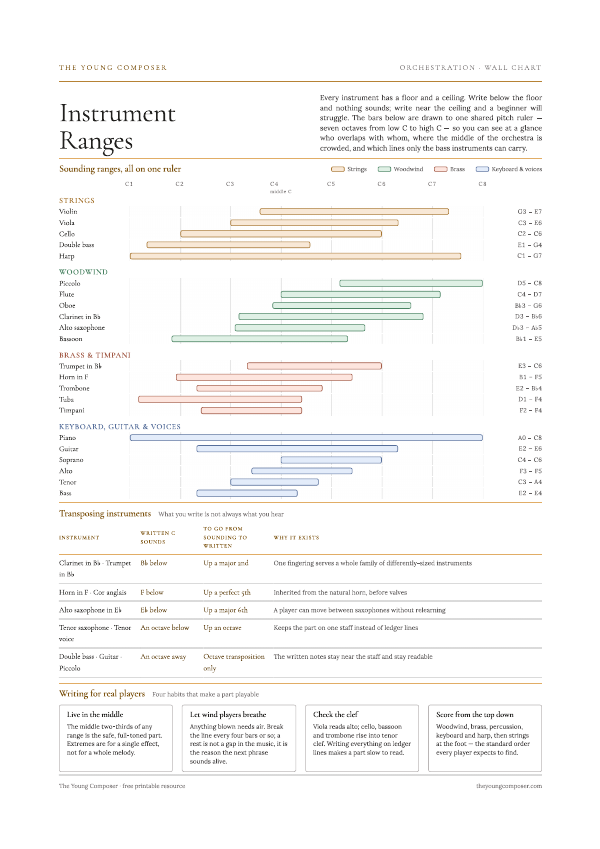
The sounding ranges of orchestral strings, woodwind, brass and keyboard instruments, all plotted on one shared pitch ruler, as a wall chart.
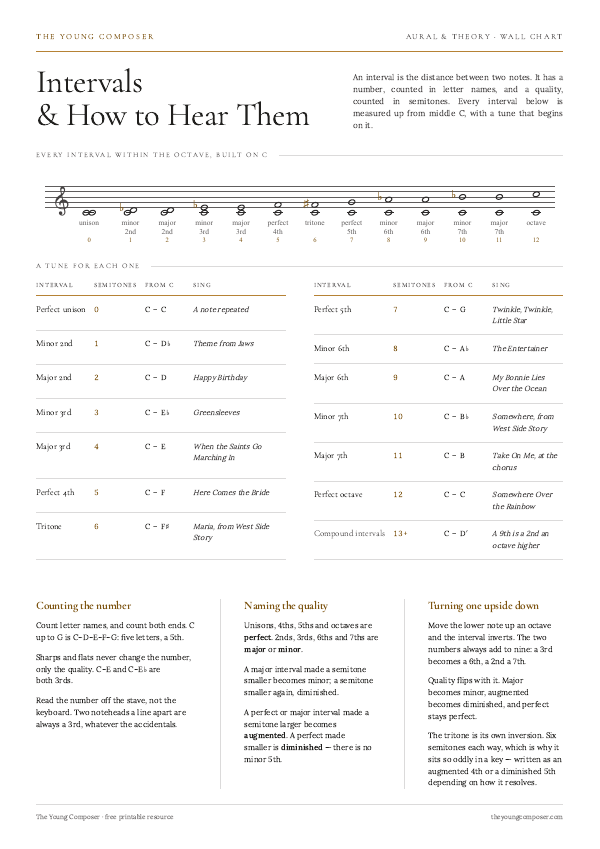
An A3 wall chart of every interval within the octave, each with a familiar tune to fix its sound in the ear, plus panels on counting the number, naming the quality, and how inversion works.
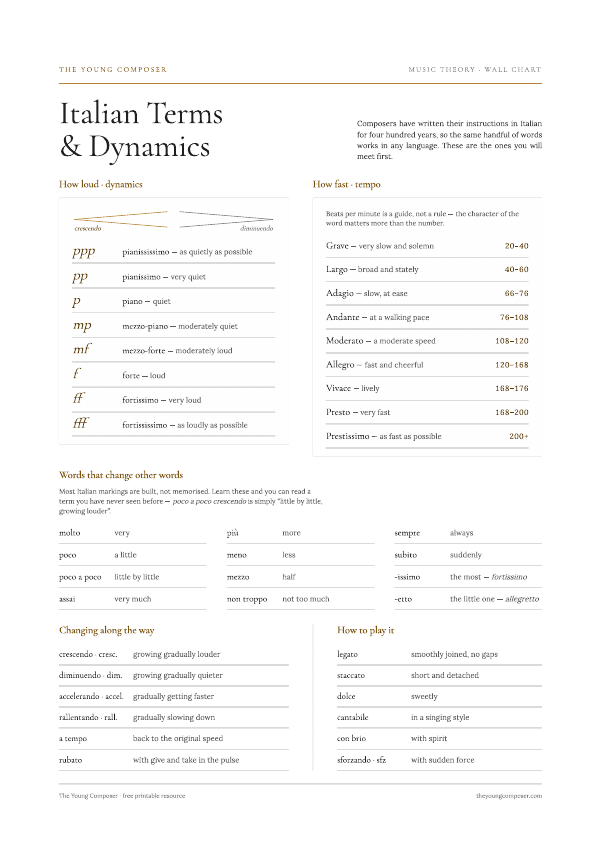
A wall chart of the Italian tempo and dynamics vocabulary composers have used for centuries, plus the modifier words that combine with them.
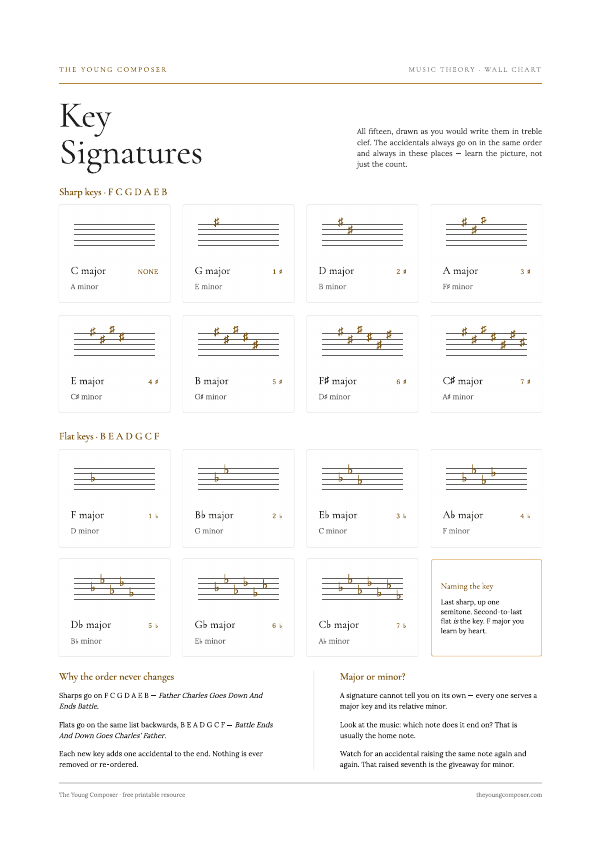
All fifteen major and minor key signatures drawn in treble clef as a wall chart, with the sharp and flat orders and how to name each key.
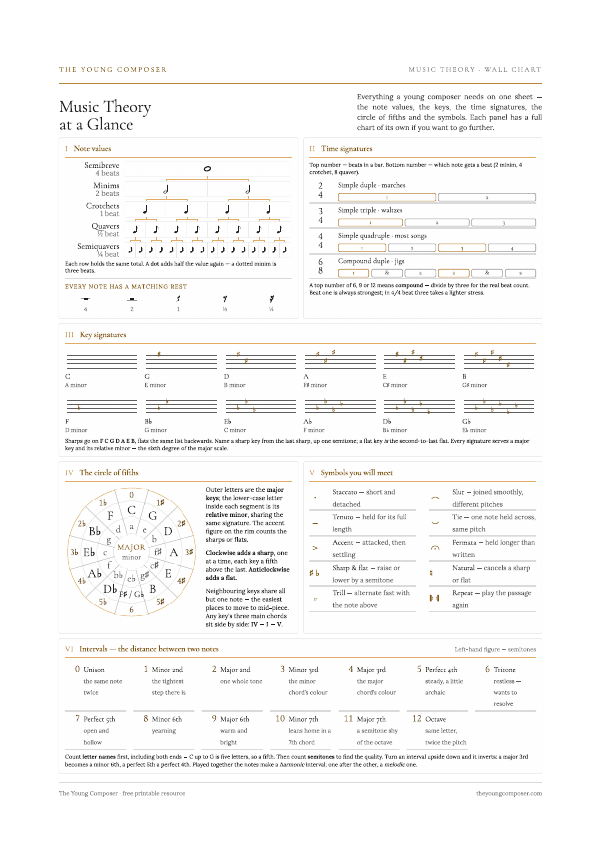
A single-sheet overview of note values, time signatures, key signatures, the circle of fifths, notation symbols and intervals — a fast wall reference or a jumping-off point to the fuller charts.
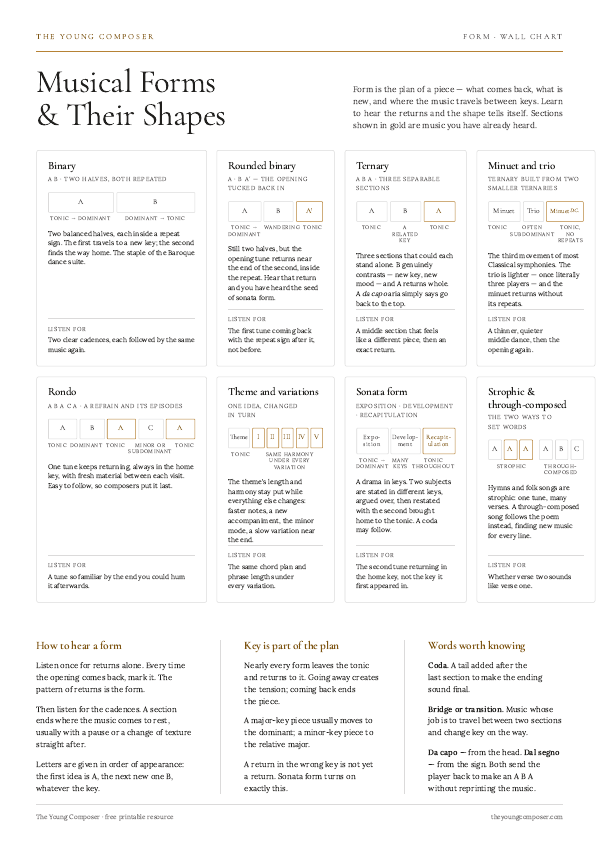
An A3 wall chart of eight musical forms, each with a structure diagram and a listening tip, plus panels on hearing a form, how key is part of the plan, and the terminology of coda, bridge and da capo.
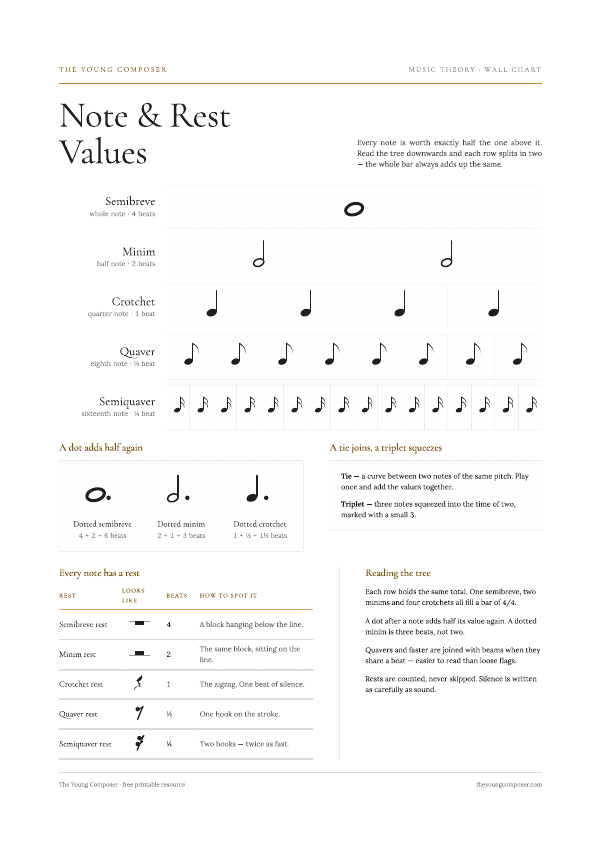
A wall chart of the note-value tree from semibreve to semiquaver, paired with matching rests, dotted notes, ties and triplets.
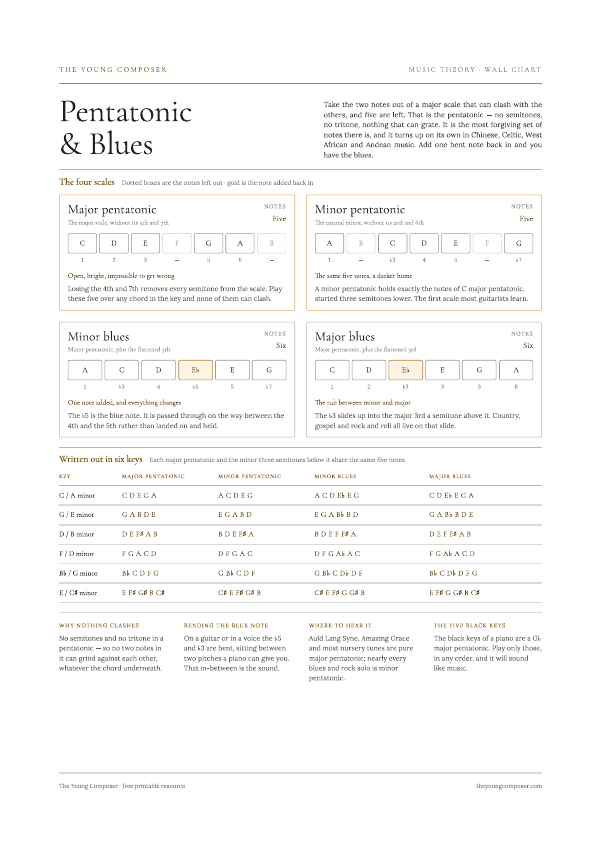
The four five/six-note scales built by removing or adding notes from a major scale, as a wall chart — major and minor pentatonic, and minor and major blues.
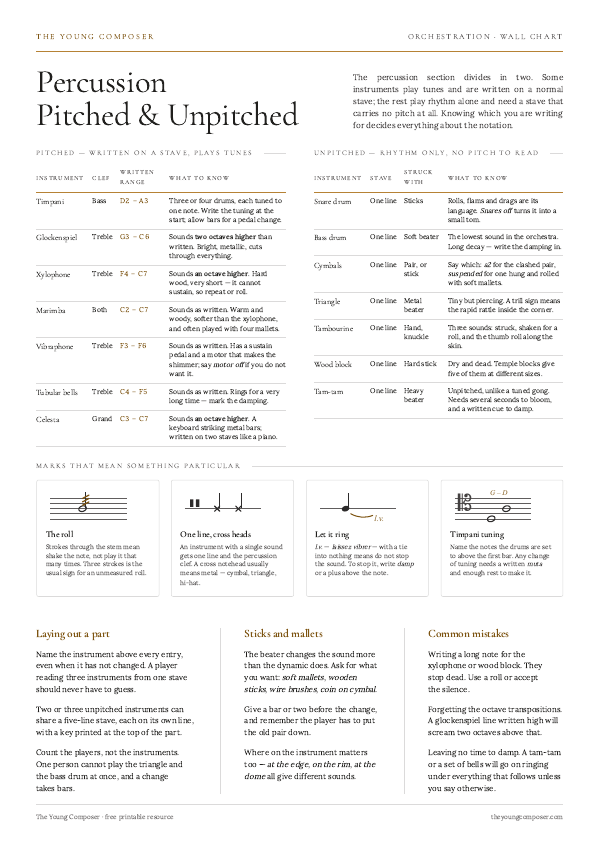
An A3 wall chart of the orchestral percussion family, split into pitched and unpitched instruments with their transposition and notation conventions, plus practical panels on laying out a part and common mistakes.
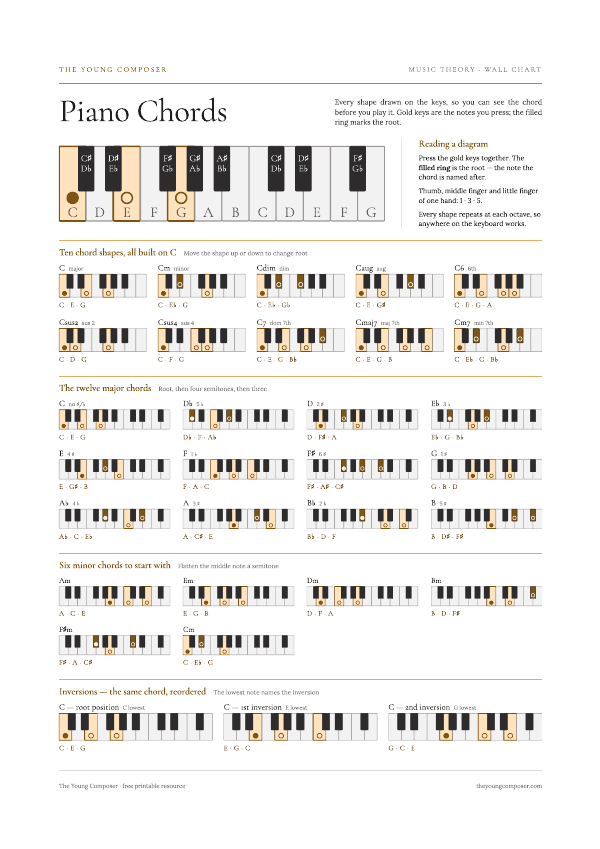
Ten chord shapes built on C, all twelve major chords, six minor chords, and how inversions reorder the same notes — all shown on the keyboard.
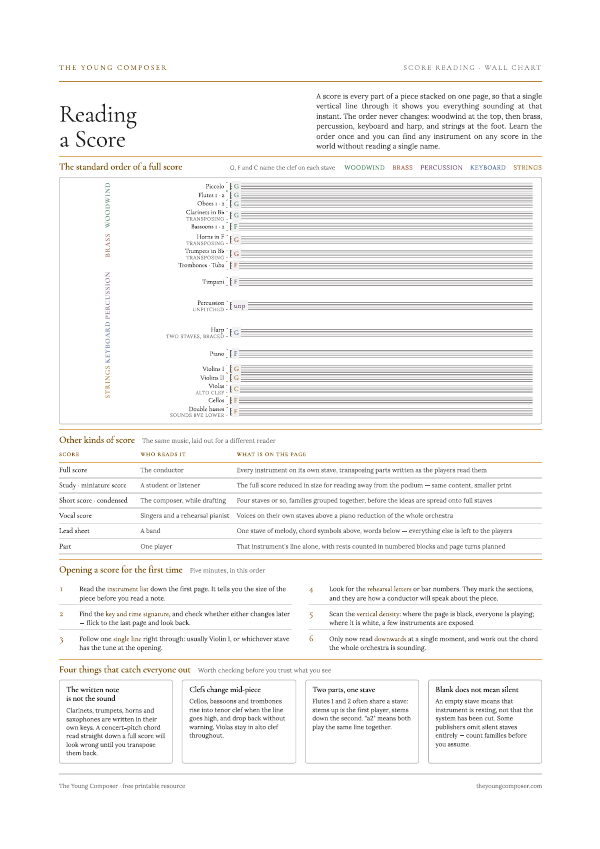
The standard order of a full score, other kinds of score, and how to open an unfamiliar score for the first time, as a wall chart.
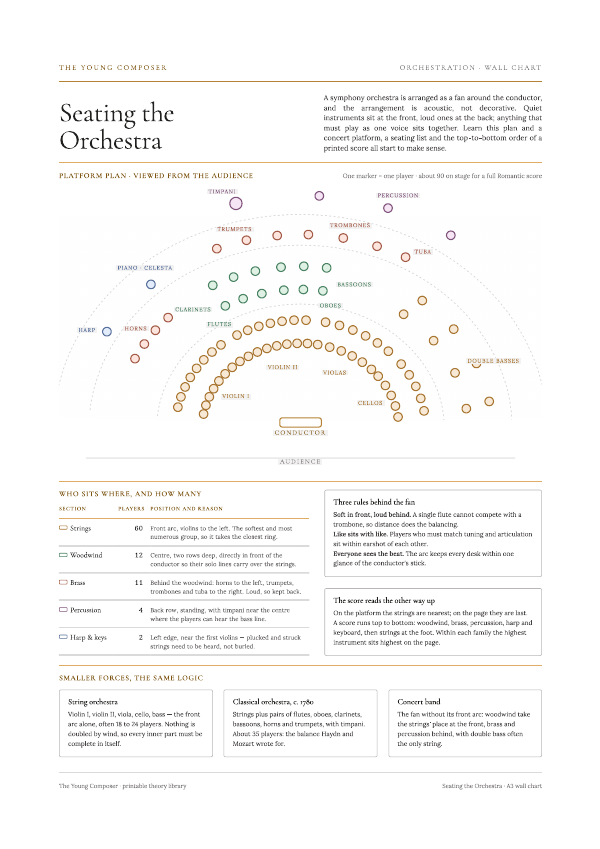
The symphony orchestra's platform plan viewed from the audience, who sits where and why, and how smaller ensembles keep the same logic, as a wall chart.
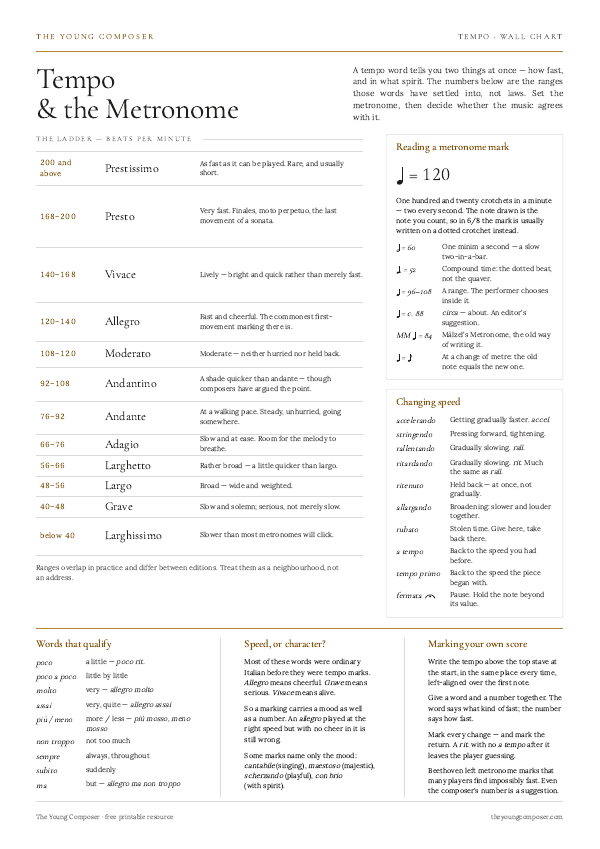
An A3 wall chart of the full tempo ladder from Larghissimo to Prestissimo with beats-per-minute ranges, how to read a metronome mark, and the words for changing and qualifying speed.
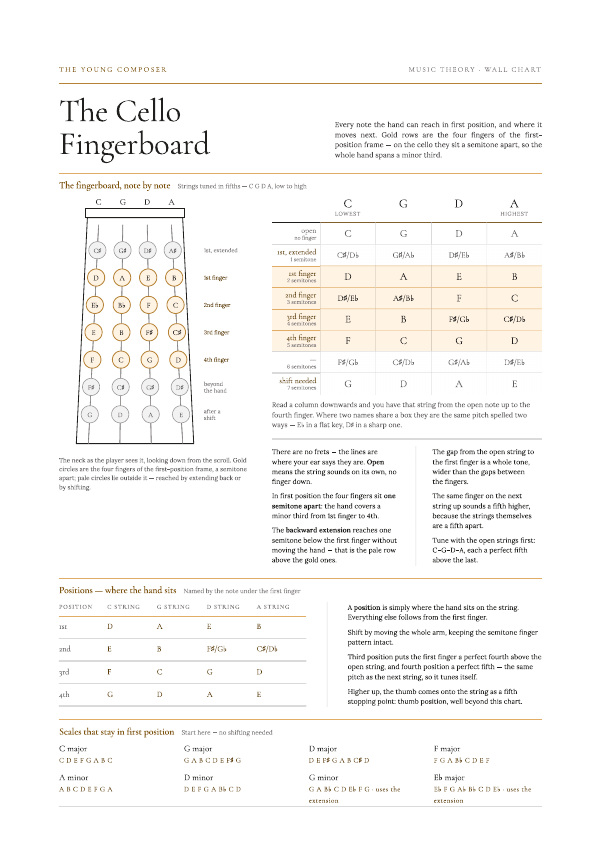
A note-by-note map of the cello fingerboard in first position, with finger positions, scales that stay in first position, and how to shift up the neck.
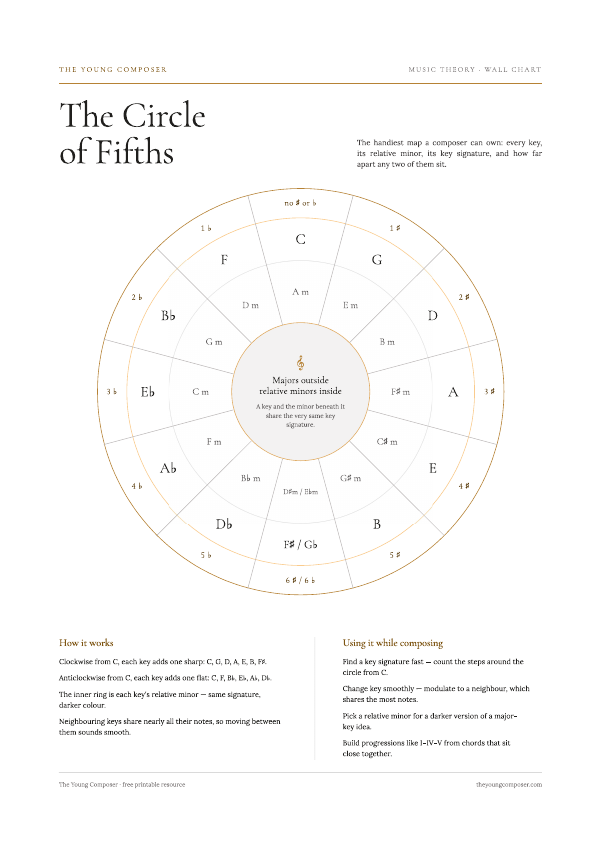
The circle of fifths as a big, printable wall chart for the classroom — every key, its relative minor, and how far apart any two keys sit.
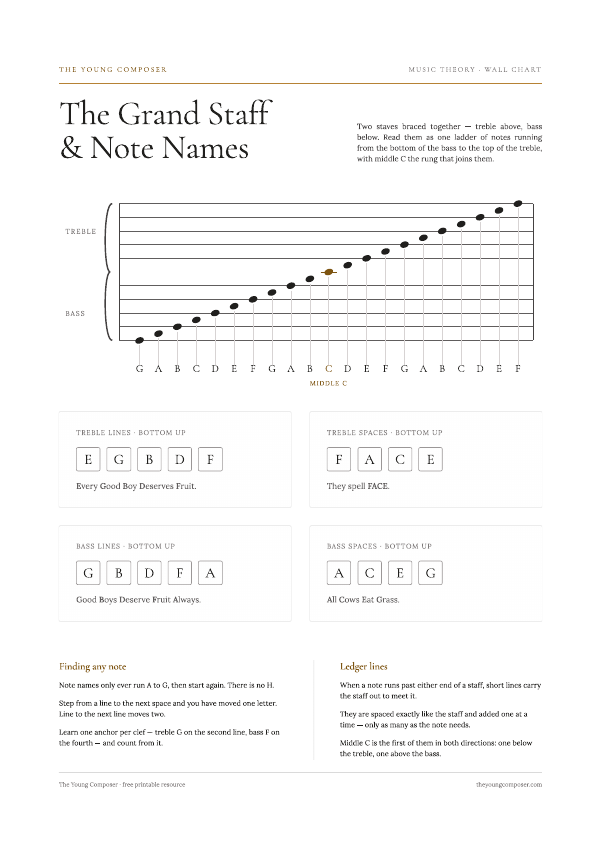
A wall-sized ladder of note names running from the bottom of the bass staff to the top of the treble, with mnemonics for every line and space.
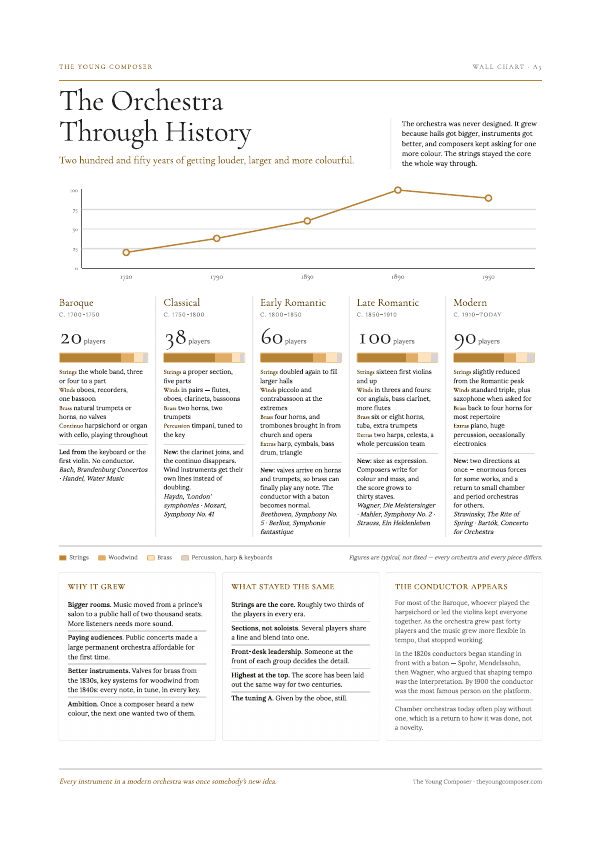
A wall chart tracking the orchestra's growth from a 20-player Baroque band to a 100-player Late Romantic orchestra, with instrumentation, repertoire and player counts for five eras.
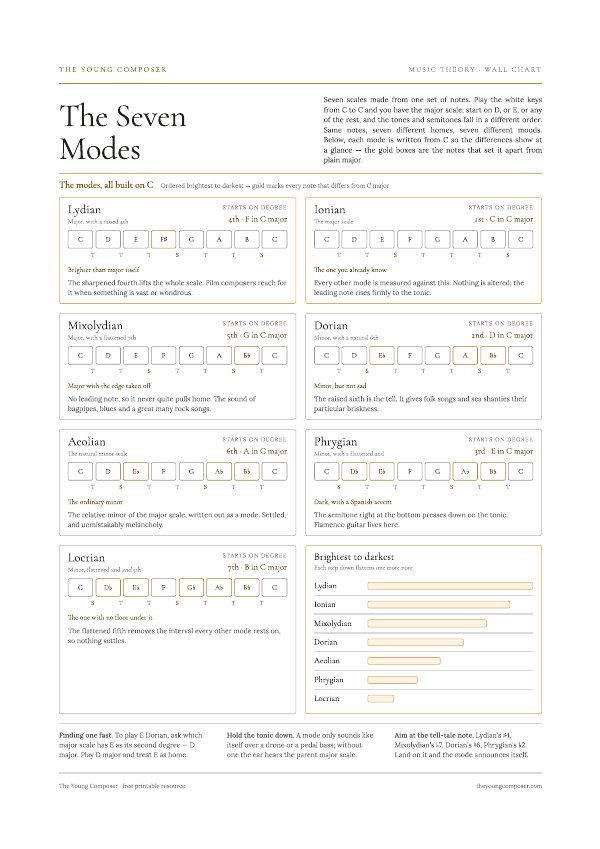
The seven modes of the major scale, all built on the same starting note, as a wall chart — with a brightest-to-darkest comparison.
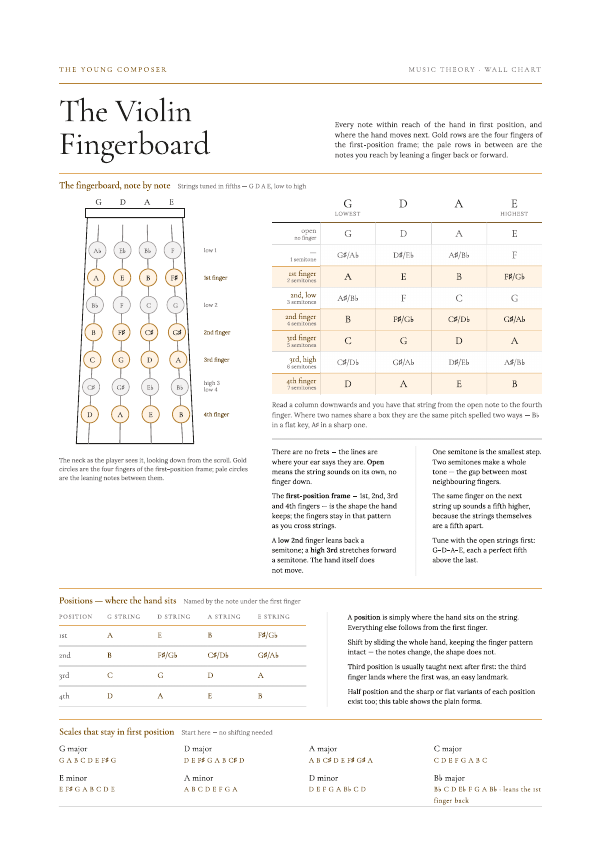
A note-by-note map of the violin fingerboard in first position, with finger positions, scales that stay in first position, and how to shift up the neck.
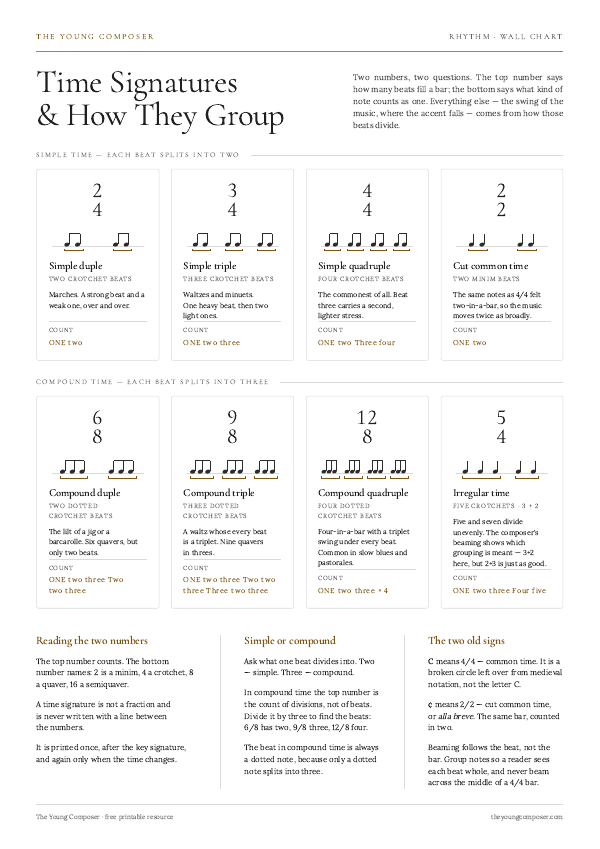
An A3 wall chart of simple and compound time signatures, each with its note groupings and counting syllables, plus panels on reading the two numbers, simple versus compound time, and the two old time signs.
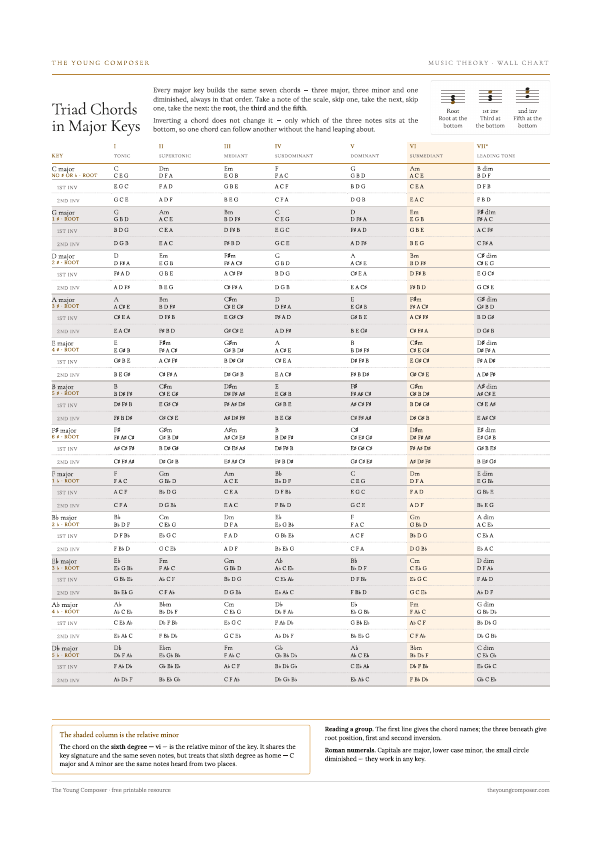
The seven triads built on every major scale degree, in all fifteen major keys, with root position and both inversions spelled out.
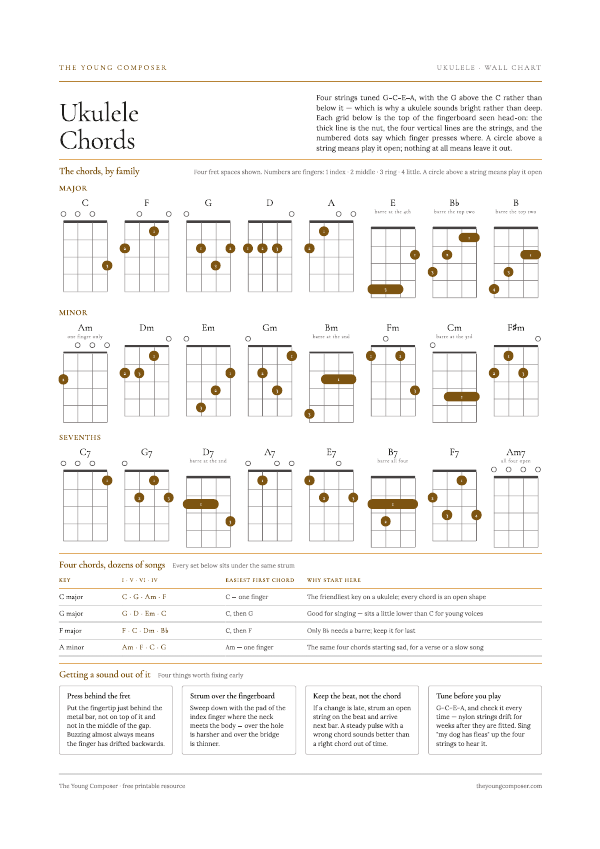
Major, minor and seventh ukulele chord shapes by family, plus starter progressions and four habits for a clean sound, as a wall chart.
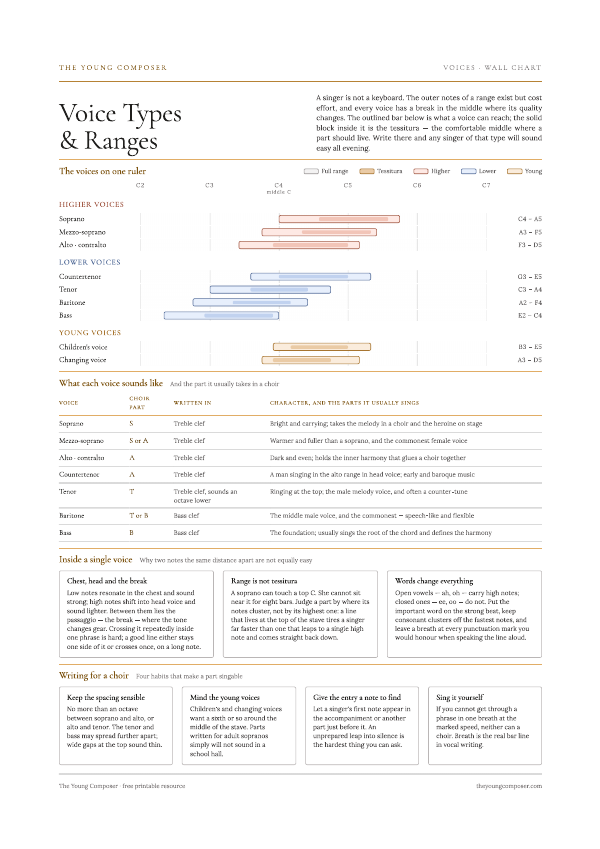
The higher, lower and young voice types, their full range and comfortable tessitura on one ruler, as a wall chart.
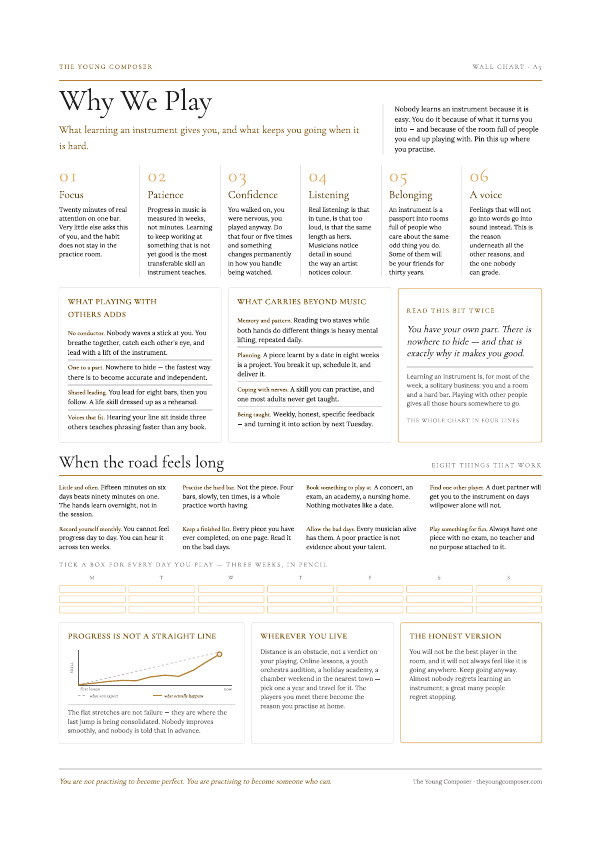
A wall chart on what learning an instrument actually gives you and what keeps you going when it's hard — six things it builds, what playing with others adds, and eight things that work when the road feels long, with a three-week tick chart.
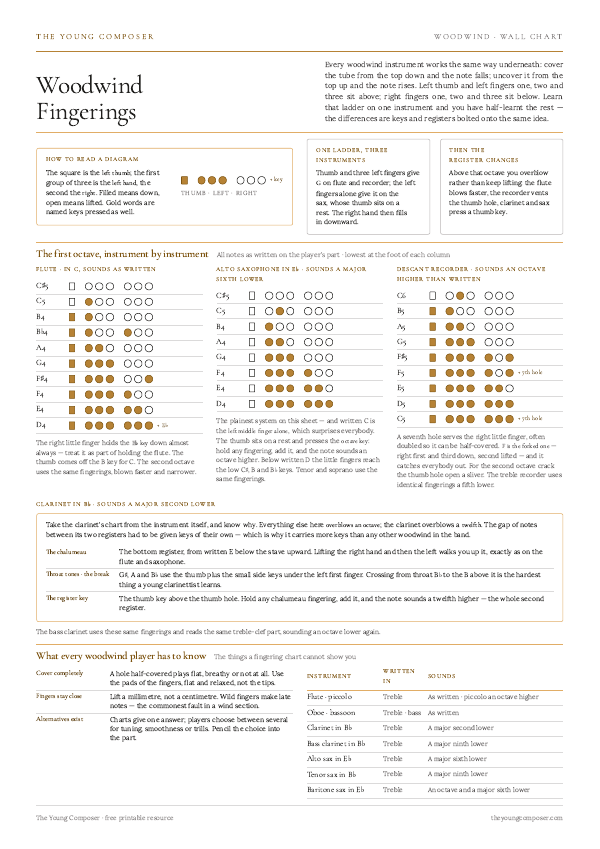
A wall chart of first-octave fingerings for flute, alto saxophone, descant recorder and clarinet in B flat, plus how each instrument's register changes work and what every woodwind player has to know.
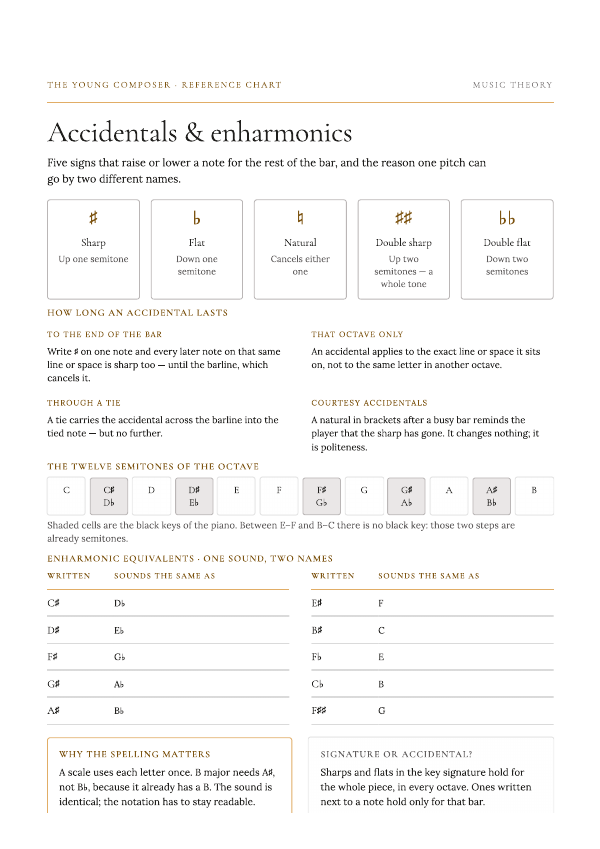
The five signs that raise or lower a note, how long an accidental lasts, and why the same pitch can be spelled two different ways.
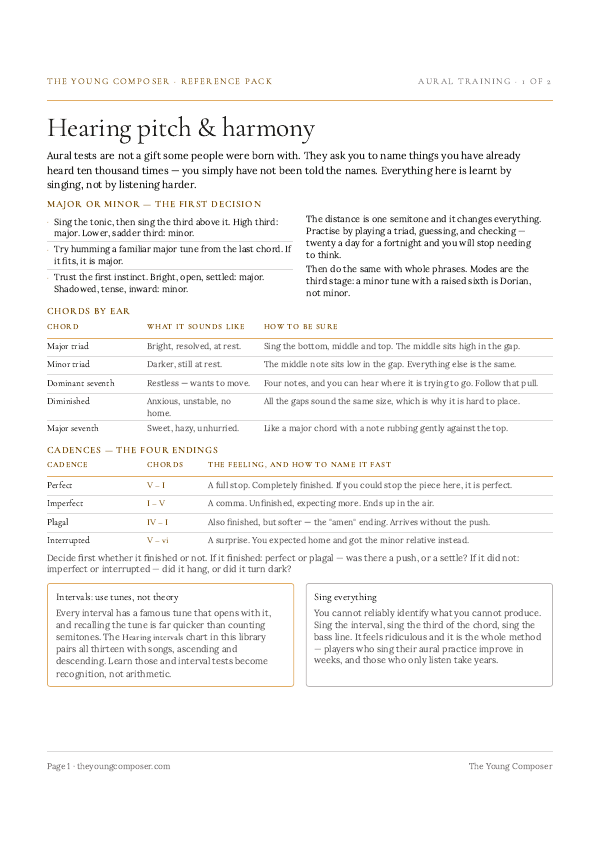
A two-sheet guide to aural tests — telling major from minor, chords and cadences by ear, finding the metre, writing down a rhythm you've heard, and how to answer decisively in the exam room.
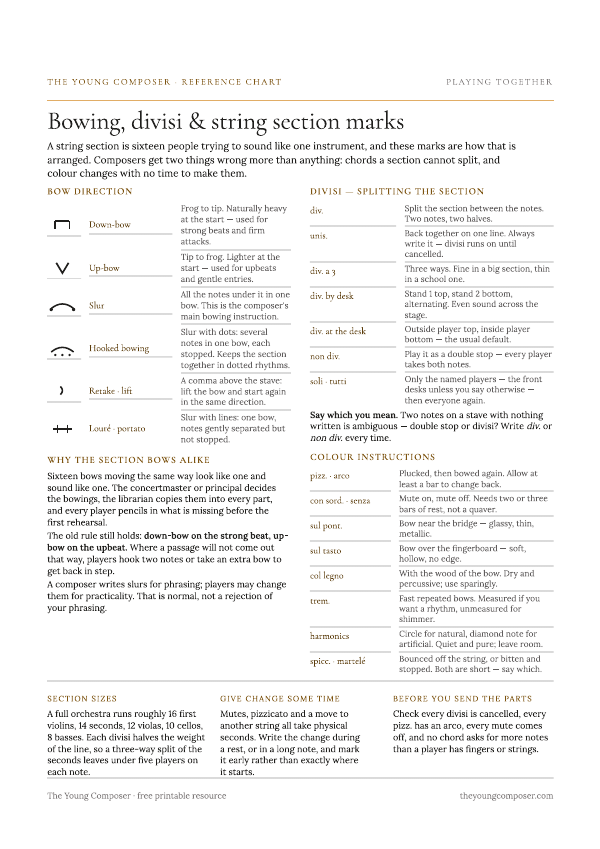
A chart of the marks a string section reads together — bow direction and slurs, splitting the section with divisi, and colour instructions such as pizzicato, mutes and sul ponticello.
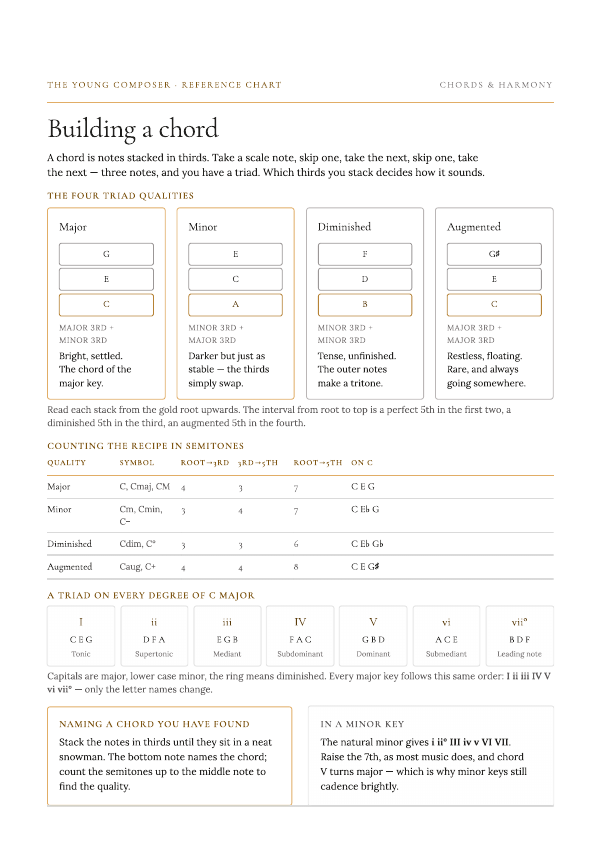
How triads are built by stacking thirds, the four triad qualities and their sound, and a triad on every degree of the major and minor scale.
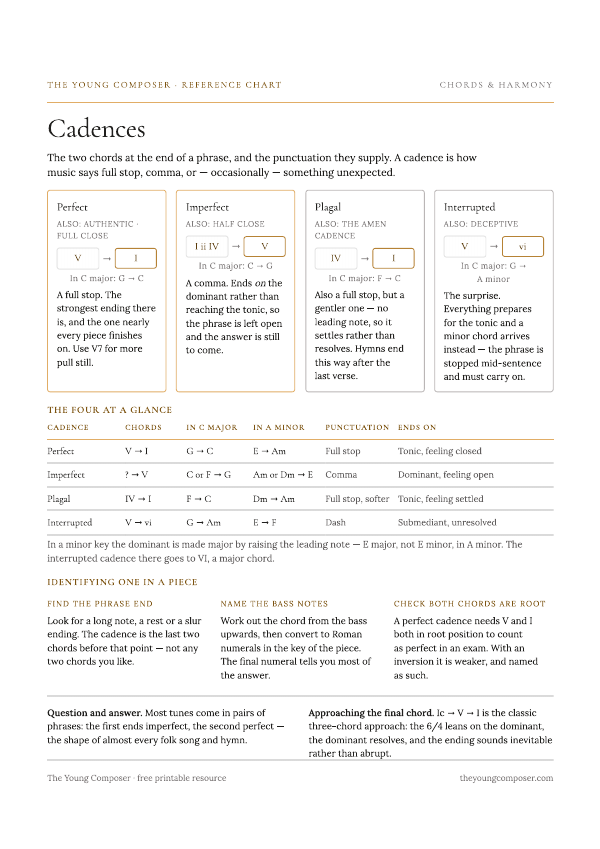
The four cadence types — perfect, imperfect, plagal and interrupted — with their chords, punctuation, and how to spot one in a piece.
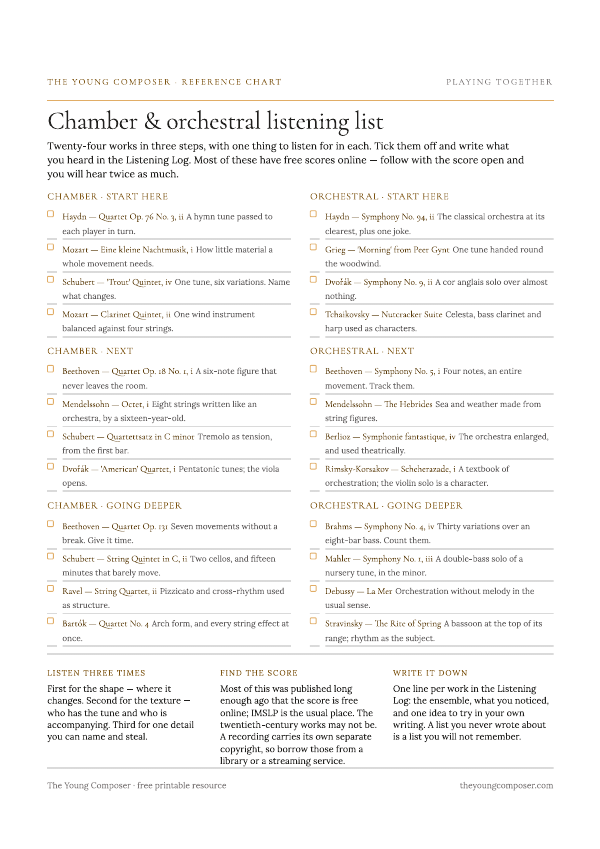
Twenty-four chamber and orchestral works in three steps, each with one thing to listen for, and tick-boxes to work through them alongside the Listening Log.
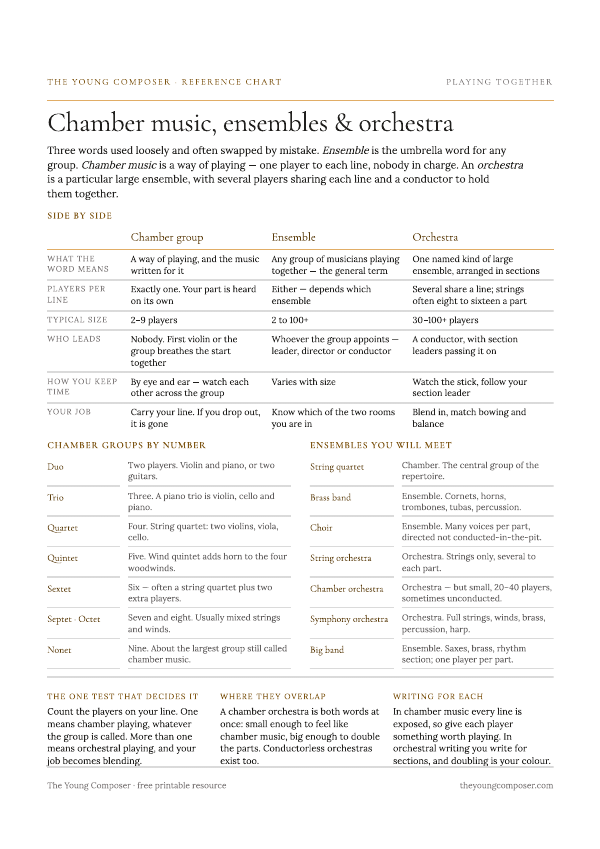
A chart untangling three loosely-used words — how chamber music, ensemble and orchestra differ in players per line, leadership and typical size, with the one test that decides which is which.
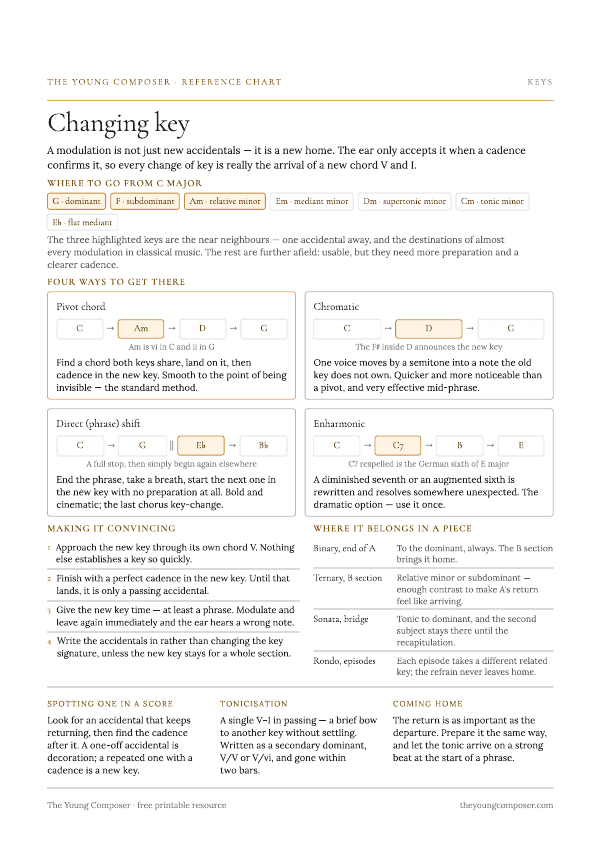
Where to modulate from C major, four ways to get there — pivot chord, chromatic, direct shift, enharmonic — and where modulation belongs in a piece.
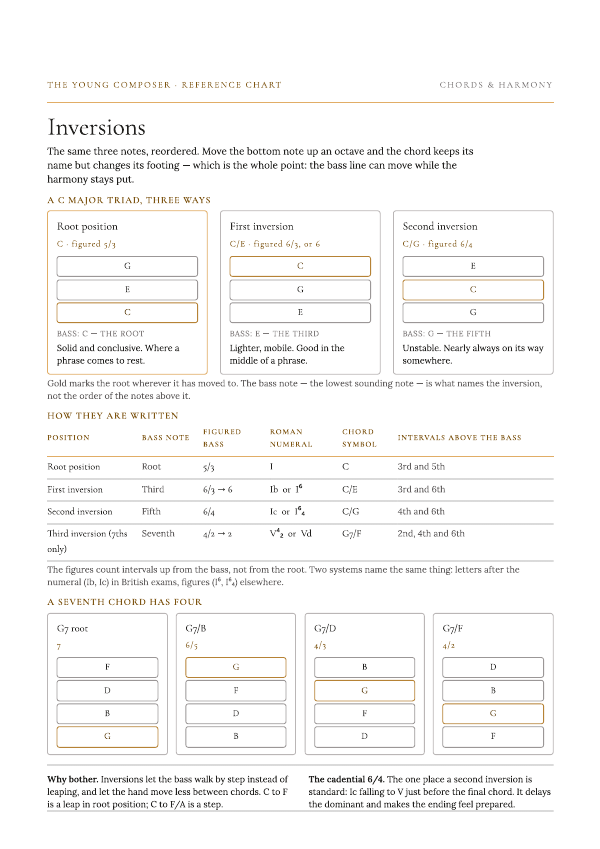
How root position, first and second inversion reorder the same three notes, with figured bass, Roman numerals, and seventh-chord inversions.
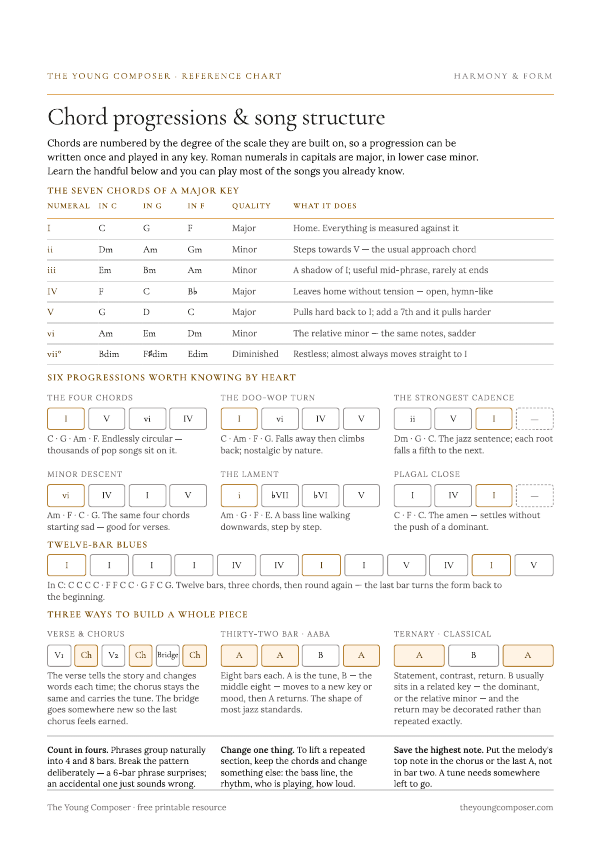
How chords are numbered by scale degree, six progressions worth knowing by heart, the twelve-bar blues, and three ways to build a whole piece.
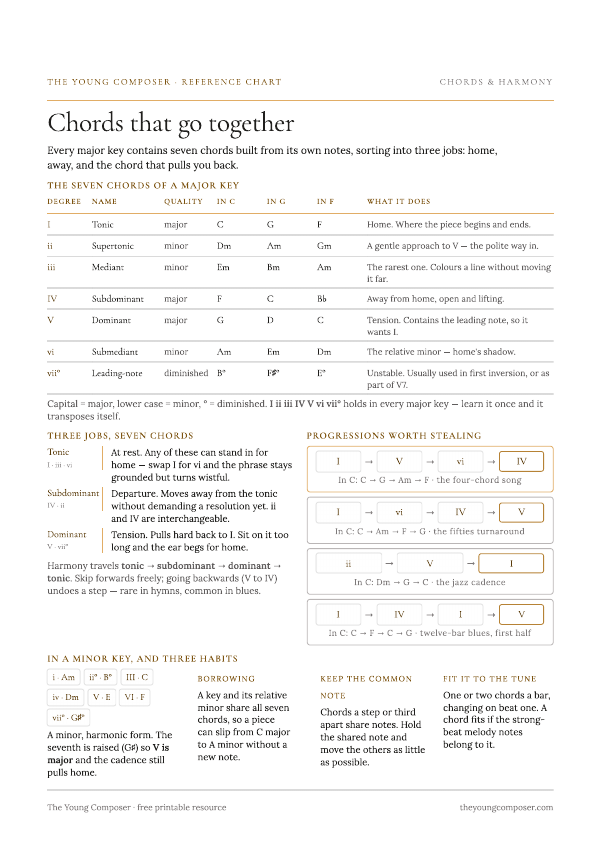
The seven chords of a major key, their three jobs of home, away and pull-back, four progressions worth stealing, and how it all shifts in a minor key.
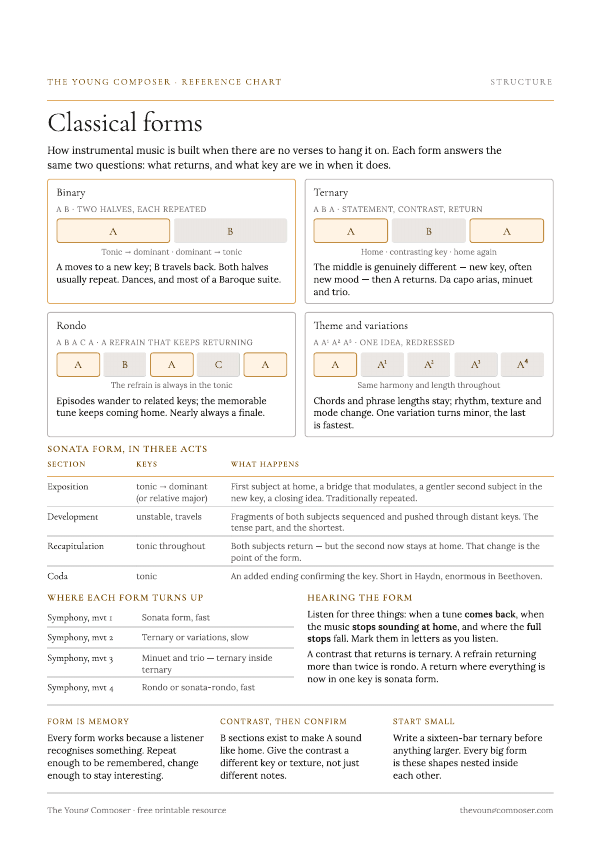
Binary, ternary, rondo and theme-and-variations laid out as diagrams, sonata form in three acts, and where each form turns up across a symphony.
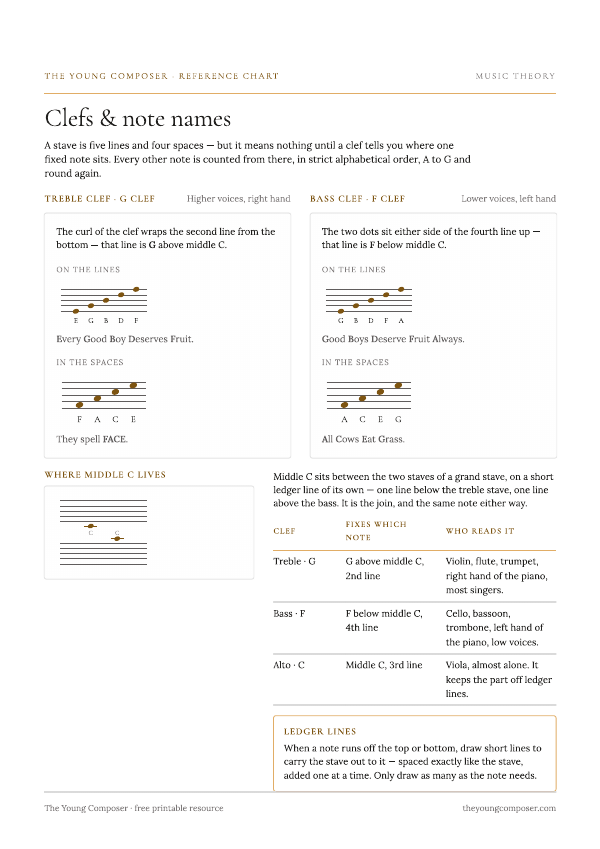
Treble and bass clef note names on the lines and spaces, plus where middle C sits between the two staves of a grand stave.
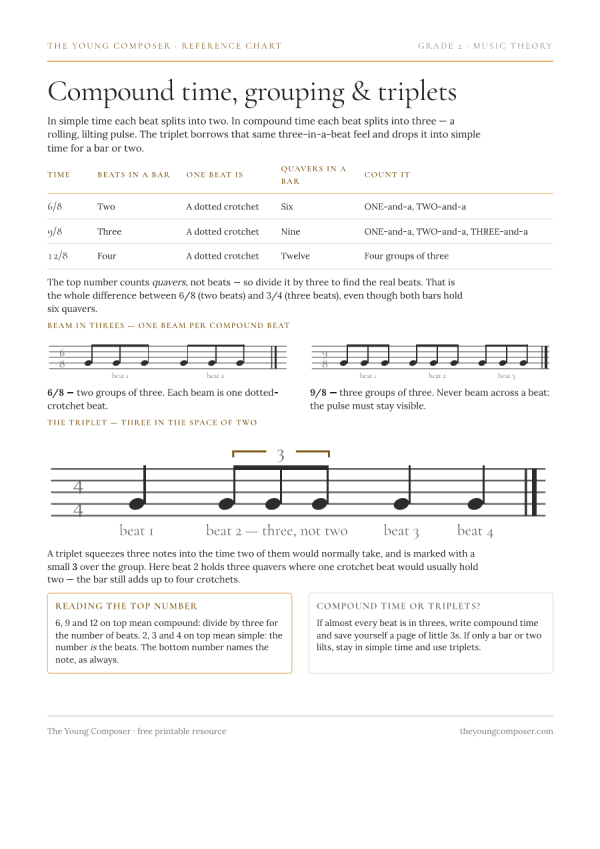
Time signatures where each beat divides into three, how to beam them correctly, and the triplet that borrows the same feel.
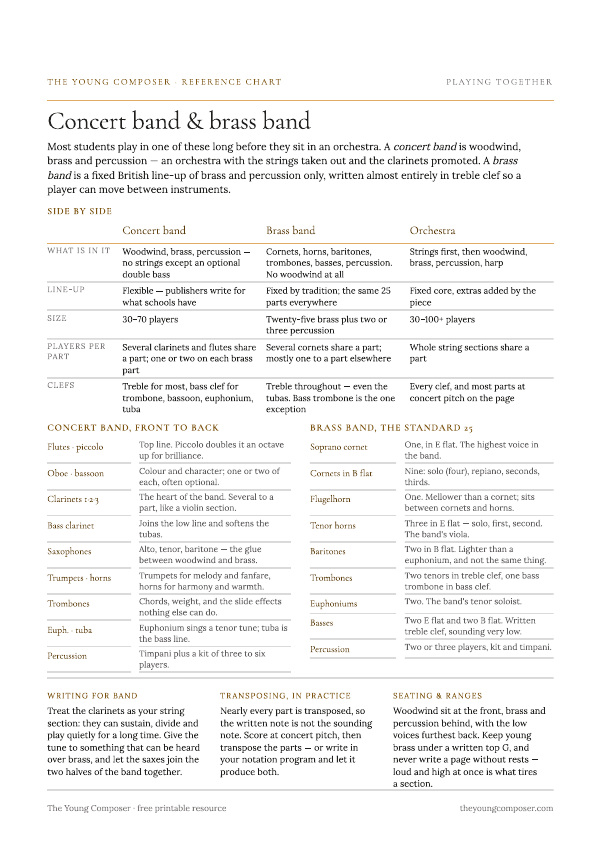
A side-by-side comparison of concert band, brass band and orchestra — line-up, size, clefs and who shares a part — plus a front-to-back guide to each band's instruments.
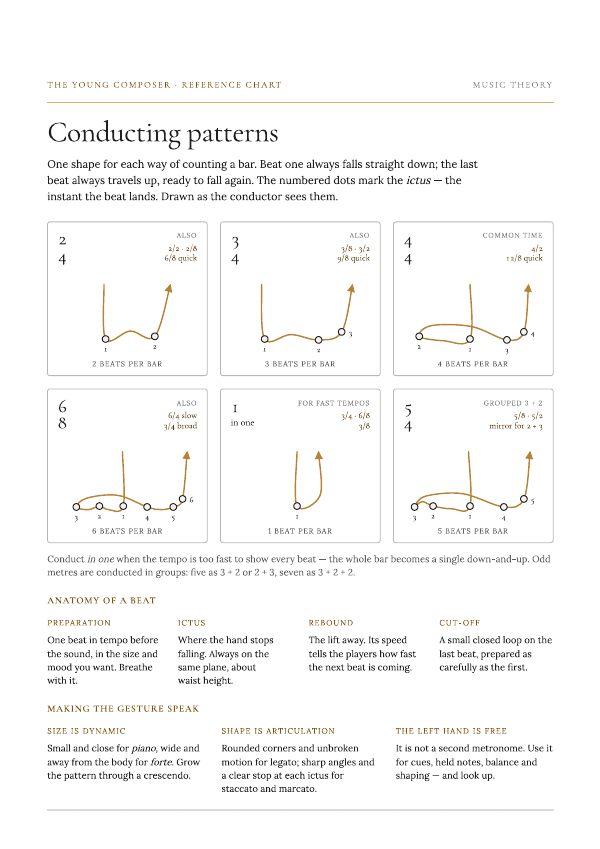
The six conducting shapes for 1 through 6 beats per bar, with the anatomy of a beat and how the gesture communicates dynamics and style.
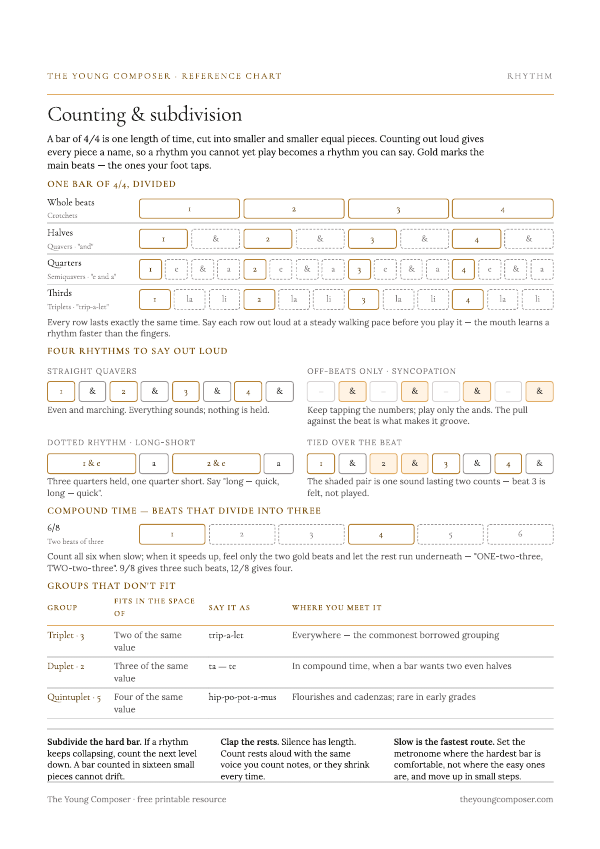
How to count a bar of 4/4 down into halves, quarters and triplets out loud, plus syncopation, dotted rhythms, compound time, and irregular groupings.
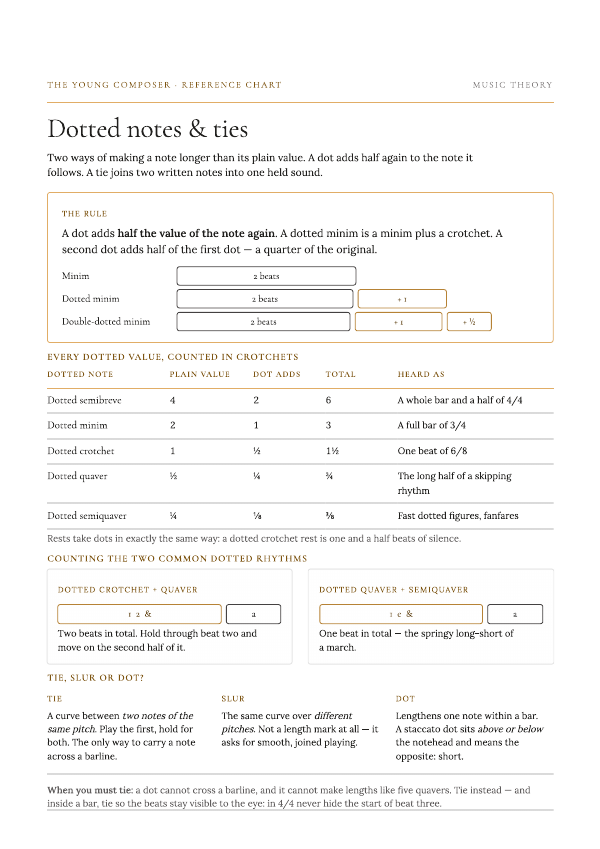
How a dot or a tie makes a note longer than its plain value, with every dotted value counted out and how to tell a tie apart from a slur or a dot.
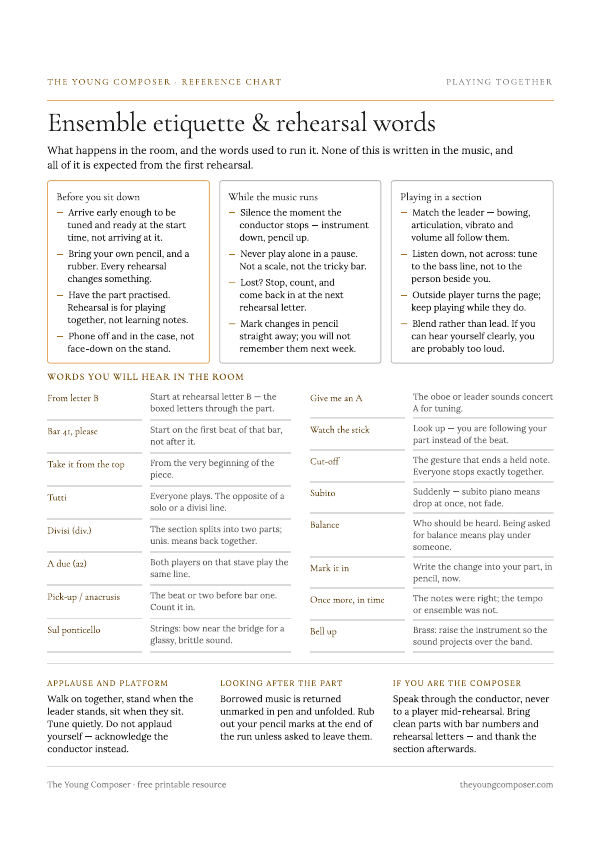
What is expected in a rehearsal room before, during and while playing in a section, plus the words you'll hear used to run it.
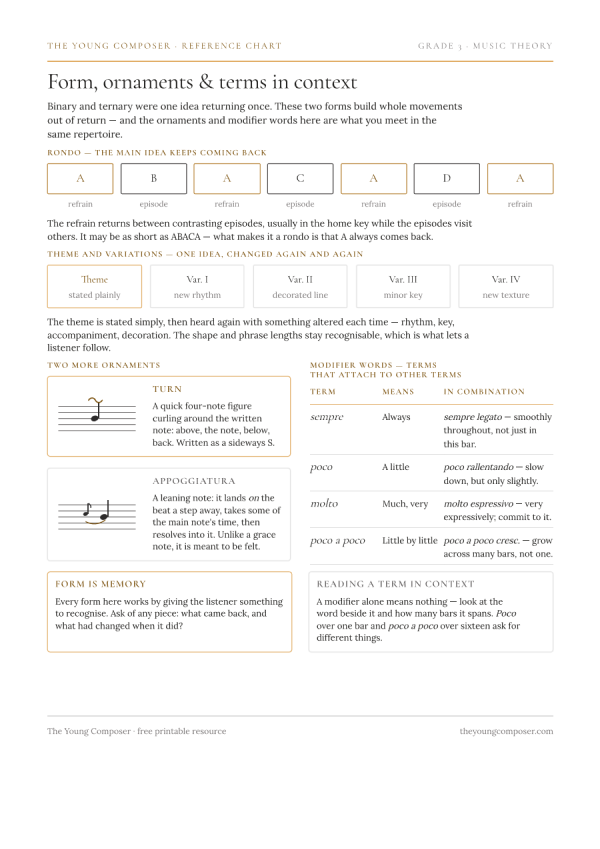
Rondo form and theme and variations, two more ornaments, and the modifier words that attach to other Italian terms.
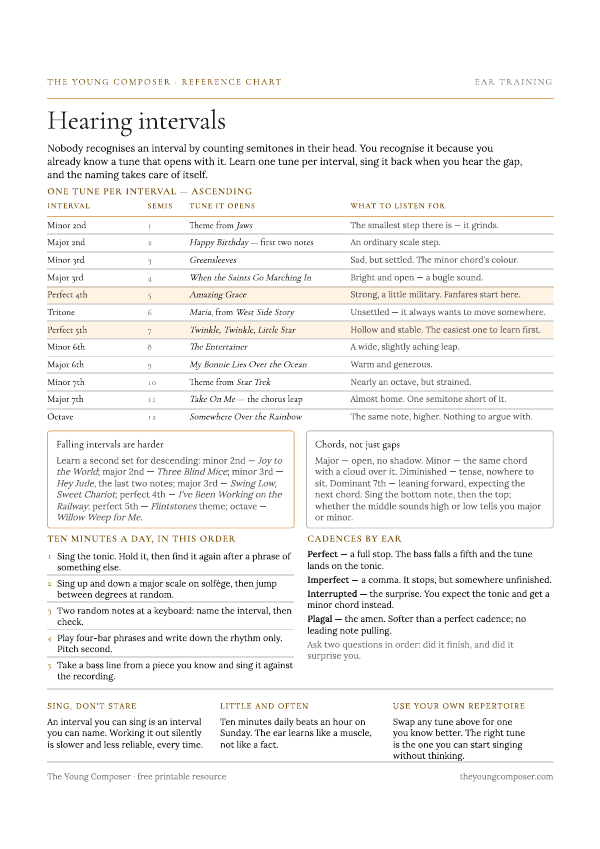
One familiar tune per interval from minor 2nd to the octave, a second set for falling intervals, cadences by ear, and a ten-minutes-a-day ear training routine.
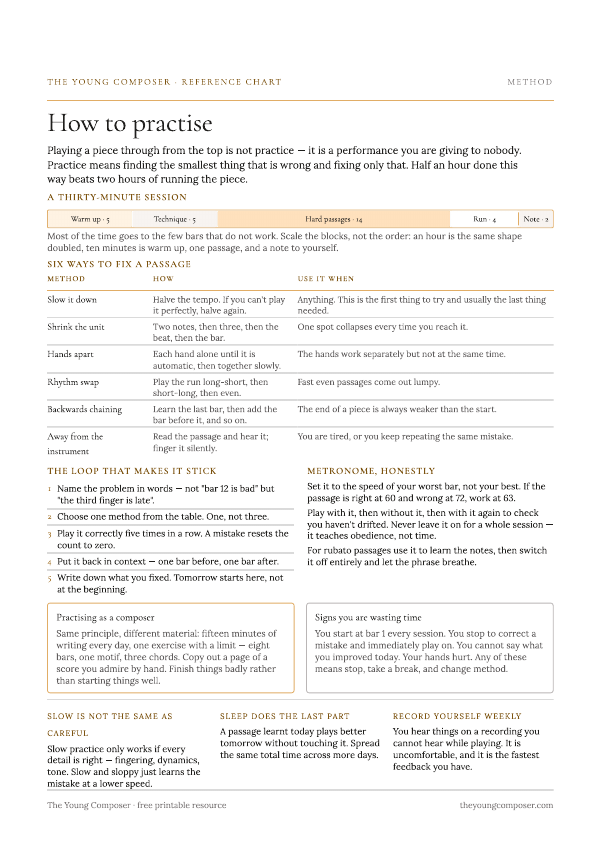
A thirty-minute practice session mapped out by minutes, six ways to fix a passage, the loop that makes a fix stick, and honest use of a metronome.
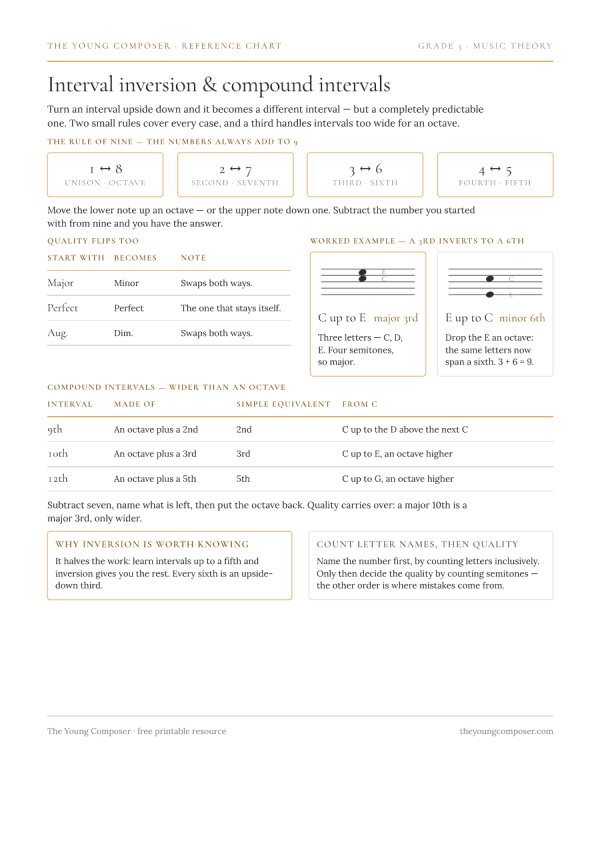
Turn an interval upside down and it becomes a different, completely predictable interval — plus how to name intervals wider than an octave.
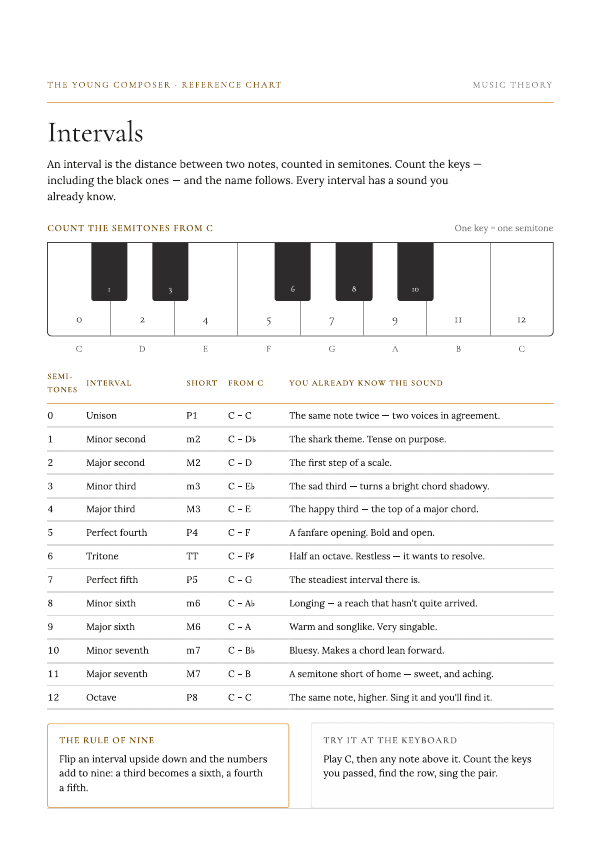
A quick-reference chart for naming musical intervals by counting semitones, from unison up to the octave.
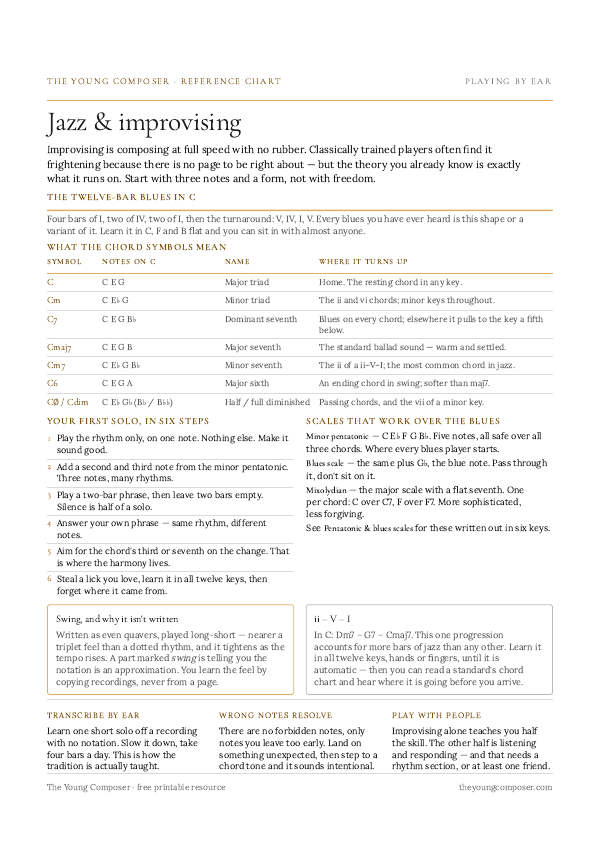
A chart on getting started with improvising — the twelve-bar blues, common jazz chord symbols, scales that work over the blues, and a six-step path to a first solo.
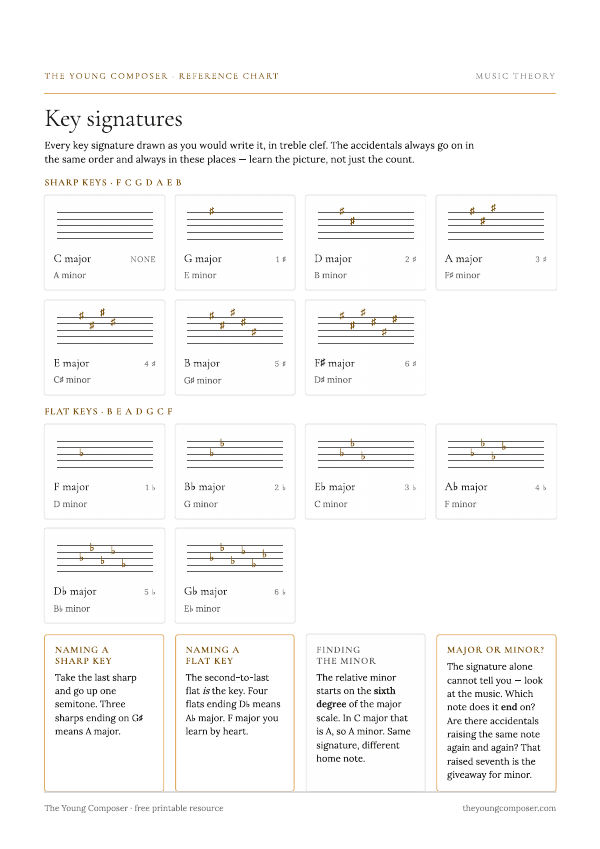
Every major and minor key signature drawn in treble clef, in sharp and flat order, with rules for naming each key at a glance.
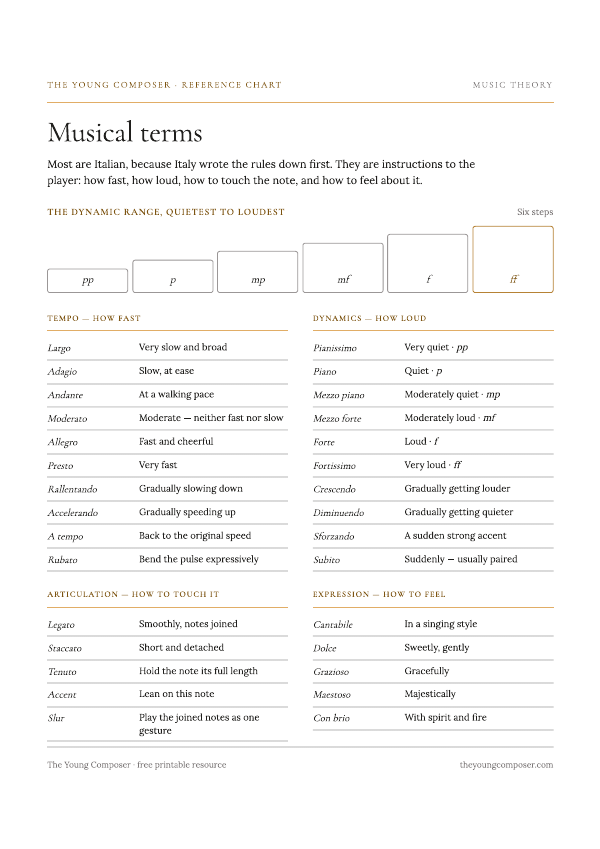
A glossary of the Italian tempo, dynamics, articulation and expression markings composers write into a score.
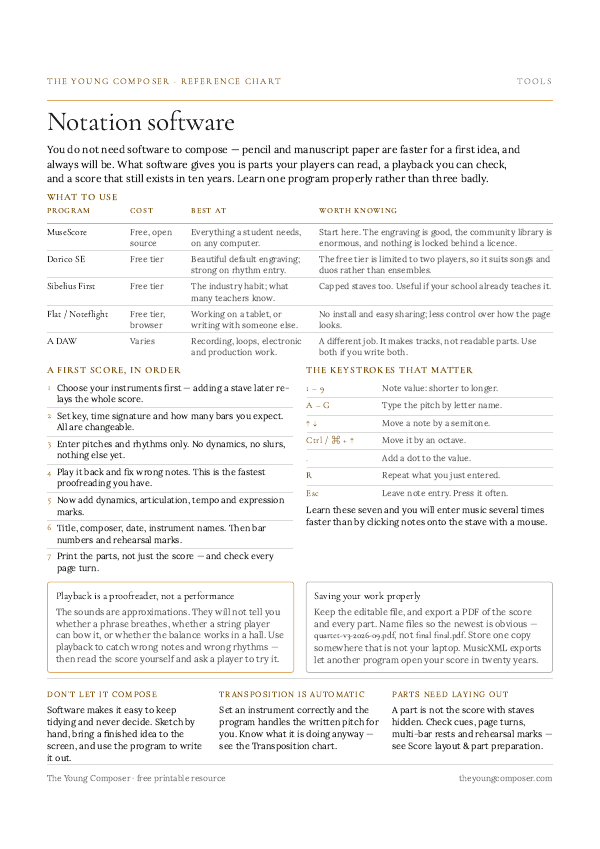
A chart comparing the free and low-cost notation programs students actually use, plus a first-score workflow in order and the seven keystrokes worth learning by heart.
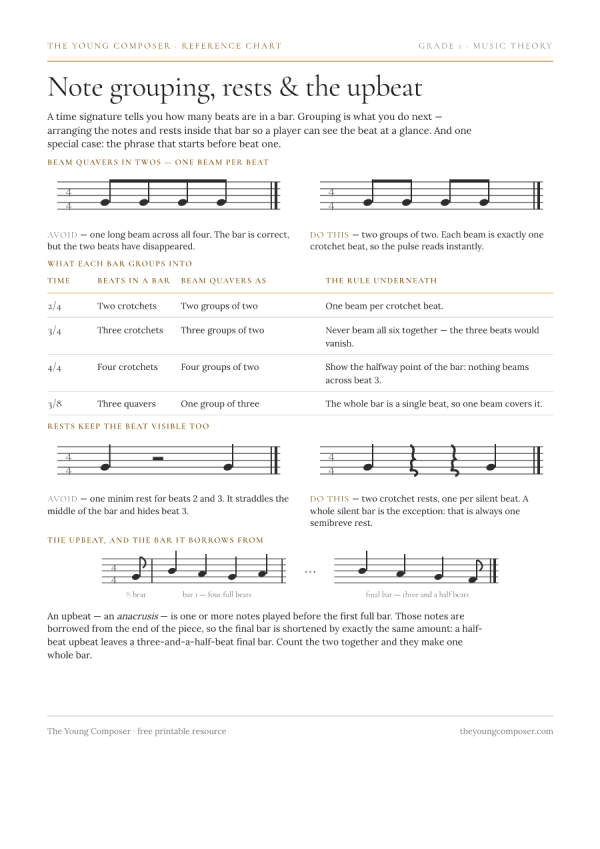
How notes and rests are grouped inside a bar so the beat stays visible, and how an upbeat borrows time from the final bar.
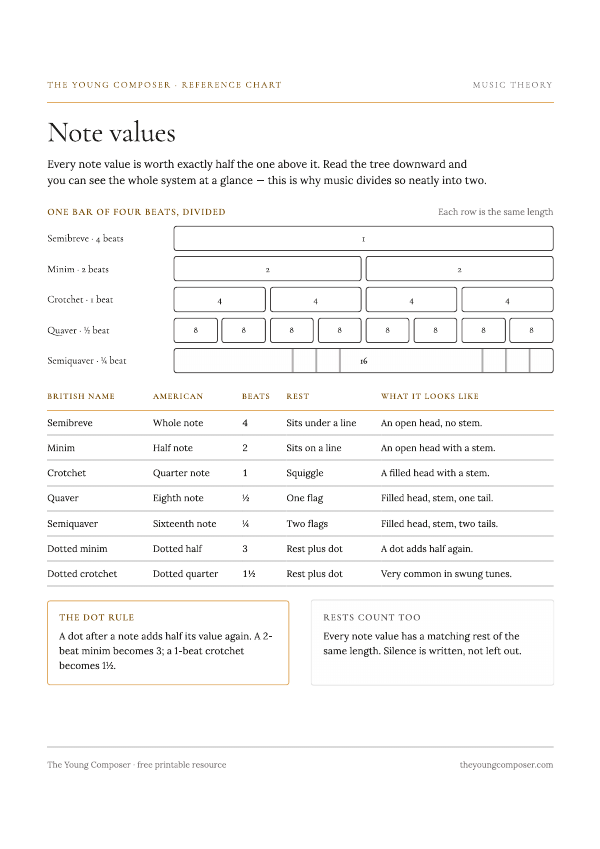
A visual tree of how semibreves divide into minims, crotchets, quavers and semiquavers, with British and American names side by side.
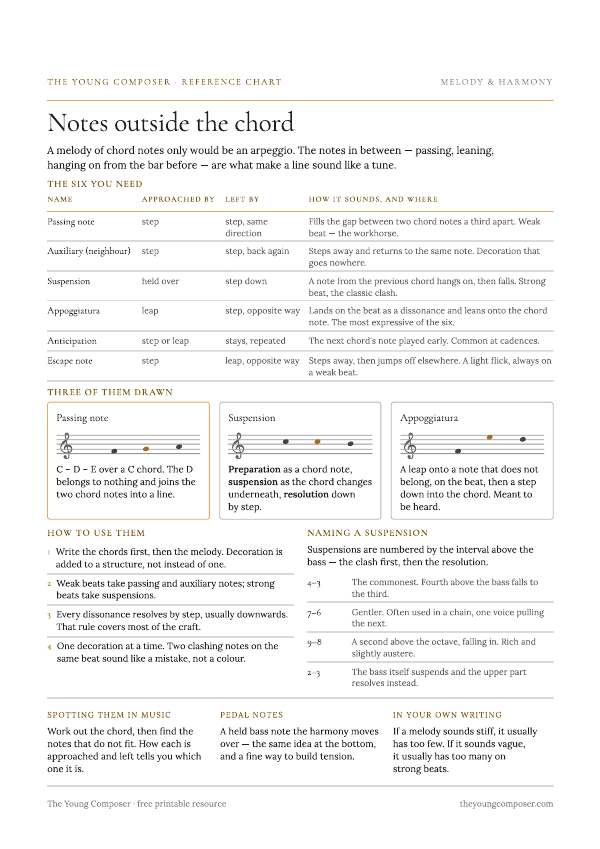
The six non-chord tones — passing notes, suspensions, appoggiaturas and more — how each is approached and left, and how suspensions are named.
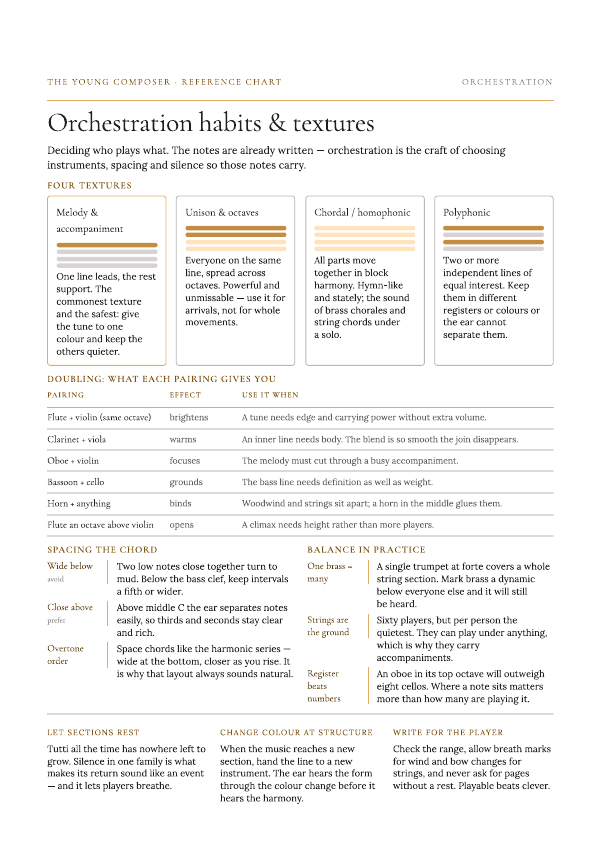
Four textures worth knowing, what each instrument pairing gives you when doubled, how to space a chord, and habits for balance and clarity.
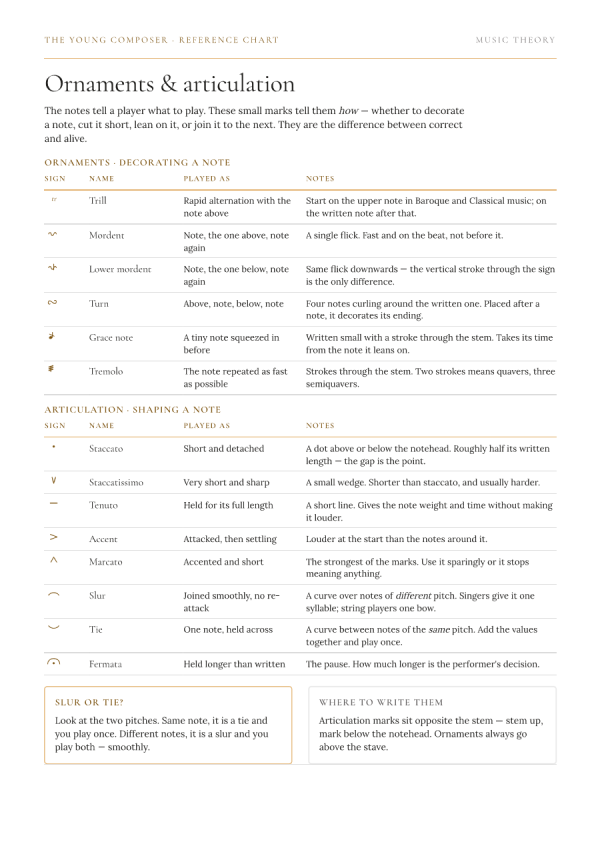
A glossary of ornament and articulation signs — trill, mordent, turn, grace note, tremolo, staccato, tenuto, slur, tie and more — with how each is played.
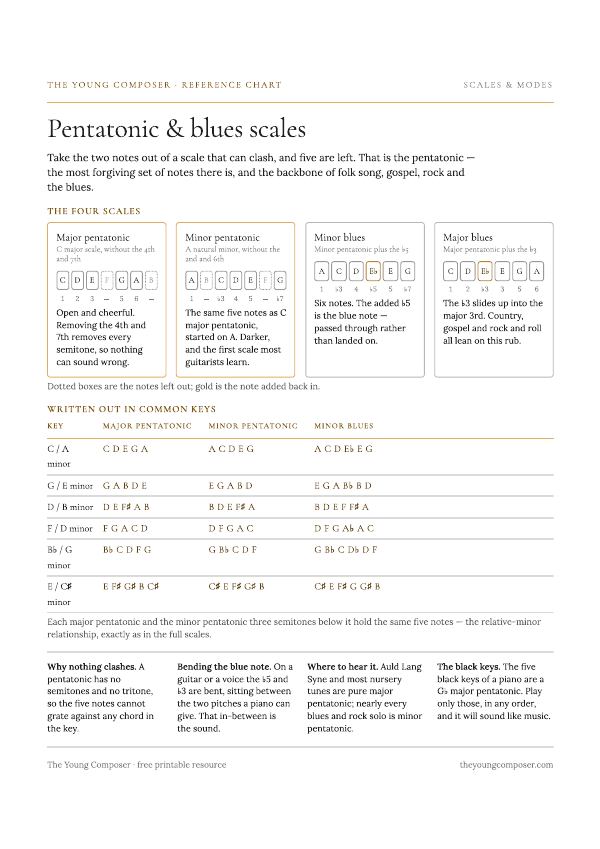
The four five/six-note scales built by removing or adding notes from a major scale — major and minor pentatonic, and minor and major blues.
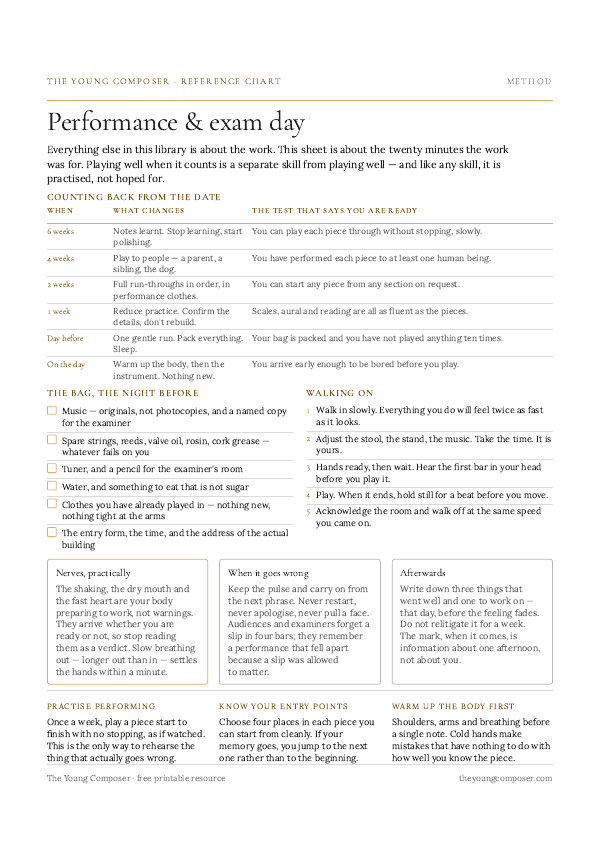
A chart on playing well when it counts — a week-by-week countdown to the date, a night-before bag checklist, walking-on steps, and how to handle nerves and mistakes.
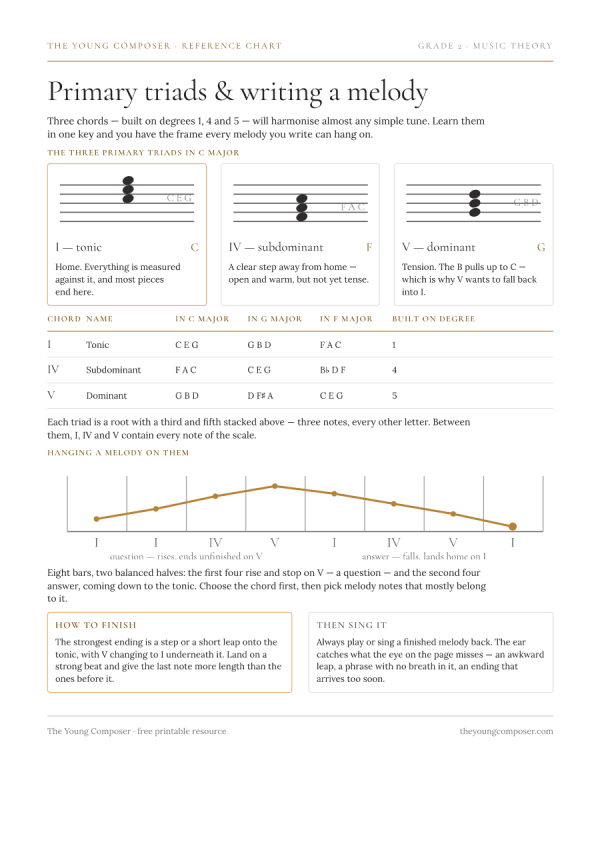
The three chords — built on degrees 1, 4 and 5 — that harmonise almost any simple tune, and how to use them to shape a melody.
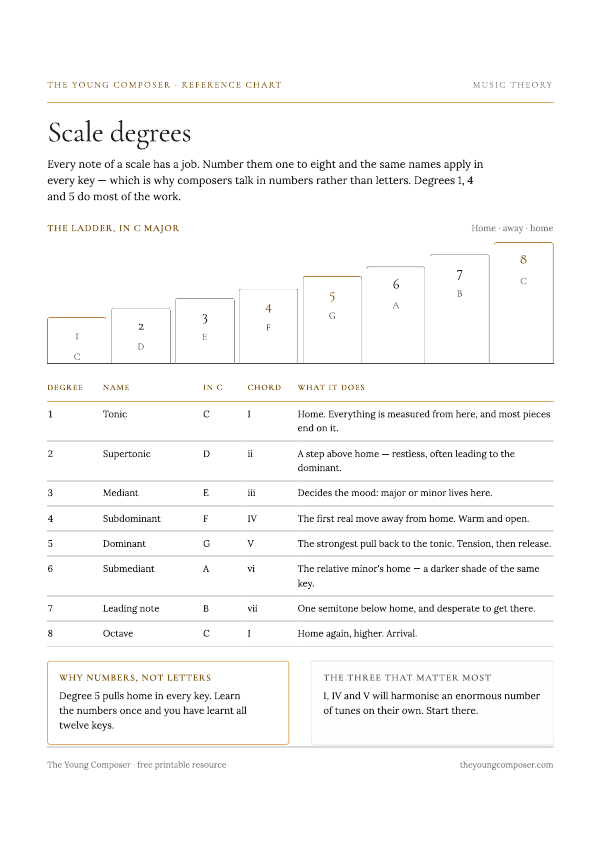
A numbered ladder of the eight scale degrees in C major, with their names, chords and role in a key.
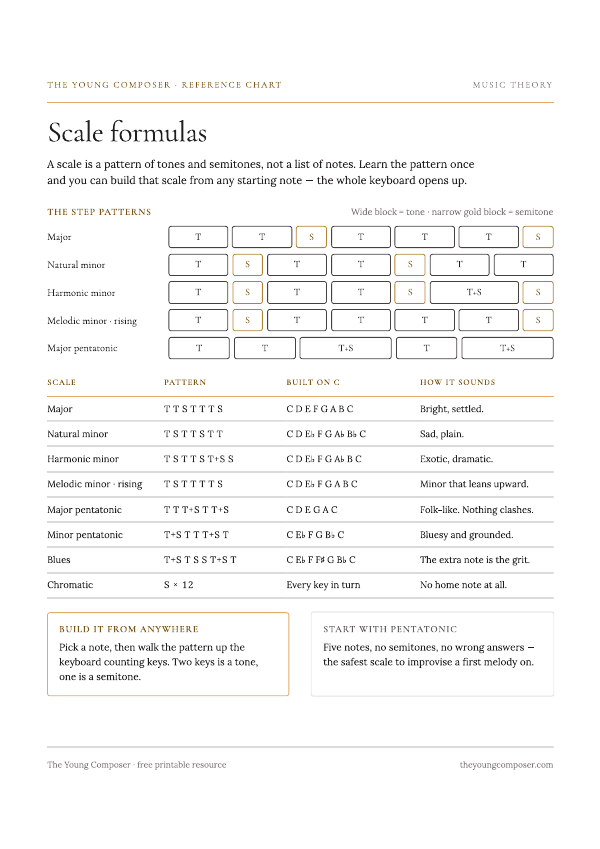
The tone/semitone step patterns behind the major, minor, pentatonic, blues and chromatic scales, so any scale can be built from any starting note.
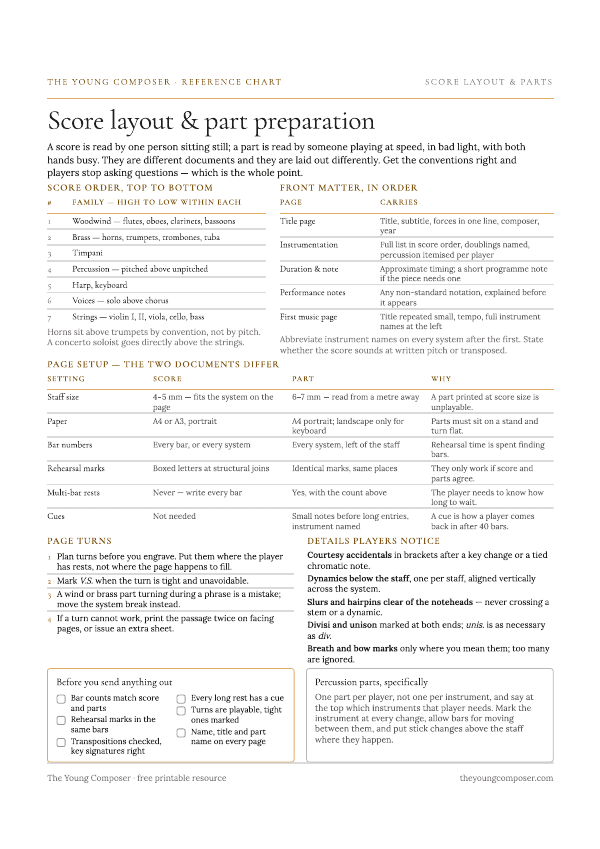
The standard order of a full score, front matter in order, how score and part page setup differ, and a checklist for details players notice.
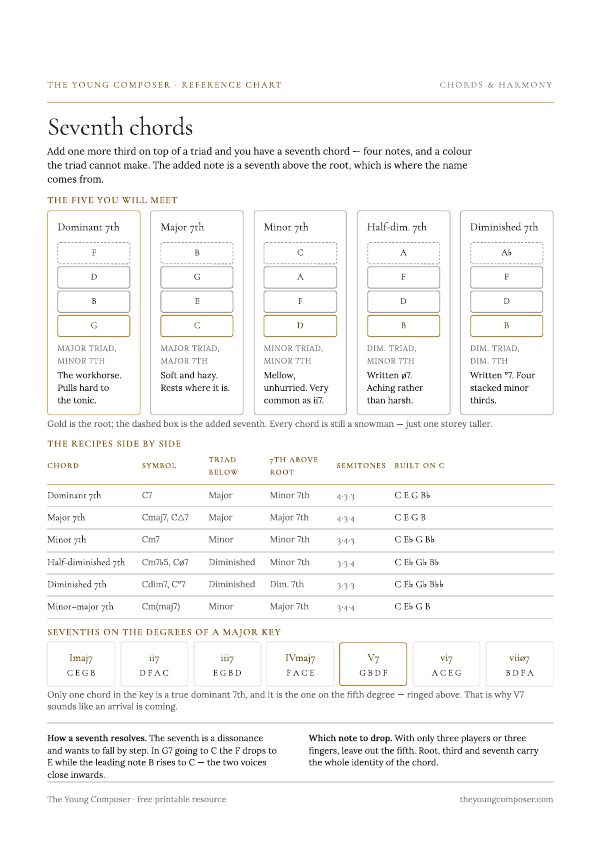
The five seventh chords you'll meet most — dominant, major, minor, half-diminished and diminished — with their recipes and how they resolve.
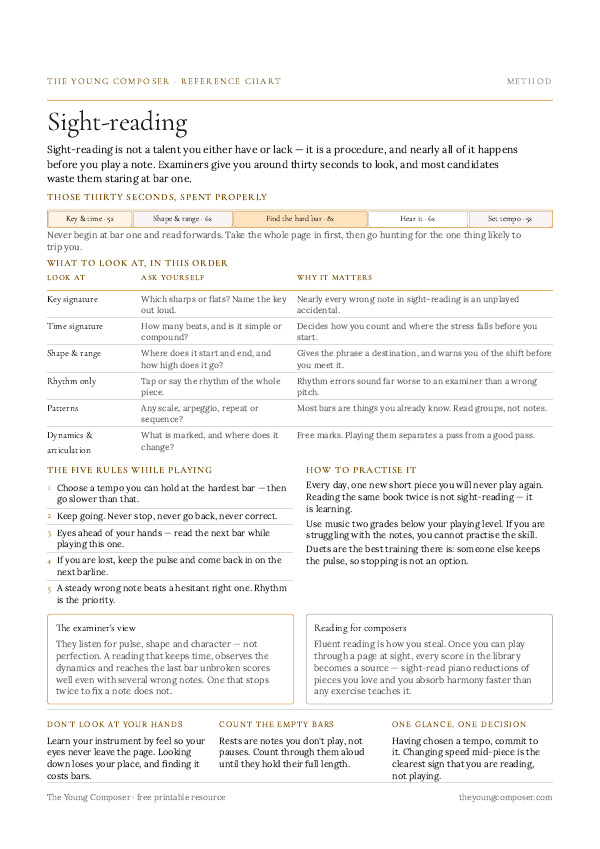
A chart treating sight-reading as a procedure rather than a talent — what to look at in the thirty seconds before you play, five rules while playing, and how to practise it.
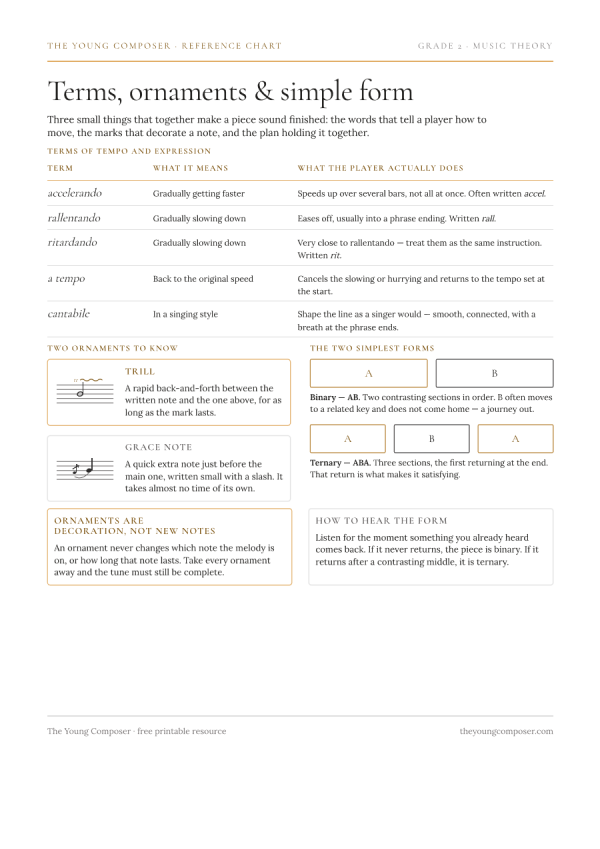
Five Italian tempo and expression terms, two essential ornaments, and the two simplest musical forms — binary and ternary.
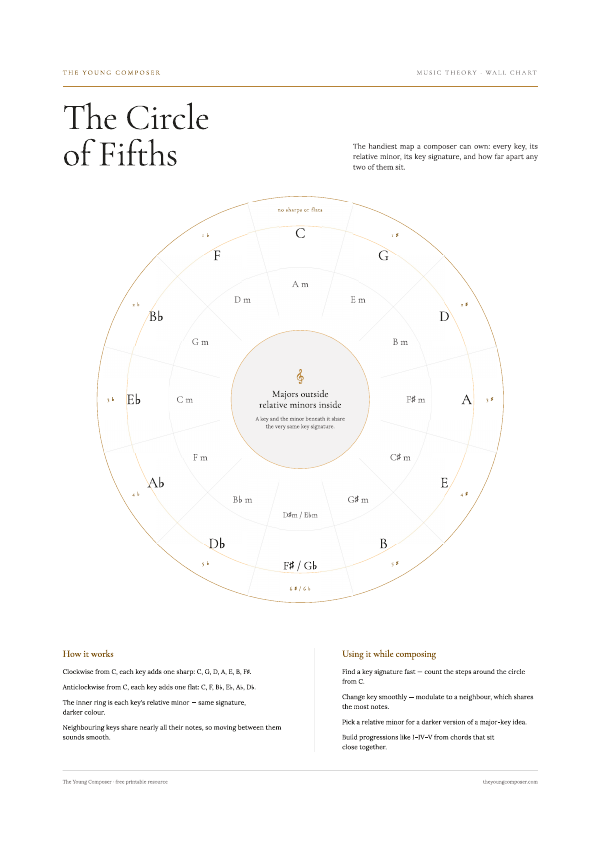
A map of all twelve keys and their relative minors, arranged by key signature, for finding key signatures and modulating smoothly.
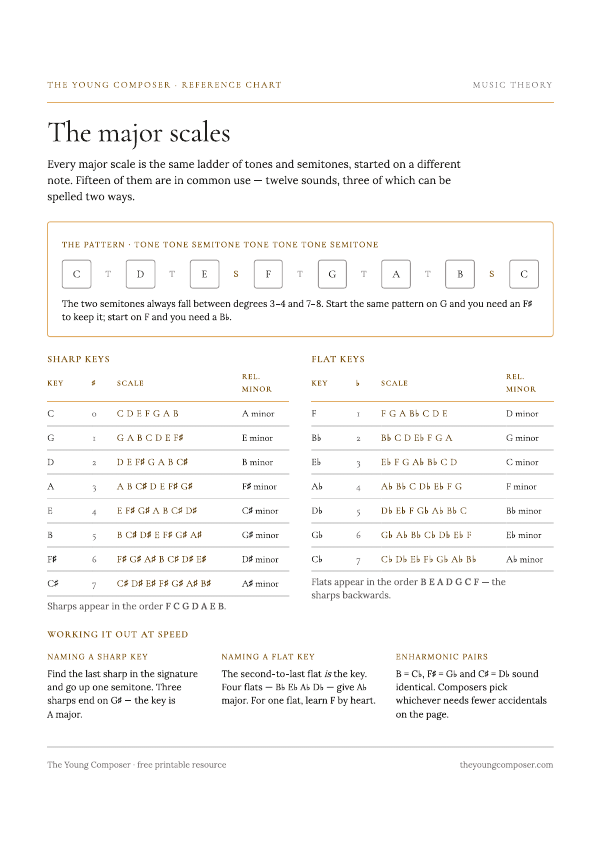
The major scale's tone/semitone pattern applied to all fifteen keys in common use, with sharp and flat keys, relative minors, and naming rules.
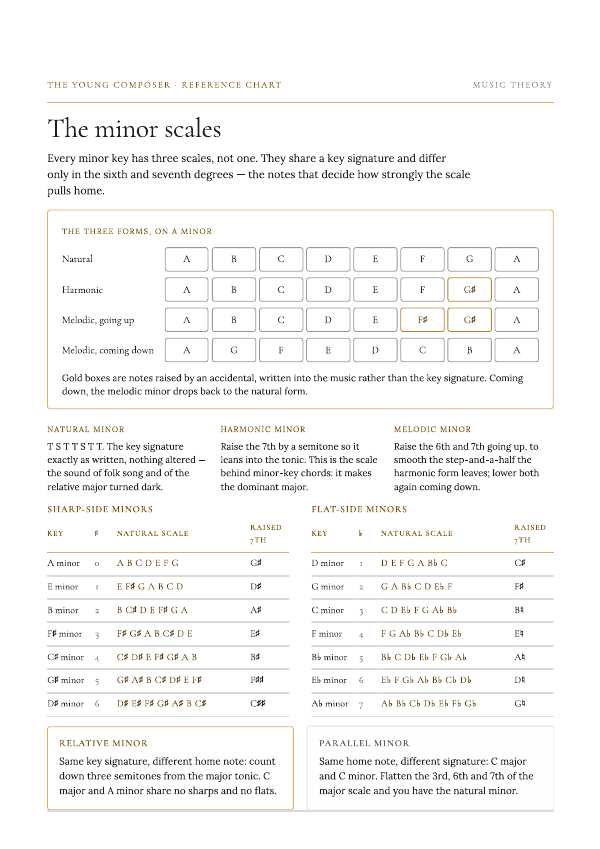
The three forms of every minor scale — natural, harmonic and melodic — with sharp-side and flat-side keys, and how relative and parallel minors differ.
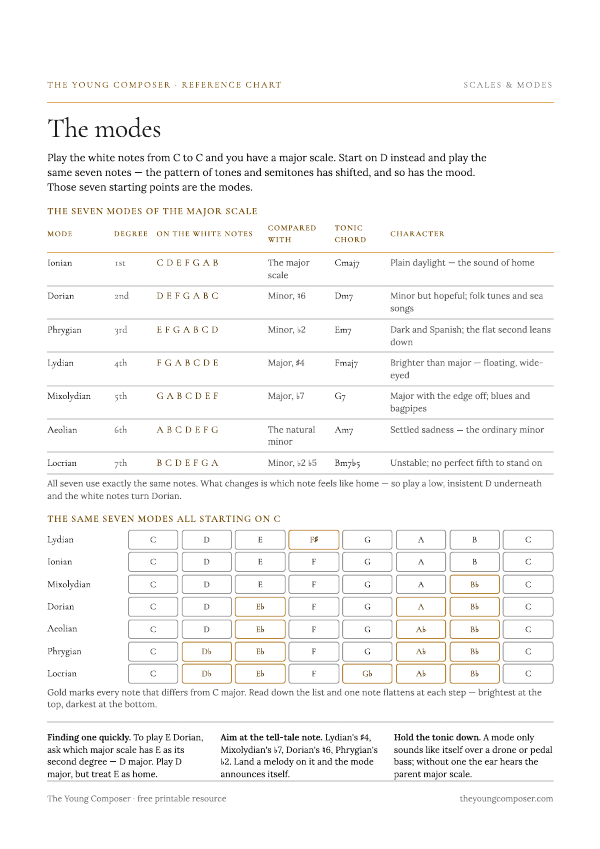
The seven modes of the major scale — same notes, different starting point — with their degree, tonic chord, and character.
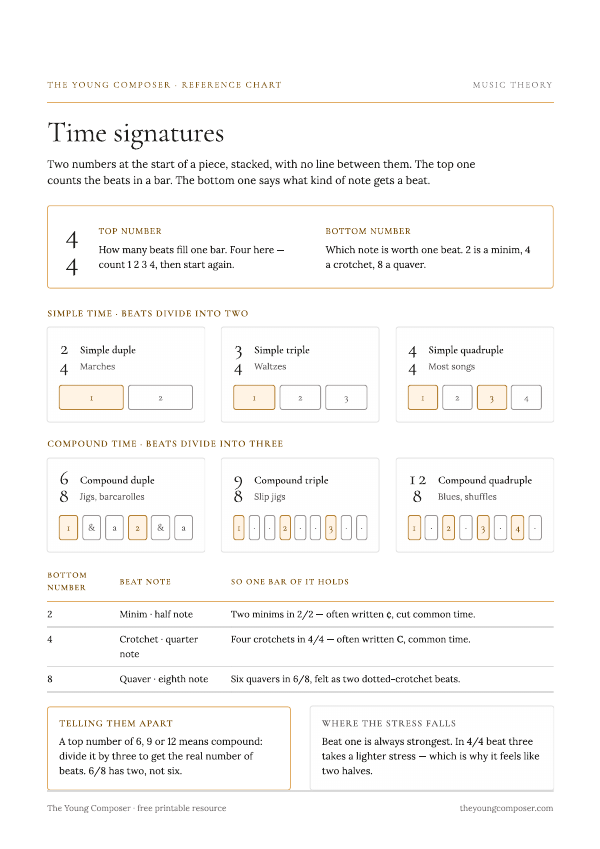
How to read a time signature's top and bottom numbers, simple vs compound time, and which note gets the beat.
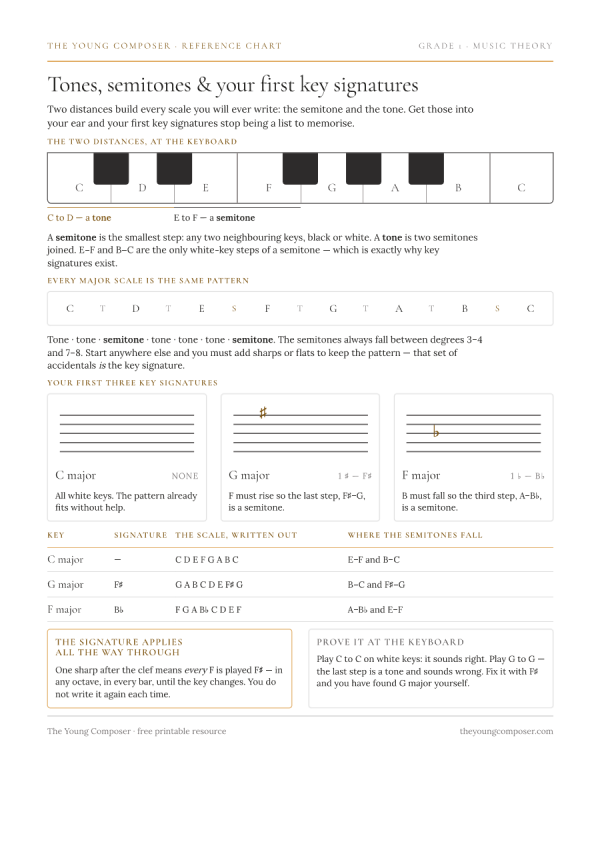
The two distances — tone and semitone — that build every scale, and how they explain your first three key signatures.
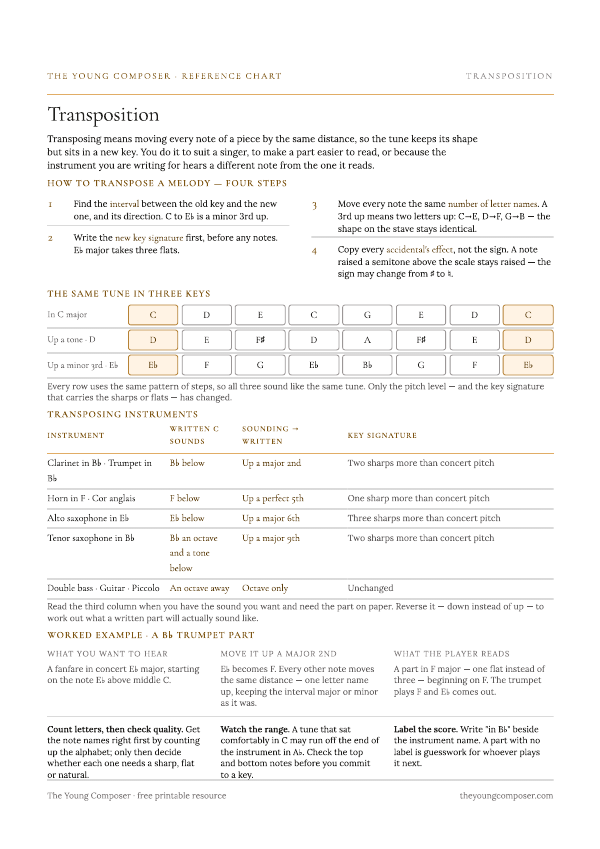
How to transpose a melody in four steps, the same tune shown in three keys, a transposing instruments table, and a worked Bb trumpet example.
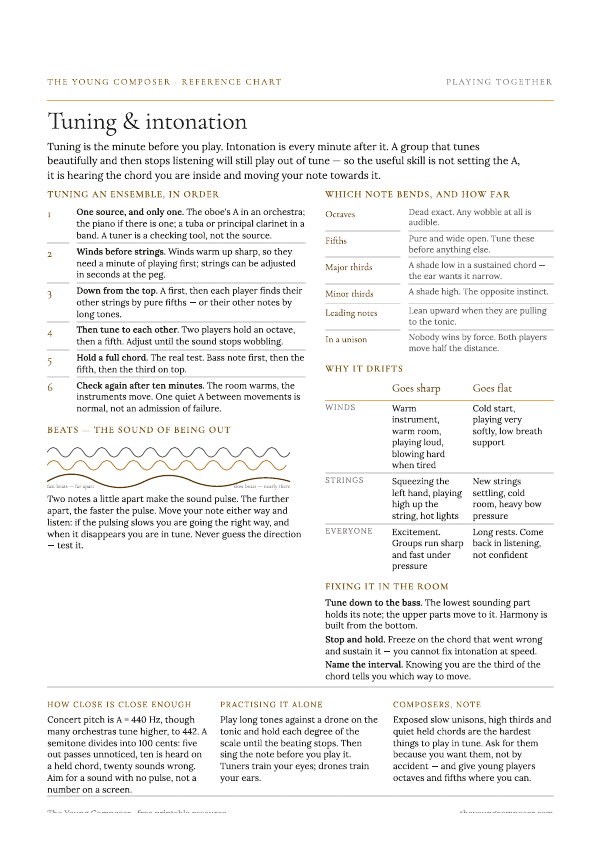
A quick-reference chart on tuning an ensemble in order, which note bends and how far in a chord, why pitch drifts sharp or flat, and how to fix intonation in the room.
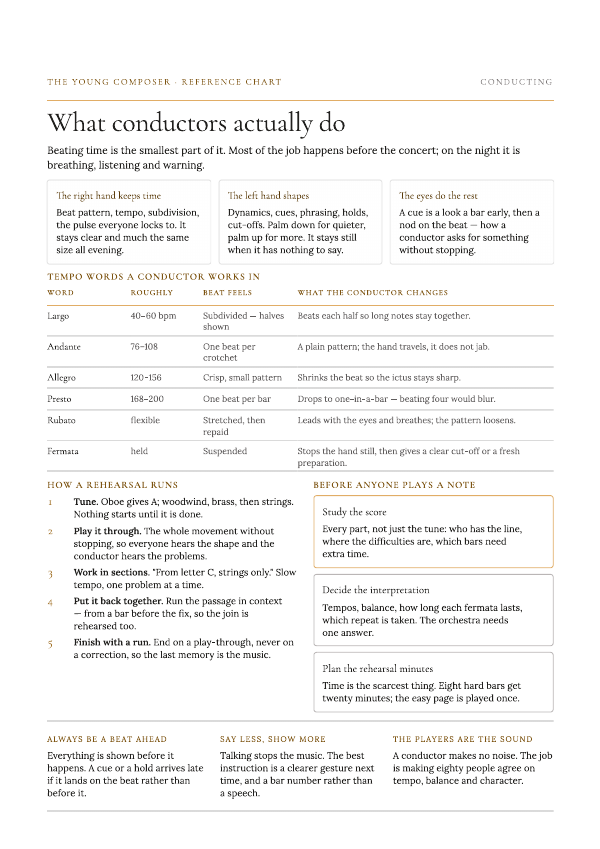
What a conductor's two hands and eyes are doing, tempo words and what they ask for, how a rehearsal runs, and what happens before anyone plays a note.
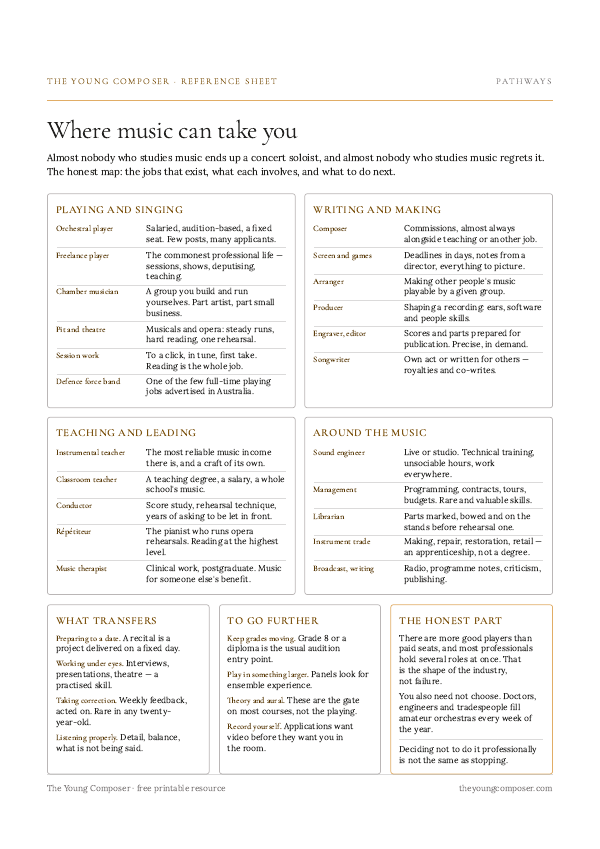
An honest map of music careers — playing and singing, writing and making, teaching and leading, and roles around the music — with what each job involves and what to do next.
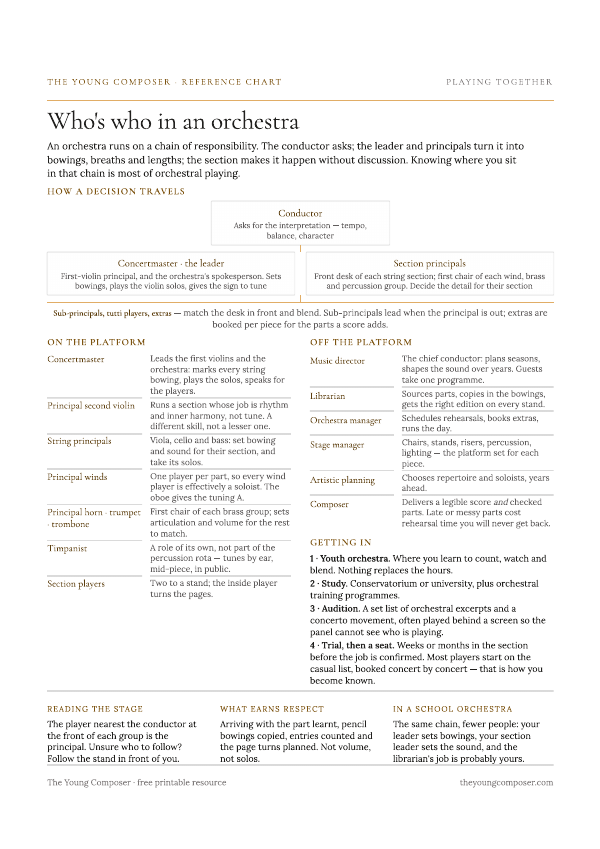
A chart of the chain of responsibility in an orchestra — how a decision travels from the conductor through the concertmaster and section principals, on-platform and off-platform roles, and how players get in.
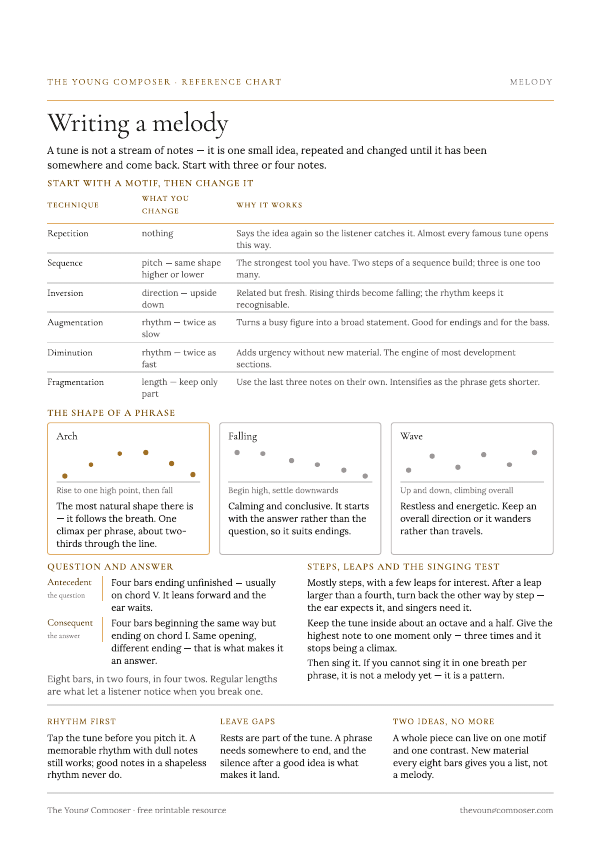
Six techniques for developing a motif, the shape of a phrase, question-and-answer structure, and habits for steps, leaps and singability.
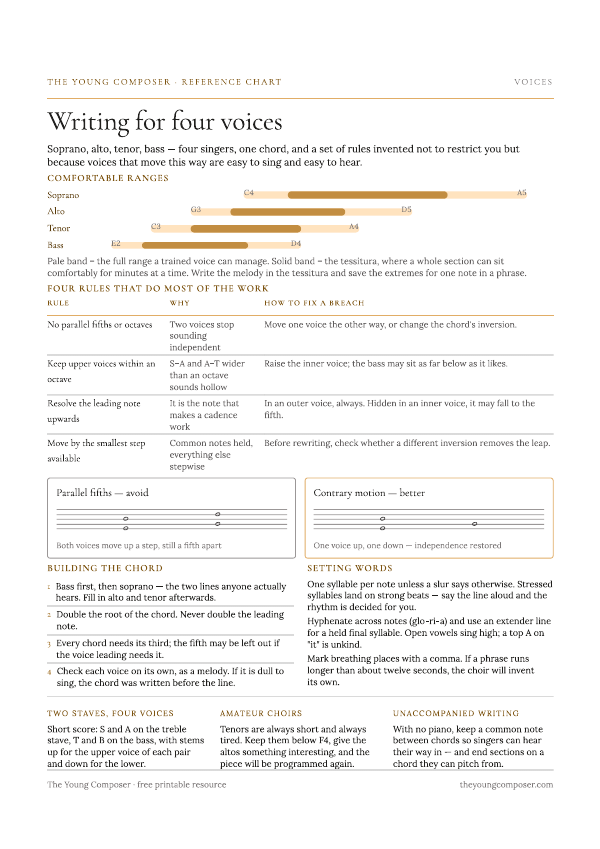
Comfortable ranges for soprano, alto, tenor and bass, four rules that do most of the work in SATB writing, and habits for building a chord and setting words.
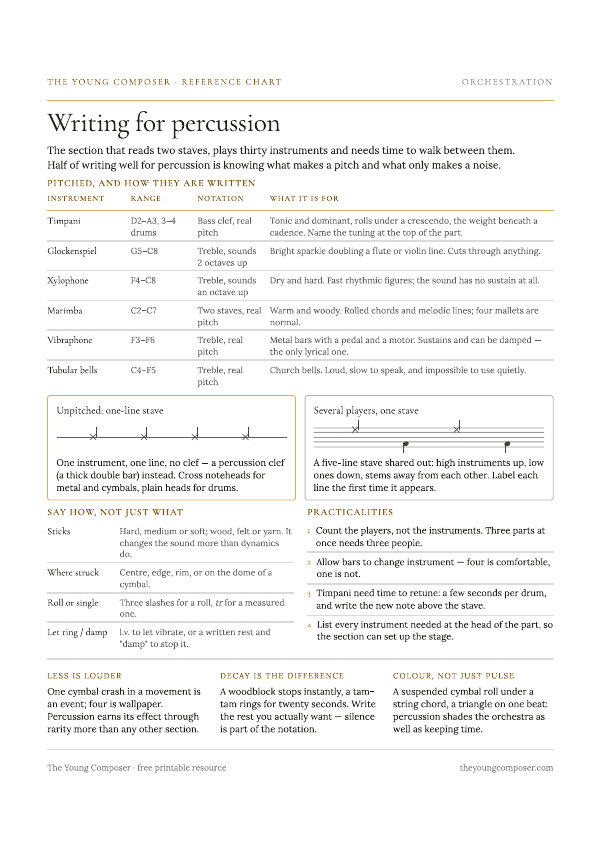
Pitched percussion instruments and how each is notated, unpitched notation on a one-line stave, and practicalities of writing a playable part.
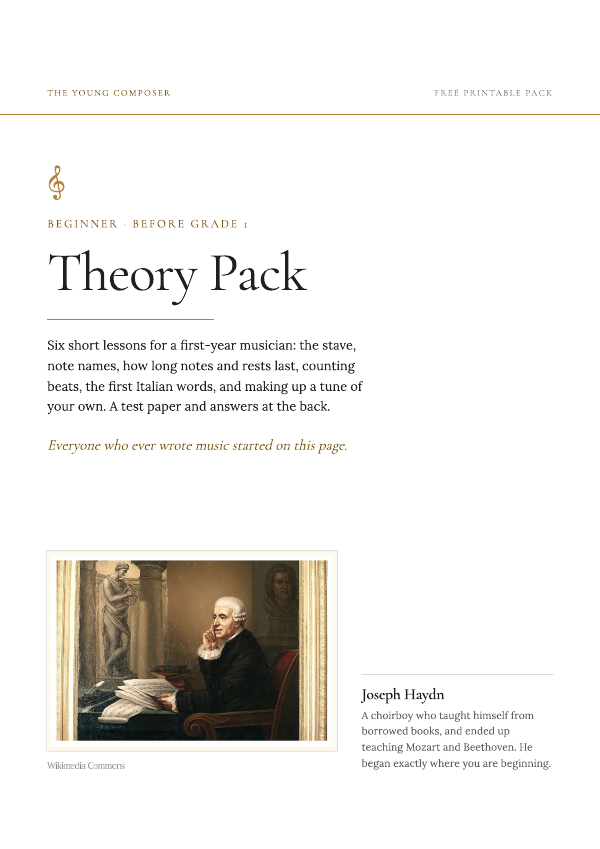
Six short lessons for a first-year musician — the stave, note names, how long notes and rests last, counting beats, the first Italian words, and making up a tune of your own — each taught then practised, with a test paper and full answer key.
Six lessons written to the shape of the AMEB Grade 1 rudiments — bass clef, dots and ties, grouping and the upbeat, first key signatures, intervals, and tonic triads — each taught then practised, with a test paper and full answer key.
Six lessons written to the shape of the AMEB Grade 2 rudiments — keys to two sharps and flats, minor scales, intervals by quality, compound time, primary triads, and simple form — each taught then practised, with a test paper and full answer key.
Six lessons written to the shape of the AMEB Grade 3 rudiments — keys to four sharps and flats, interval inversion, chords and figured symbols, cadences, modulation and transposition, and form — each taught then practised, with a test paper and full answer key.
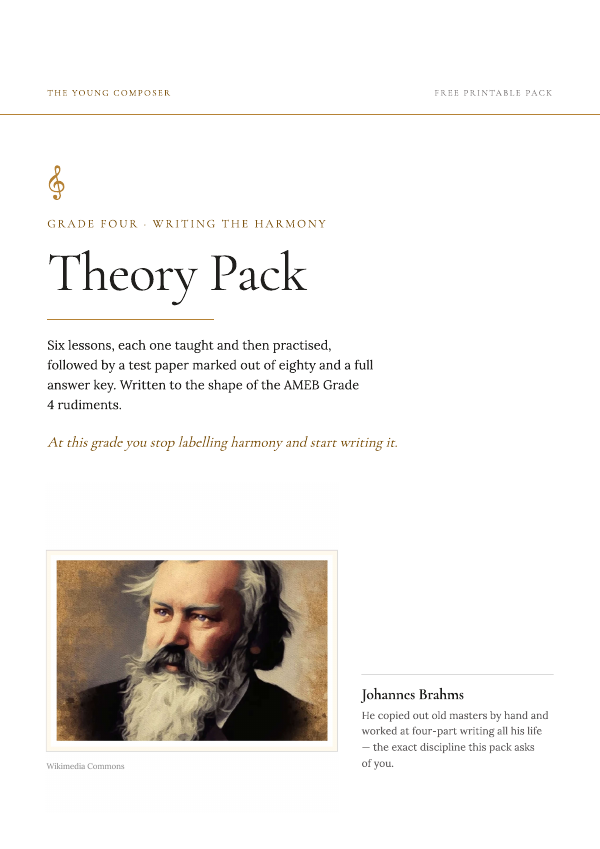
Six lessons written to the shape of the AMEB Grade 4 rudiments — keys to six sharps and flats, irregular time, the dominant seventh, writing in four parts, completing a melody, and transposing instruments — each taught then practised, with a test paper and full answer key.
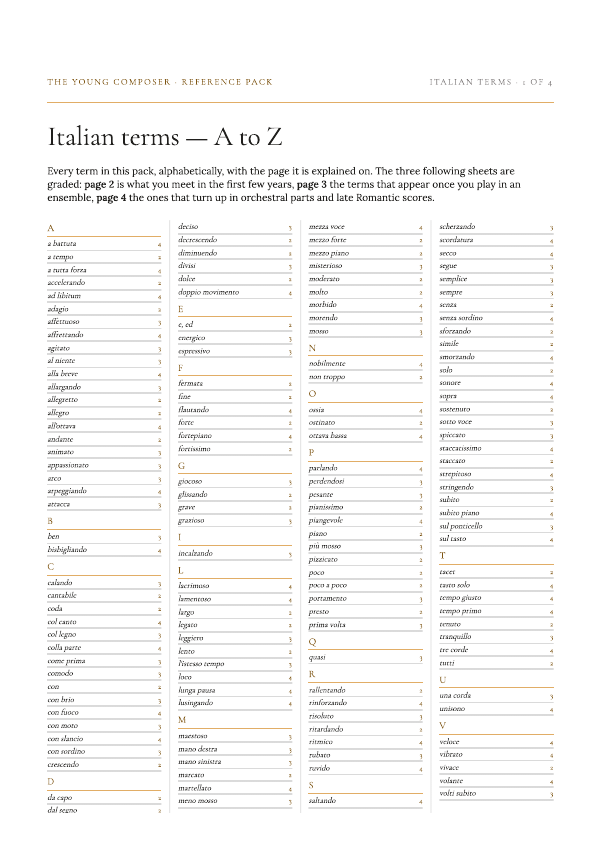
Every Italian musical term alphabetically with the page it's explained on, then graded lists of beginner, intermediate and advanced terms with plain-English meanings.
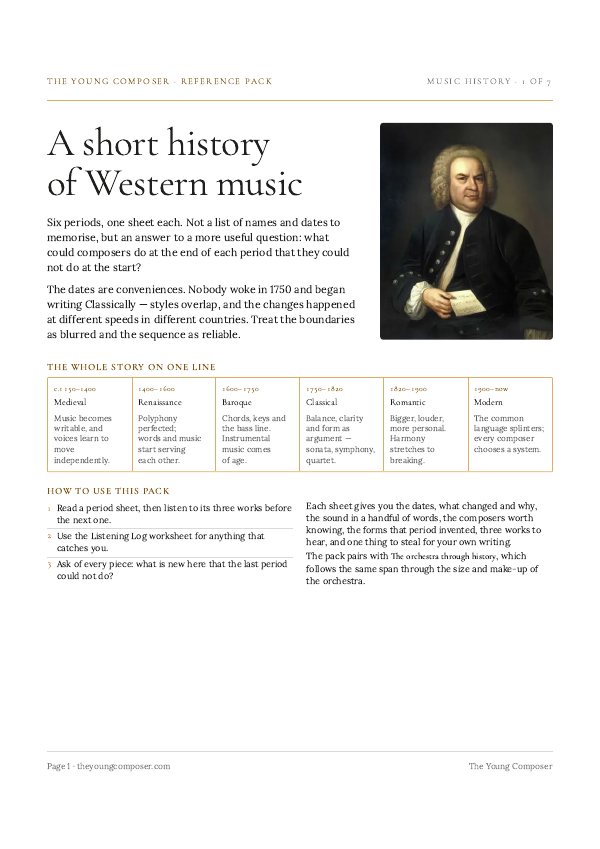
A six-period tour of Western music history, one sheet each, answering what composers could do at the end of each period that they couldn't at the start — with who to know and three works to hear per era.
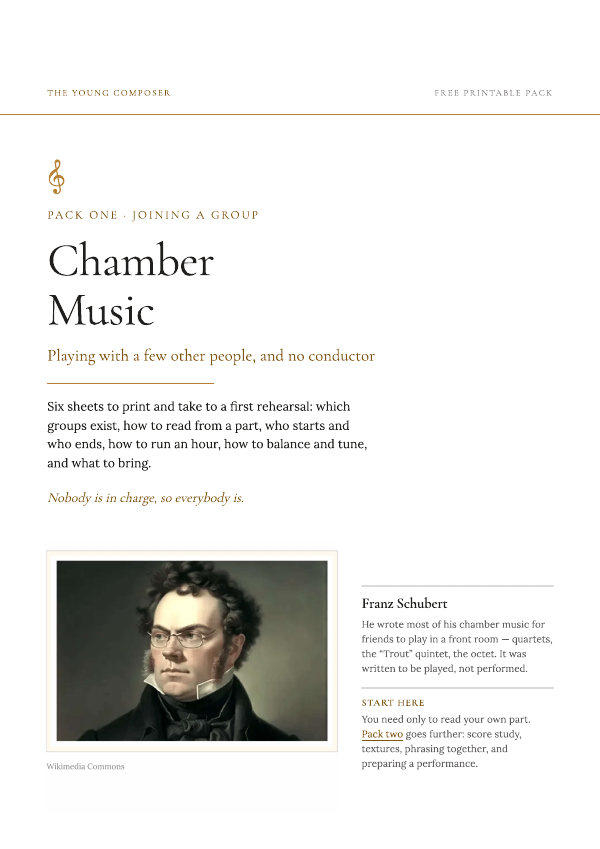
Six sheets to print and take to a first rehearsal — which groups exist, how to read from a part, starting and ending together, how to run an hour, balance and tuning, and what to bring.
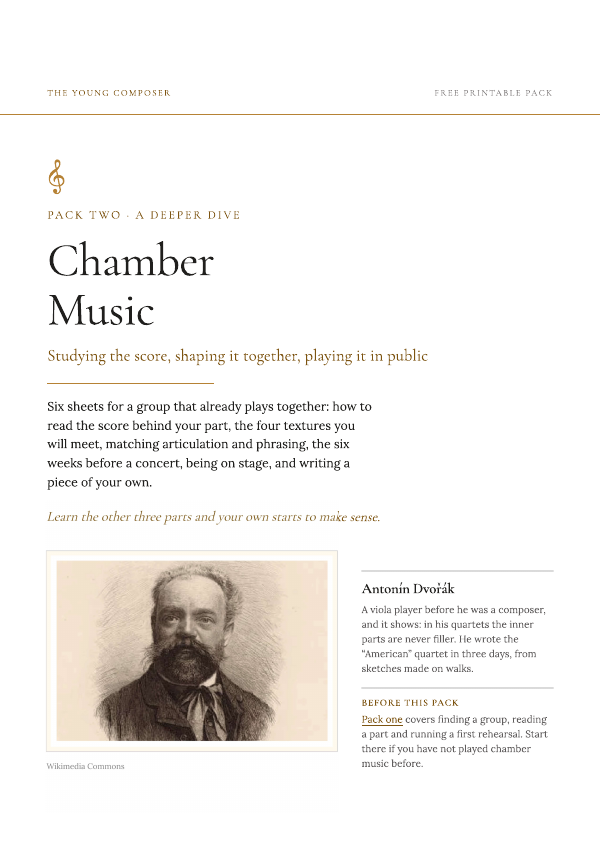
Six sheets for a group that already plays together — reading the score behind your part, the four textures you will meet, matching phrasing and articulation, six weeks to a concert, being on stage, and a worksheet for writing for your own group.
Six sheets to print, write on and take to a first rehearsal — the four families of the orchestra, seating, conducting patterns, what the conductor is doing, the circle of fifths, and how to join an ensemble.
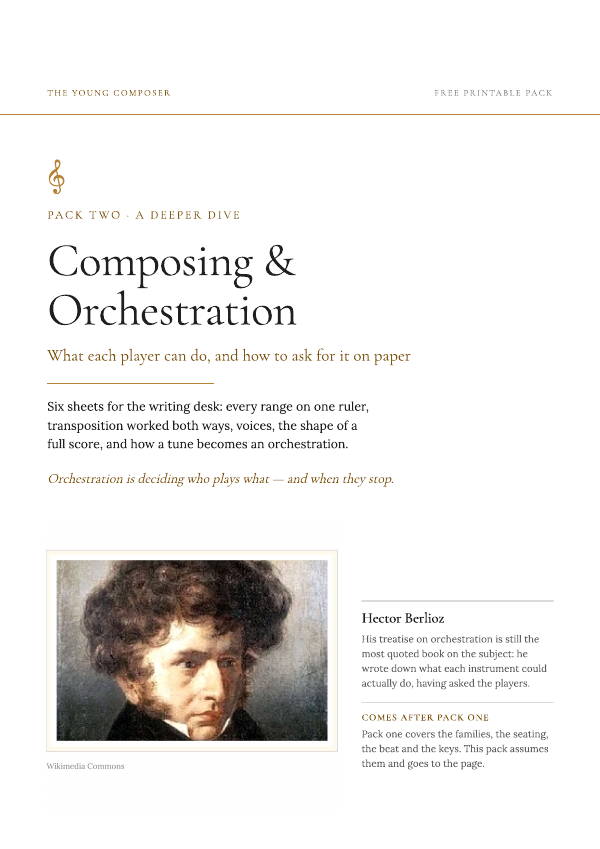
Six sheets for the writing desk — every instrument range on one ruler, transposition worked both ways, voice types, reading a full score, orchestrating an idea, and a plan-your-piece worksheet.
One page each on Bach, Haydn, Mozart, Beethoven, Berlioz, Mendelssohn, Clara Schumann and Brahms — what happened to them, what they changed, three pieces to hear, and one thing worth stealing for your own writing.
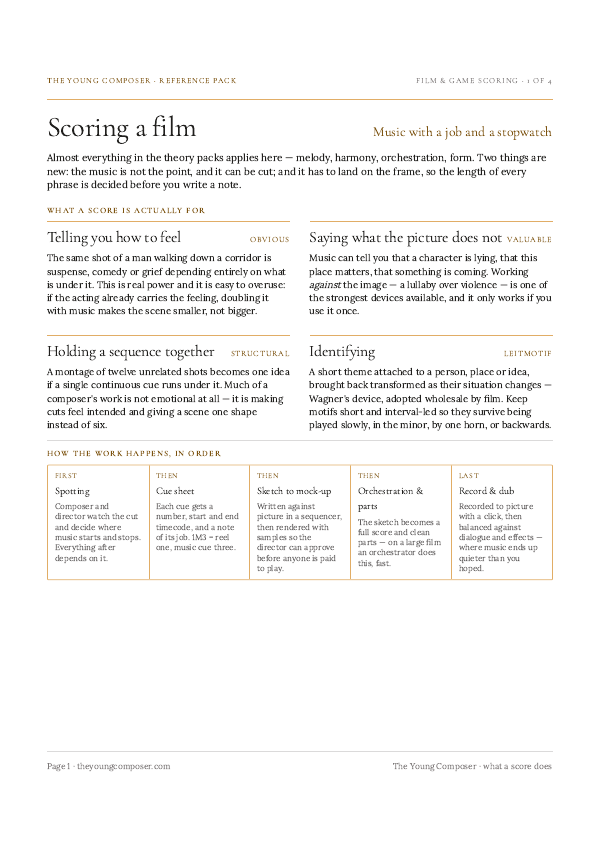
A pack on writing music with a job and a stopwatch — what a film score is actually for, the vocabulary of spotting and cue sheets, how game music differs from linear scoring, and where to start.
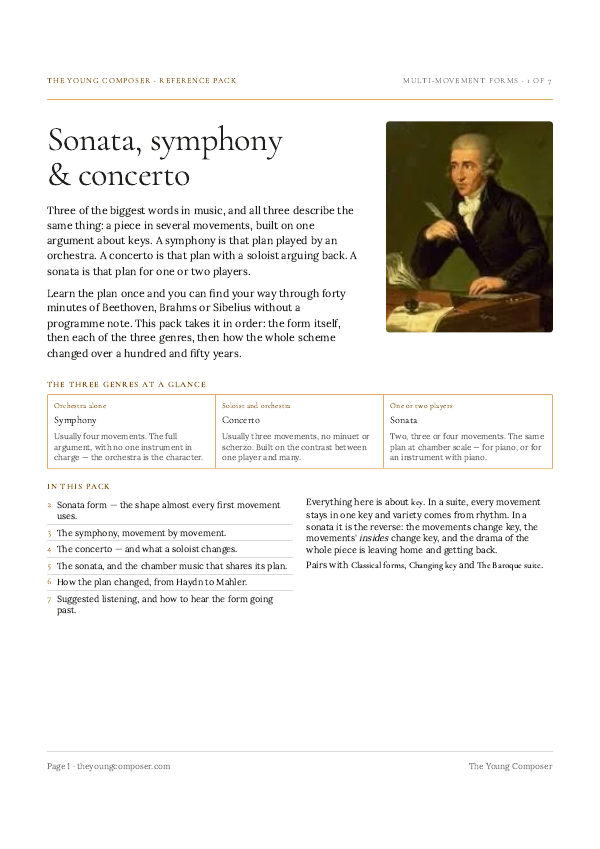
A pack unpacking the one plan behind music's three biggest multi-movement forms — sonata form itself, then the symphony, the concerto and the sonata in turn, and how the whole scheme changed from Haydn to Mahler.
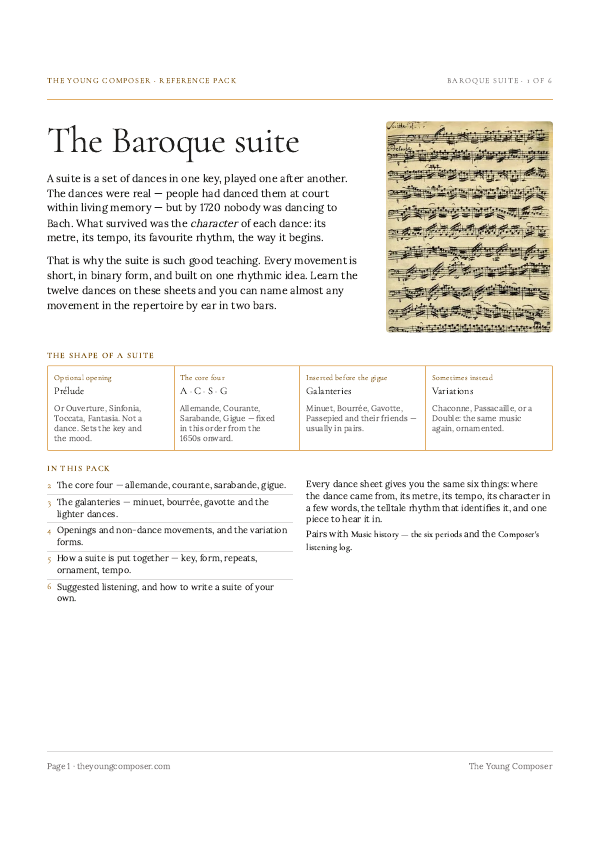
A pack on how a Baroque dance suite is built — the core four movements, the optional galanteries, openings and variation movements, and the six conventions that hold a suite together, with a model suite to write yourself.
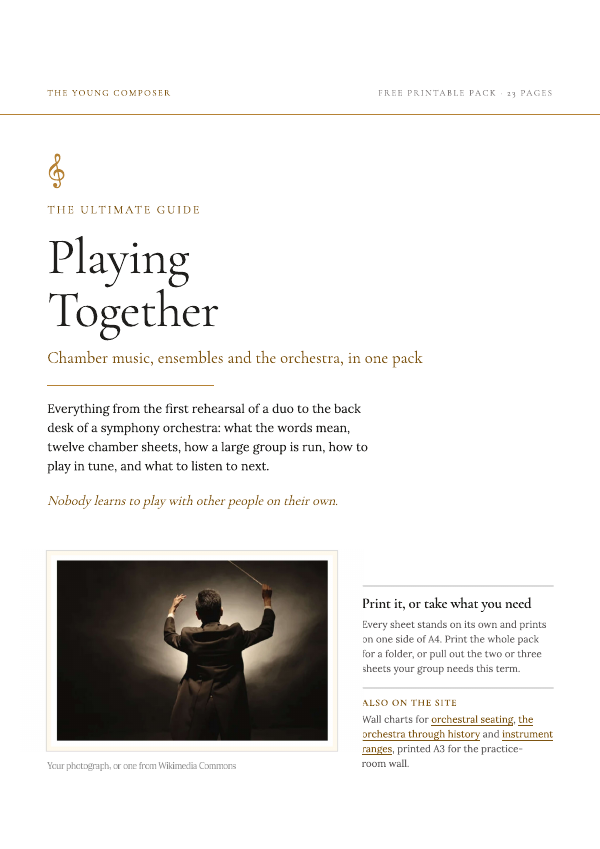
A 23-page, four-part course in one pack — what the words mean, chamber music in twelve sheets, playing in a large group, and getting the most from rehearsal — for anyone moving from playing alone to playing with others.
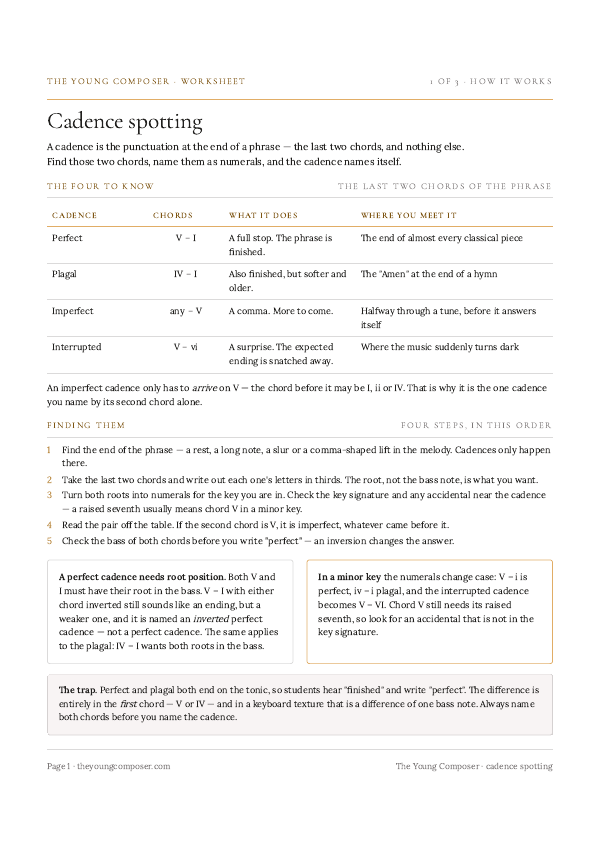
A worksheet on naming the four cadences from their last two chords, with a four-step finding method, sixteen drill questions in notation and numerals, four short-answer questions, and a full answer key.
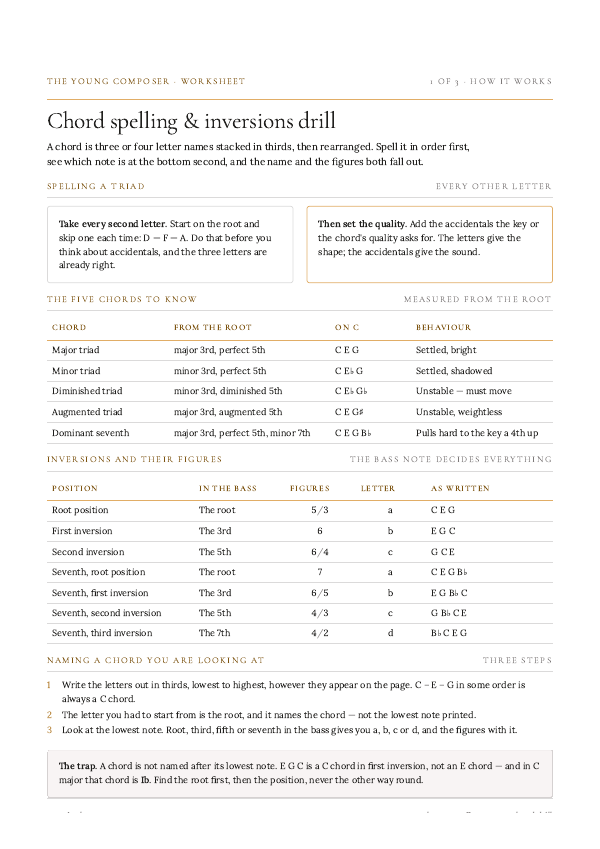
A worksheet on spelling the five chords every student needs, naming a chord from its notes, and giving the figures and position of triads and sevenths, with a stave-building section and a full answer key.
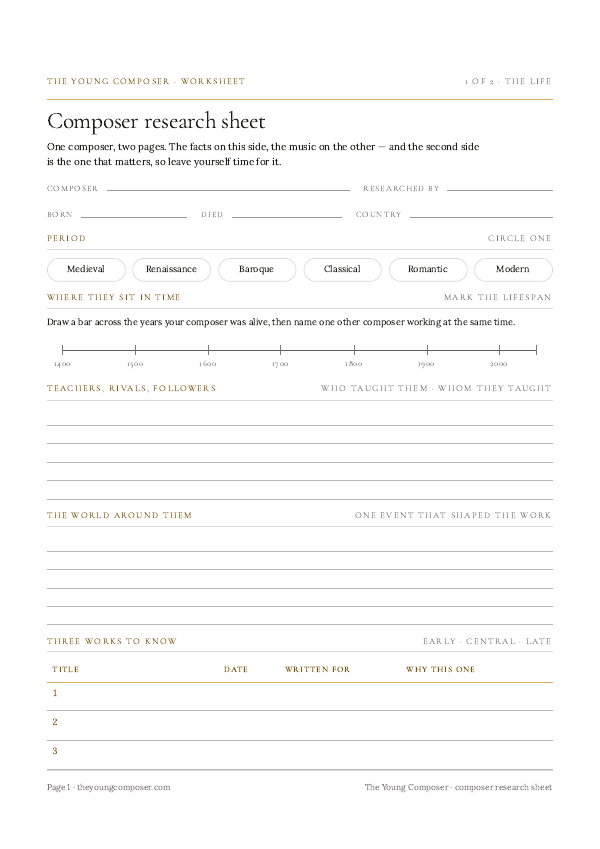
A two-page fillable worksheet for researching one composer — the facts and where they sit in time on one side, and close listening to three of their works on the other.
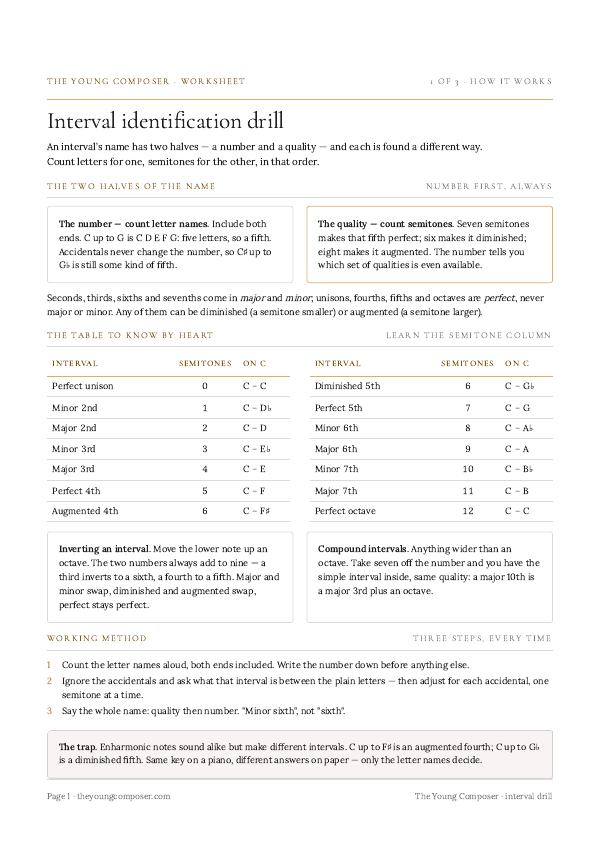
A worksheet on naming intervals by counting letters for the number and semitones for the quality, with a full semitone table, inverting and compound intervals, and a three-step working method.
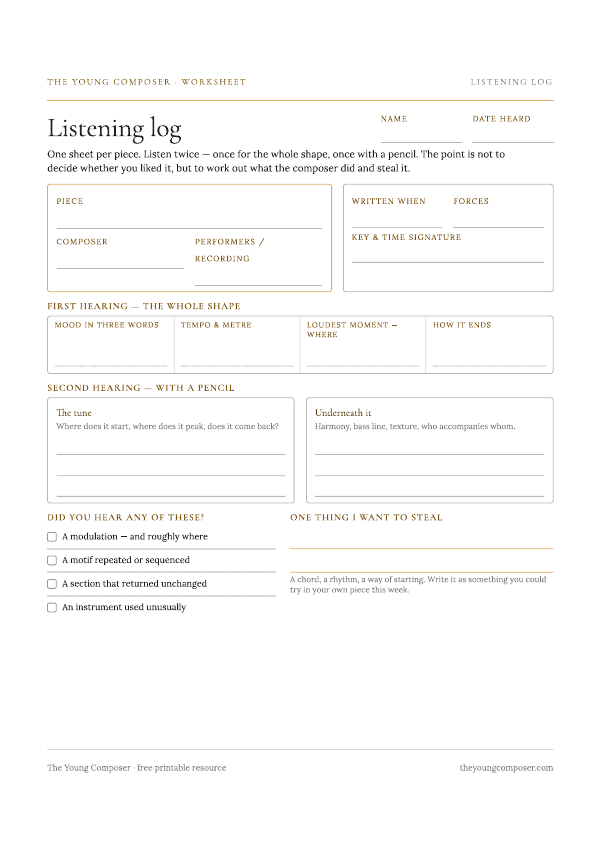
A fillable worksheet for listening to a piece twice — once for the whole shape, once with a pencil — and writing down what the composer did.
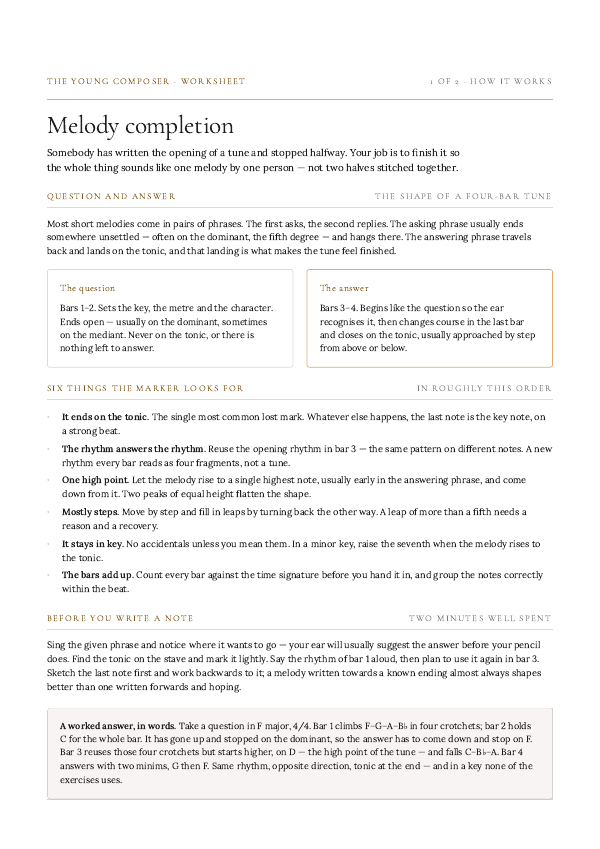
A worksheet for finishing a given opening phrase into a matching four-bar melody, with the question-and-answer shape explained, six things a marker looks for, and five graded exercises.
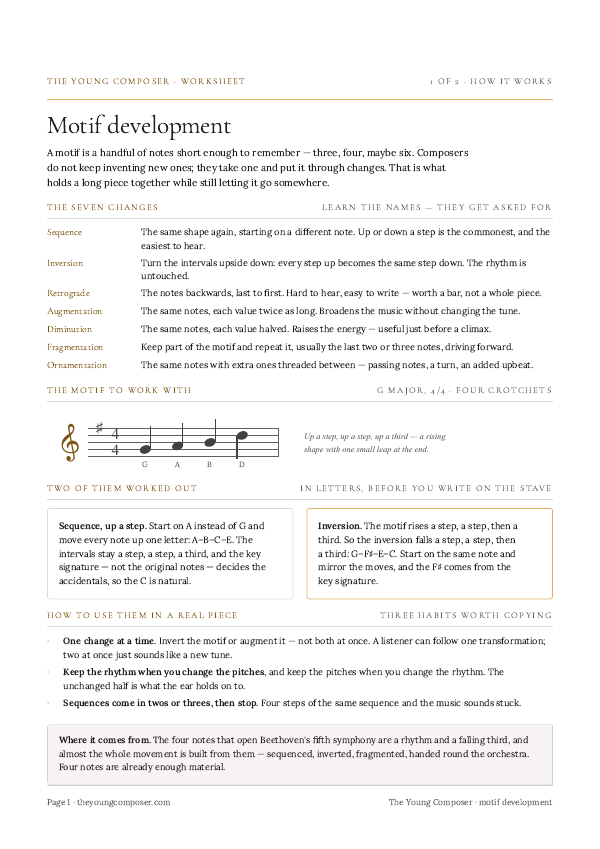
A worksheet on the seven changes composers use to develop a short motif — sequence, inversion, retrograde, augmentation, diminution, fragmentation and ornamentation — with a worked example and exercises on a given four-note motif.
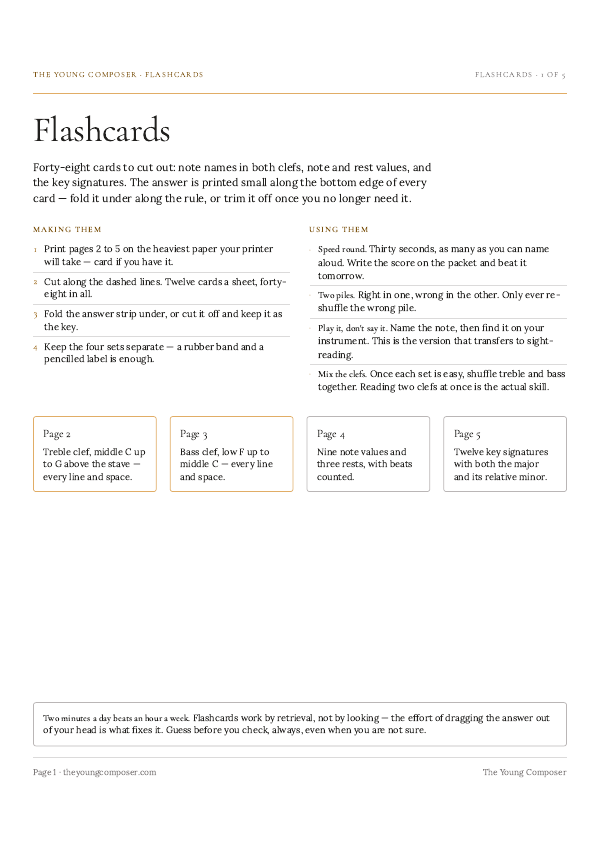
Forty-eight cut-out flashcards for drilling note names in both clefs, note and rest values, and key signatures, with the answer printed along the bottom edge of every card.
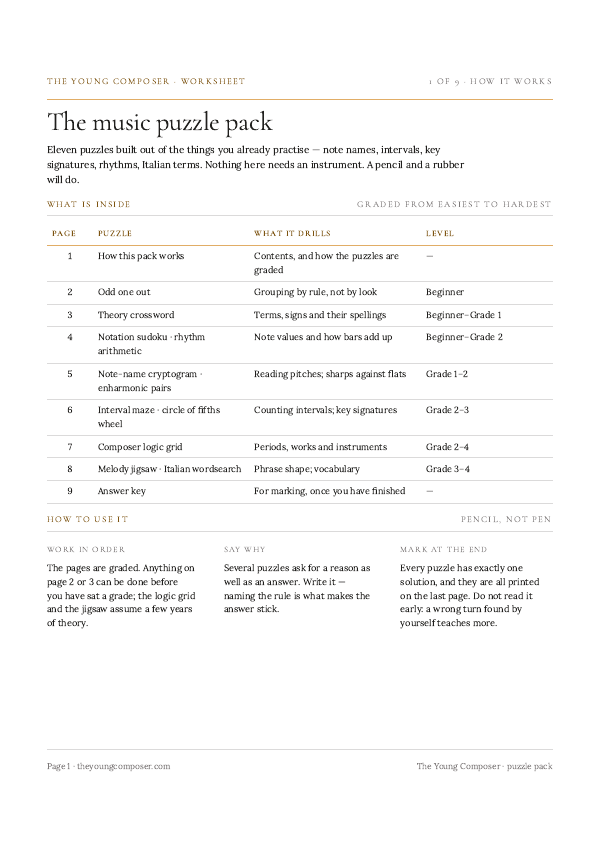
Eleven graded music-theory puzzles — odd one out, a crossword, sudoku, rhythm arithmetic, a cryptogram, a maze, a logic grid, a melody jigsaw and an Italian wordsearch — with a full answer key.
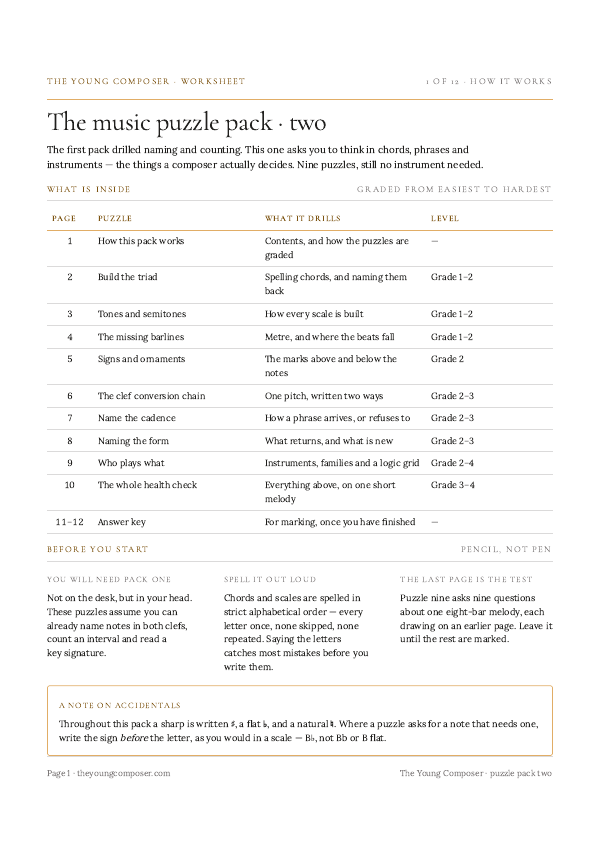
Ten graded puzzles that move from naming into thinking like a composer — building triads, scales, cadences, form and orchestration — ending in a nine-question health check on one melody, with a full answer key.
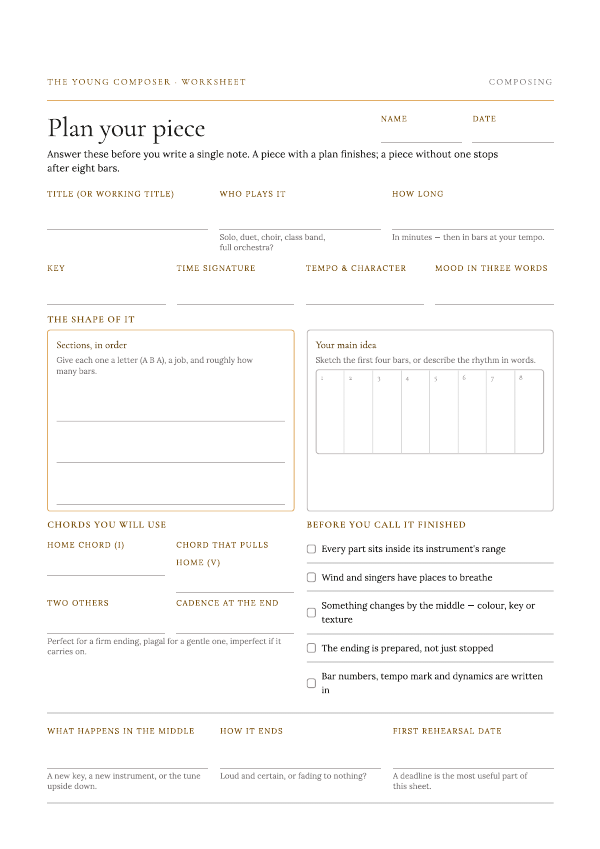
A fillable worksheet for deciding the forces, key, tempo, shape and chords of a piece before writing a single note.
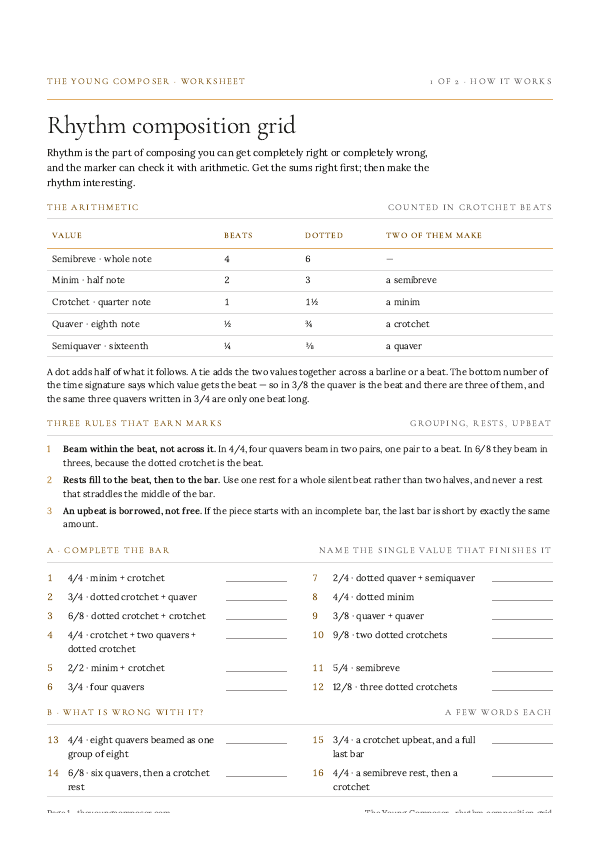
A worksheet drilling rhythmic arithmetic and beaming rules, then a blank four-bar grid for writing rhythms of your own and turning one into music.
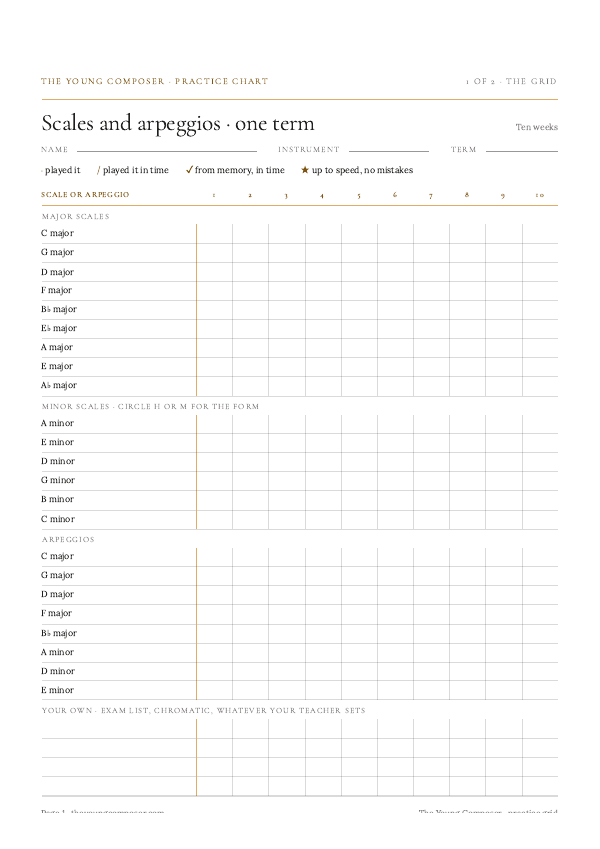
A ten-week practice grid for scales and arpeggios with a four-level marking system — played it, played it in time, from memory, and up to speed — plus a ten-minute weekly routine for getting real progress out of them.
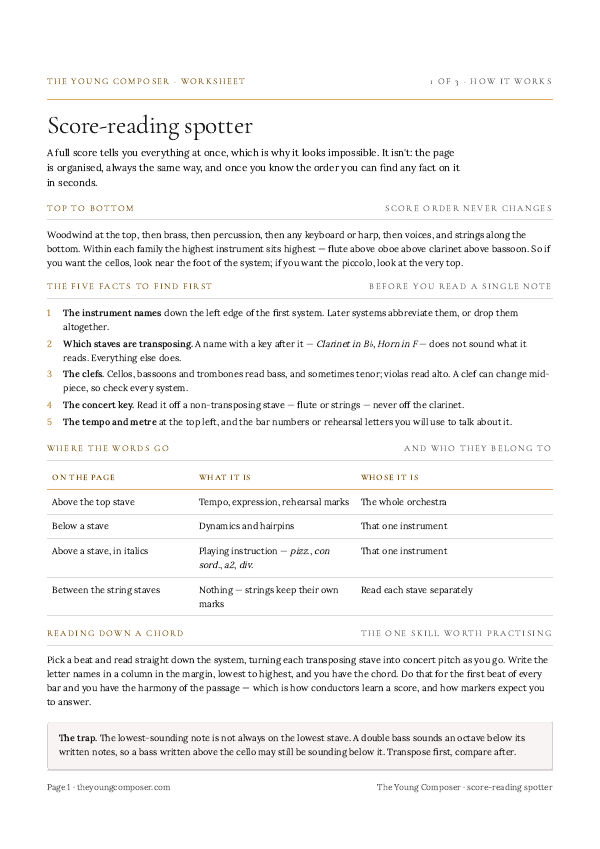
A worksheet on finding your way around a full score — the standard top-to-bottom order, the five facts to find before reading a note, and two graded exercises spotting facts and deliberate errors in a printed extract.
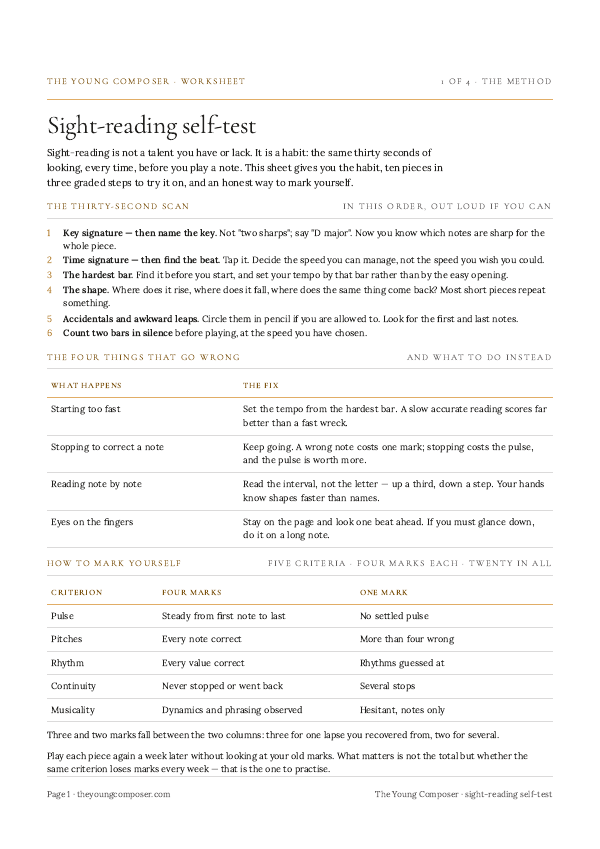
Ten short pieces across three graded steps for practising the sight-reading habit, with a thirty-second scan routine, five marking criteria, and a self-scoring grid for each piece.
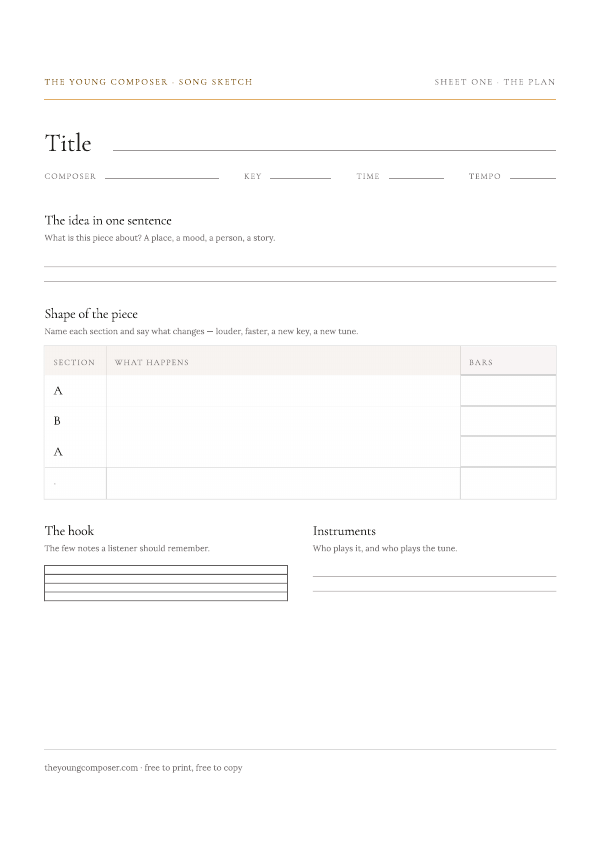
A two-sheet worksheet for planning a song's structure and hook, then writing out the tune and lyrics.
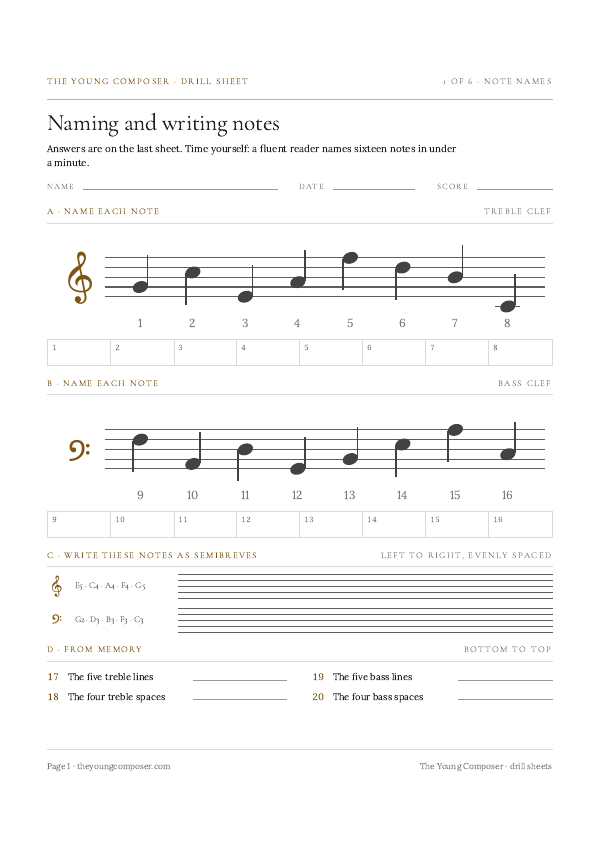
Six timed drill sheets covering note names, key signatures, intervals, rhythm, chords and scales, each with a name/date/score line, plus a full answer key on the last page.
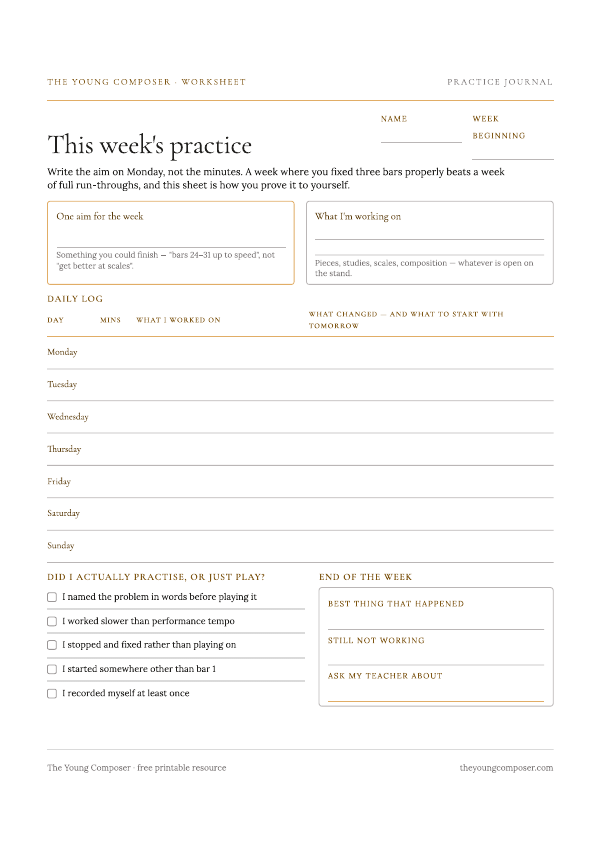
A fillable weekly practice journal with one aim for the week, a daily log for what changed, and an end-of-week review.
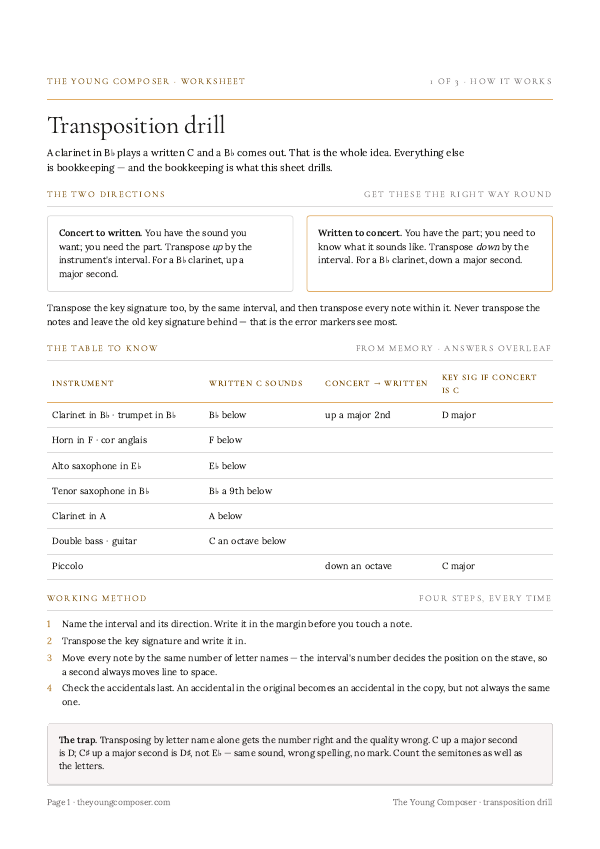
A worksheet drilling concert-to-written and written-to-concert transposition for the common transposing instruments, with a table to know from memory, a four-step working method, and a full answer key.
Blank staff paper with a title block for composer, key, time and date on page one, plus a continuation page of plain staves.
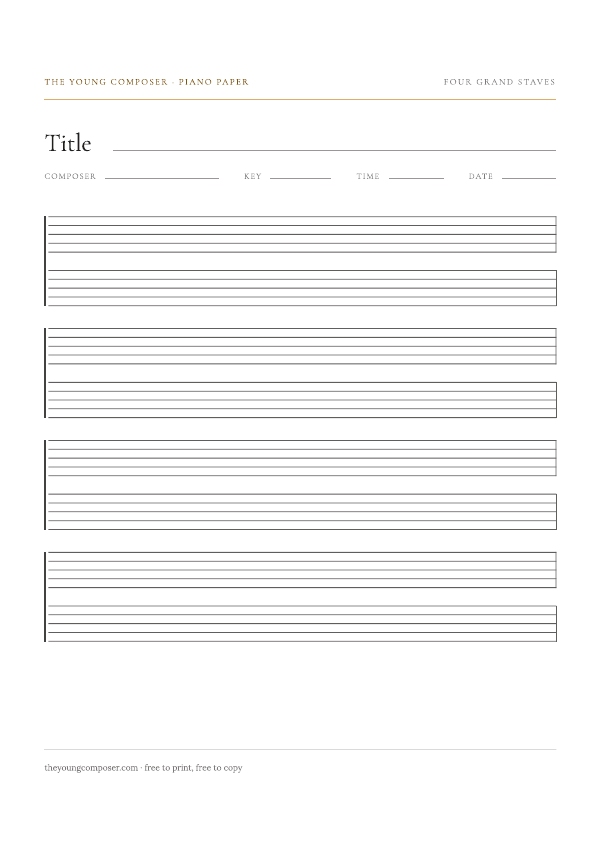
Blank grand-staff paper for piano writing, with a title block for composer, key, time and date on page one.
Looking for step-by-step lessons instead? Head to Music Theory. Want composing ideas? Try Composing.