Codex Harmonicus I — De Proportione Sonorum
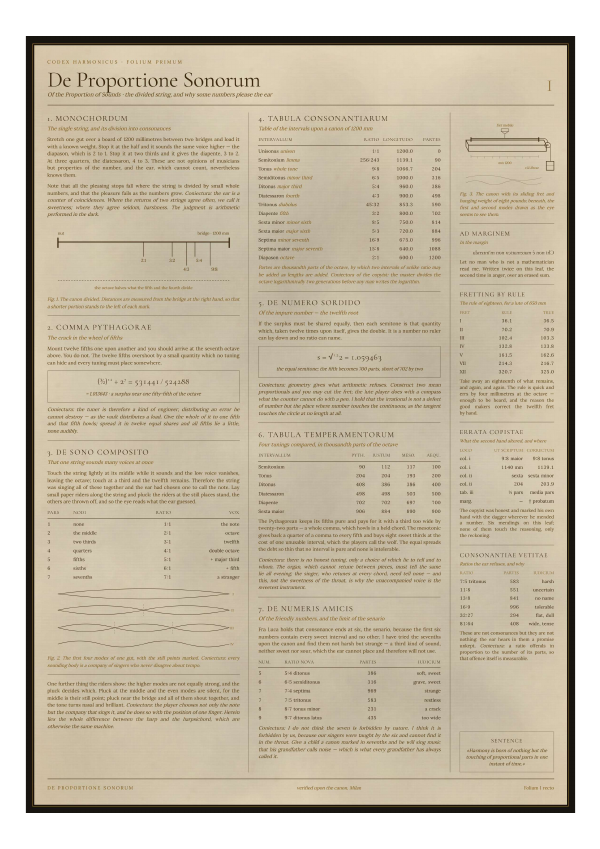
Folio I of the Codex Harmonicus, a recovered-manuscript-style plate on the divided string and the ratios of consonance — the single string, the wheel of fifths, and why some numbers please the ear.
Part fact, part fiction, but built for curious minds: tucked inside a bundle of old hydraulic notes, a copyist in Milan found six loose leaves that didn't seem to belong with the rest. They weren't about pumps or bridges — they were about sound. The same restless hand that sketched flying machines and dissected the human eye had turned its attention to music: why a plucked string agrees with itself, whether a room can help a choir or ruin it, whether a machine could ever be taught to play. Alongside those six recovered folios sit four workshop notebooks — a maker's own reckonings for a piano, a violin, a cello and a guitar, each built from the same obsessive measuring and the same stubborn idea that beautiful sound is really just careful arithmetic, wearing a much nicer coat.
None of this ever happened, of course — Leonardo never went near a fortepiano, and ‘the master’ in these pages is having rather more fun with logarithms than the real Leonardo ever got around to. But every ratio, measurement and idea inside is genuine music theory or real instrument-making science, just told in a five-hundred-year-old disguise. Unroll one below and see what the old man in the workshop was really getting at.
Folio I of the Codex Harmonicus, a recovered-manuscript-style plate on the divided string and the ratios of consonance — the single string, the wheel of fifths, and why some numbers please the ear.
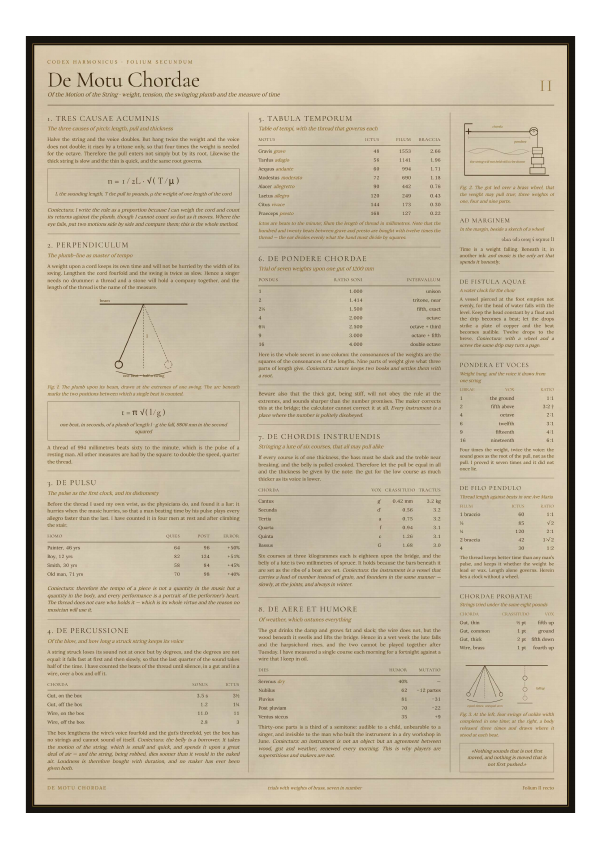
Folio II of the Codex Harmonicus, a recovered-manuscript-style plate on tension, weight and the measure of time — the three causes of pitch, the swinging pendulum, and a table of tempo markings against a beating thread.
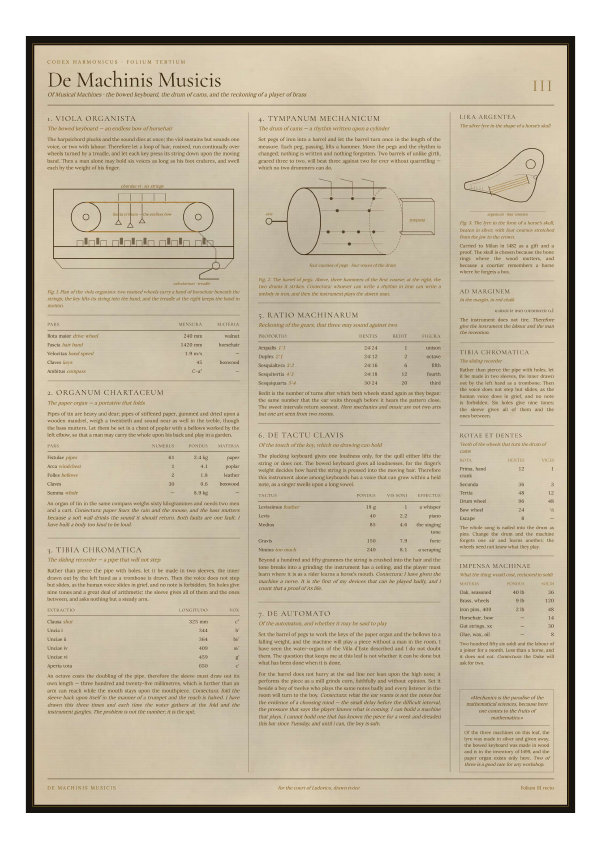
Folio III of the Codex Harmonicus, a recovered-manuscript-style plate on invented instruments — the bowed keyboard, the drum of pinned cams, the folding paper organ, and a barrel-driven automaton.
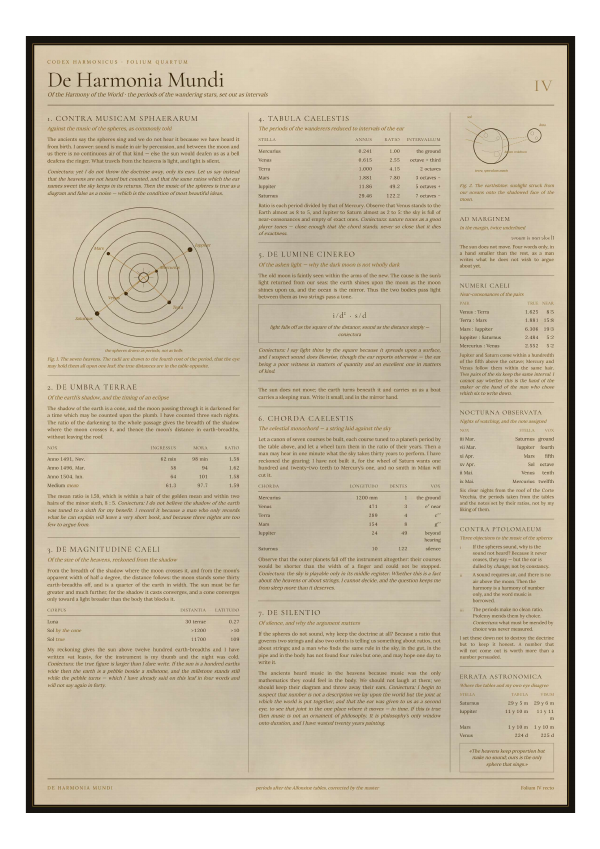
Folio IV of the Codex Harmonicus, a recovered-manuscript-style plate on the music of the spheres — the periods of the wandering stars reduced to musical intervals, and a diagram of the seven heavens drawn as periods, not distances.
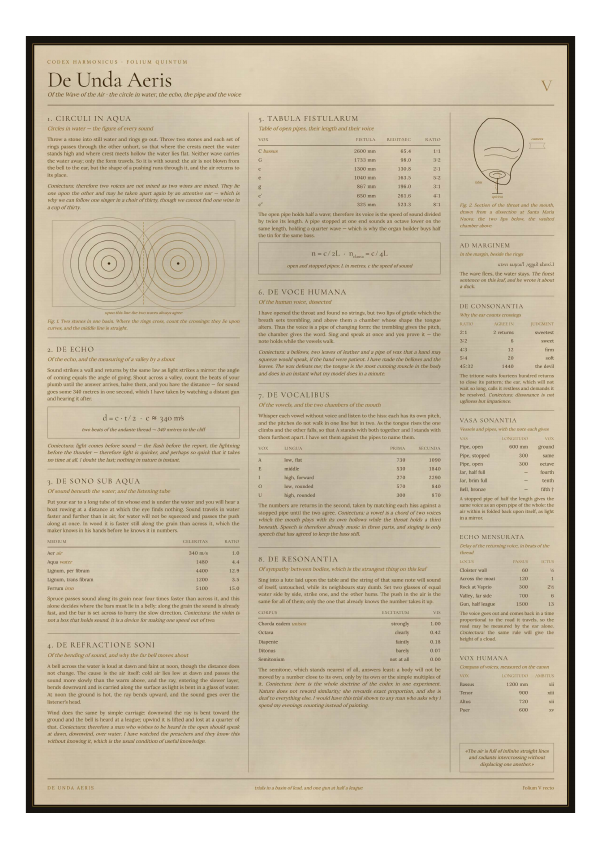
Folio V of the Codex Harmonicus, a recovered-manuscript-style plate on sound as a wave in air — ripples on water as a model for sound, the speed of an echo, the dissected human voice, and sympathetic resonance between bodies.
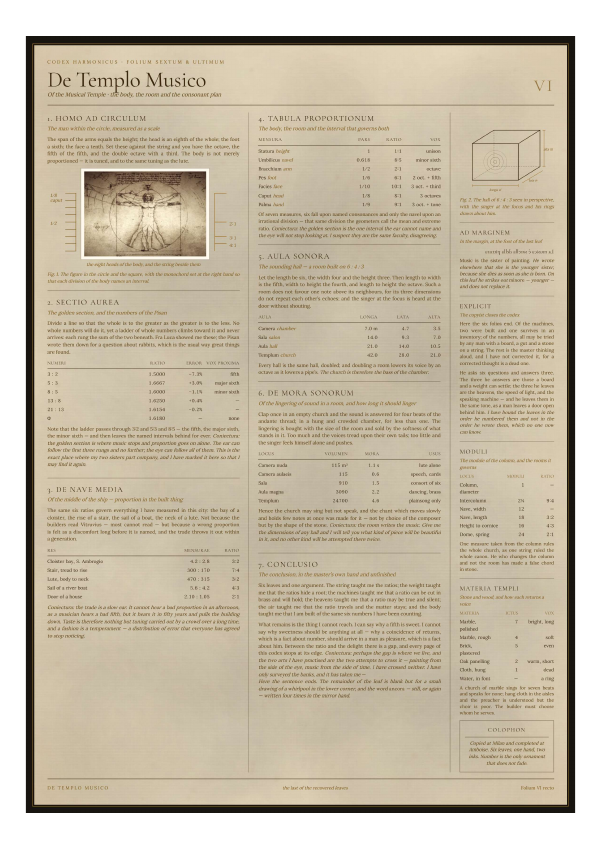
Folio VI and final leaf of the Codex Harmonicus, a recovered-manuscript-style plate on the body, the room and the consonant plan — the golden section, a room built on a chord, and the copyist's closing note.
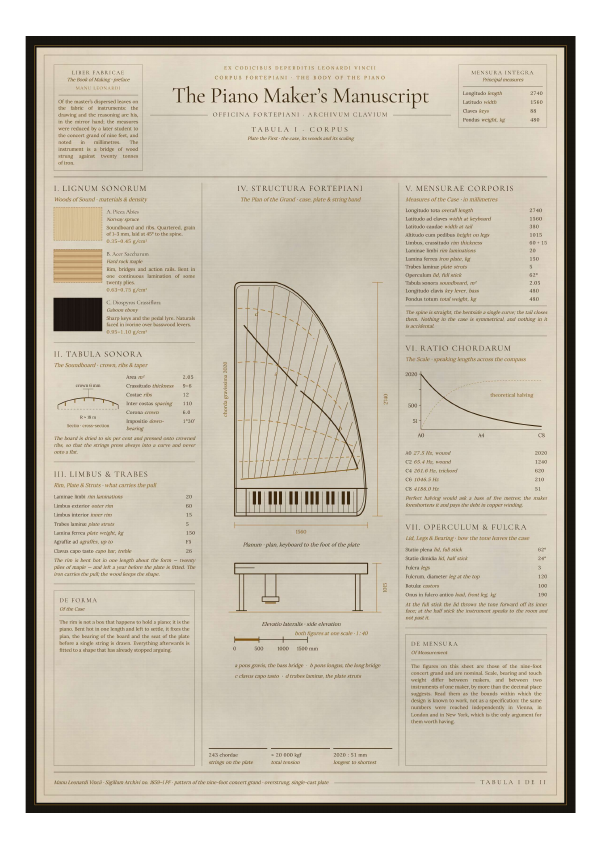
A two-plate technical dossier on the grand piano in the style of a maker's workshop manuscript — the case and scaling on Plate One, the action, touch and pedals on Plate Two.
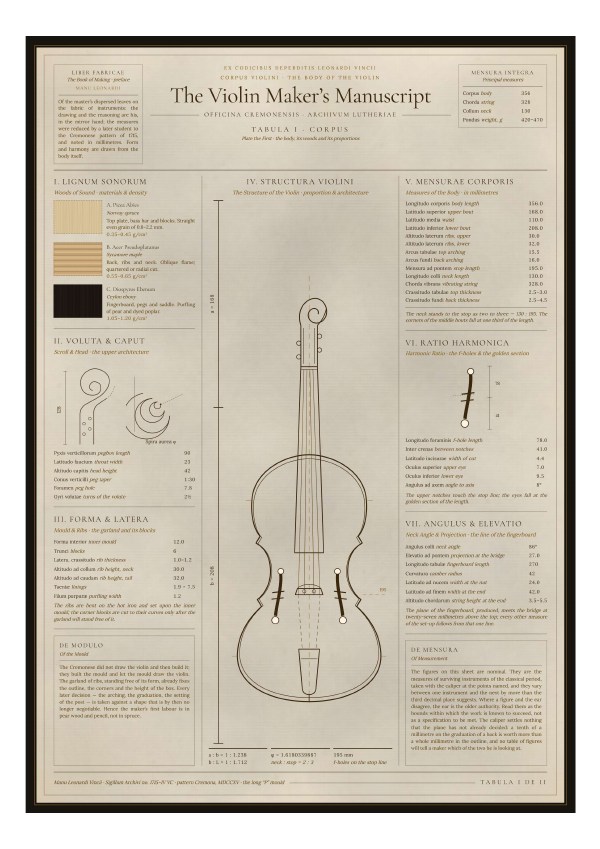
A two-plate technical dossier on the violin in the style of a luthier's workshop manuscript — body proportions and woods on Plate One, resonance, bridge, strings and the bow on Plate Two.
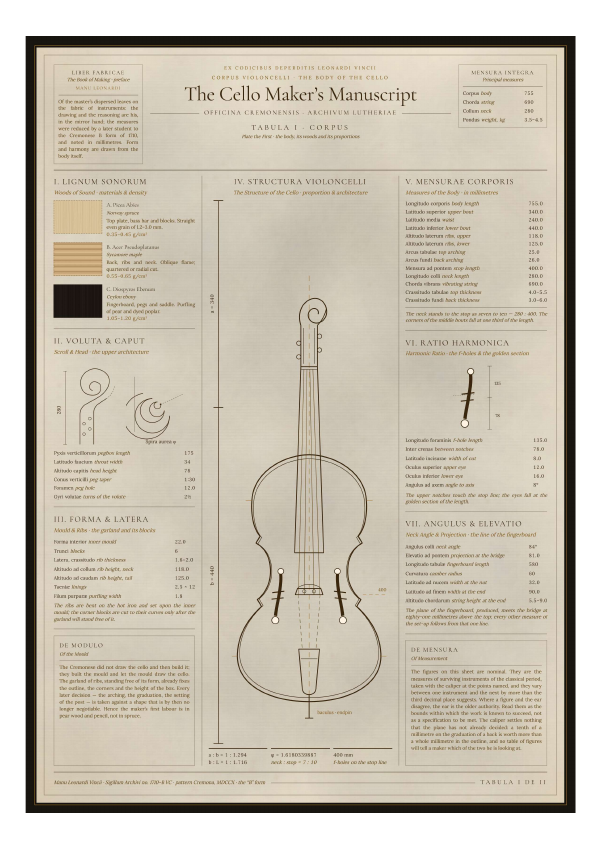
A two-plate technical dossier on the cello in the style of a luthier's workshop manuscript — body proportions and woods on Plate One, resonance, bridge, strings and the bow on Plate Two.
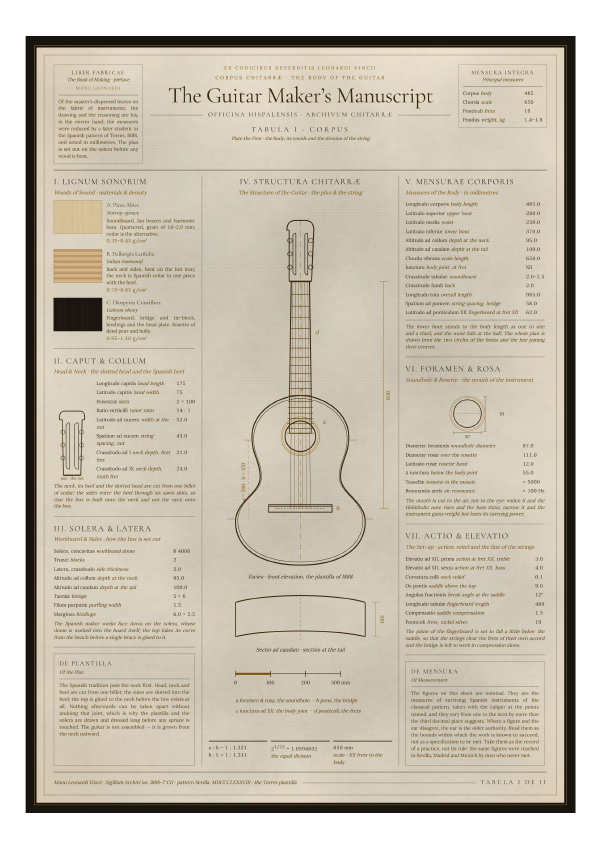
A two-plate technical dossier on the classical guitar in the style of a luthier's workshop manuscript — body plan and woods on Plate One, resonance, bracing and strings on Plate Two.
Looking for real, printable reference sheets instead? Head to Printables.