Play Together
Chamber music, ensembles and orchestras — how to join a group, read a part, run a rehearsal, and everything else that changes the moment you're not playing alone any more. A whole shelf of charts and packs on this site covers it in detail; here's the overview.
What the words mean
Chamber music, ensemble, orchestra — untangled.
The three words get used loosely. A reference chart lays out the one real test — players per line — and where a chamber orchestra sits across both words at once. A second chart does the same job for concert band, brass band and orchestra: line-up, size, clefs, and who shares a part.
- The test that decides it: count the players on a line — one each is chamber music, more is an ensemble or orchestra.
- Sizes named: duo up to nonet for chamber groups, standard line-ups for concert and brass band.
- Writing for each: exposed lines in chamber music, against sections and doubling in orchestral and band writing.
Chamber music
Playing with a few other people, and no conductor.
Two packs take you from finding a group to preparing a performance. Pack One covers which groups exist, reading from a part, starting and ending together, running a rehearsal, and balance and tuning. Pack Two goes further — the score behind your part, the four textures, matching phrasing, and six weeks to a concert. The wall chart puts the rehearsal-room essentials on one page for the stand.
- No conductor, so everybody is one. Tempo, dynamics and when to start are agreed between the players, not handed down.
- One player to a part. A mistake has nowhere to hide — which is exactly what sharpens rhythm and listening.
- The four textures: melody and accompaniment, dialogue, homophony, and counterpoint — name the texture and you know your job.
In a large group
Sections, seating, and who's in charge.
Who's Who in an Orchestra traces the chain of responsibility from the conductor through the concertmaster to section principals. What Conductors Actually Do and a wall chart of the six beat patterns explain the gestures themselves. Round that out with seating the orchestra, tuning an ensemble in order, the marks a string section reads together, and a wall chart tracking the orchestra's growth from a 20-player Baroque band to a 100-player Late Romantic one.
- A decision travels: conductor → concertmaster → section principal → section — the same chain, small orchestra or large.
- Six shapes, every time signature. The conducting pattern shows preparation, ictus and rebound, whatever the beat count.
- Bowed alike, tuned together. A string section's colour instructions and a six-step tuning order keep sixteen players sounding like one.
Around the rehearsal
The room, the words, and what to listen for.
A chart of rehearsal-room etiquette covers what's expected before, during and while playing in a section, plus the shorthand you'll hear used to run it — "from the top", "take it down", "sub-divide". A listening list pairs twenty-four chamber and orchestral works with one specific thing to listen for in each, to work through alongside the Listening Log.
- Ask, don't tell. Rehearsal language that gets a better result, faster.
- Twenty-four works, three steps each. Once for shape, once for texture, once for a detail worth stealing.
- Words worth knowing: tacet, D.C. al Fine, divisi, attacca — shorthand every part assumes you already read.
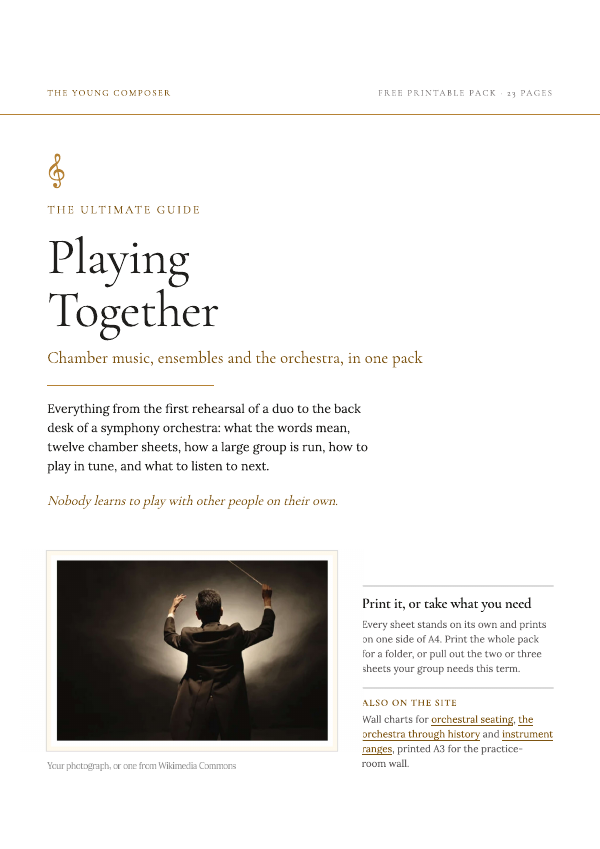
The Ultimate Guide to Playing Together
A 23-page, four-part course in one pack — what the words mean, chamber music in twelve sheets, playing in a large group, and getting the most from rehearsal — for anyone moving from playing alone to playing with others.
- Part One: What the Words Mean — chamber music, ensemble and orchestra distinguished; concert band and brass band compared
- Part Two: Chamber Music in Twelve Sheets — finding a group, reading a part, starting and ending together, running a rehearsal, balance and blend, a first-rehearsal checklist, score study, four textures, phrasing as one, six weeks to a concert, performing, and a write-your-own rehearsal plan
- Part Three: In a Large Group — who's who in an orchestra, tuning and intonation, bowing/divisi and string marks, what conductors do, and conducting patterns
- Part Four: Around the Rehearsal — ensemble etiquette and rehearsal words, and a chamber and orchestral listening list
New to composing generally? Head to Composing. Want the graded theory lessons instead? Try Music Theory.