How to Practise
Twenty focused minutes beats ninety unfocused ones. A session mapped by the minute, six ways to unstick a hard passage, and the habits that make a fix actually stick.
“Playing a piece through from the top is not practice — it is a performance you are giving to nobody.”
Practice means finding the smallest thing that is wrong and fixing only that. Half an hour done this way beats two hours of running the piece.
A thirty-minute session
Most of the time goes to the few bars that don't work. Scale the blocks, not the order — an hour is the same shape doubled; ten minutes is a warm up, one passage, and a note to yourself.
Six ways to fix a passage
Slow it down
Halve the tempo. If you can't play it perfectly, halve again.
Use it when: anything — the first thing to try, and usually the last thing needed.
Shrink the unit
Two notes, then three, then the beat, then the bar.
Use it when: one spot collapses every time you reach it.
Hands apart
Each hand alone until it's automatic, then together slowly.
Use it when: the hands work separately but not at the same time.
Rhythm swap
Play the run long-short, then short-long, then even.
Use it when: fast even passages come out lumpy.
Backwards chaining
Learn the last bar, then add the bar before it, and so on.
Use it when: the end of a piece is always weaker than the start.
Away from the instrument
Read the passage and hear it; finger it silently.
Use it when: you're tired, or you keep repeating the same mistake.
The loop that makes it stick
Name the problem in words — not "bar 12 is bad" but "the third finger is late".
Choose one method from the table above. One, not three.
Play it correctly five times in a row. A mistake resets the count to zero.
Put it back in context — one bar before, one bar after.
Write down what you fixed. Tomorrow starts here, not at the beginning.
Metronome, honestly
Set it to the speed of your worst bar, not your best. If the passage is right at 60 and wrong at 72, work at 63.
Play with it, then without it, then with it again to check you haven't drifted. Never leave it on for a whole session — it teaches obedience, not time.
For rubato passages, use it to learn the notes, then switch it off entirely and let the phrase breathe. Try it with the site's own Metronome.
Practising as a composer
Same principle, different material: fifteen minutes of writing every day, one exercise with a limit — eight bars, one motif, three chords. Copy out a page of a score you admire by hand. Finish things badly rather than starting things well.
Signs you're wasting time
You start at bar 1 every session. You stop to correct a mistake and immediately play on. You can't say what you improved today. Your hands hurt. Any of these means stop, take a break, and change method.
Three more things that matter
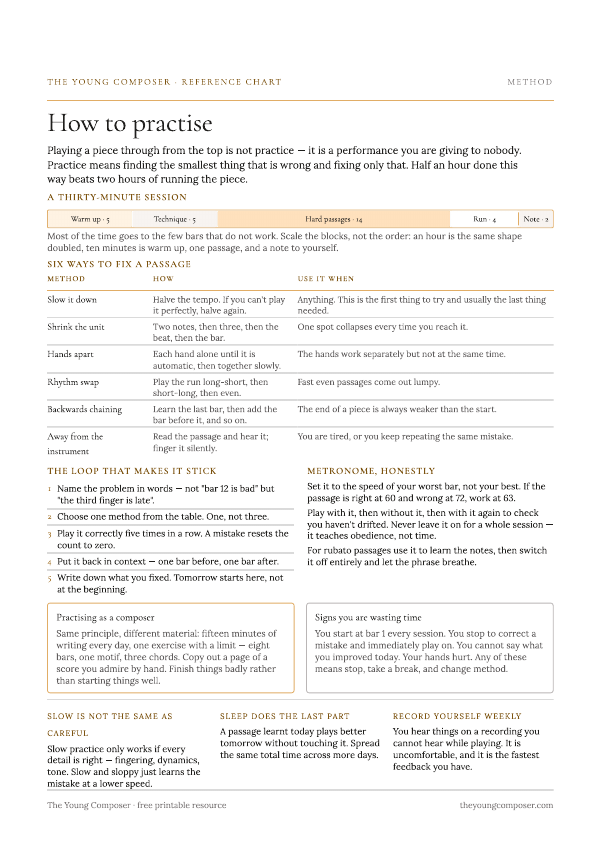
How to Practise
A thirty-minute practice session mapped out by minutes, six ways to fix a passage, the loop that makes a fix stick, and honest use of a metronome.
Print This Week's Practice alongside it to log the loop as you go.
There is no shortcut to twenty focused minutes. But twenty focused minutes, most days, is most of the secret.
Practice isn't about talent. It's about knowing exactly what you're fixing.Want the why behind it? Why covers what keeps you motivated. Writing your own music? Composing has your first tips. For everything else, there's Printables.