Why We Play
What learning an instrument actually gives you, and what keeps you going when it's hard.
Nobody learns an instrument because it is easy. You do it because of what it turns you into — and because of the room full of people you end up playing with.
Six things it builds
Focus
Twenty minutes of real attention on one bar. Very little else asks this of you, and the habit does not stay in the practice room.
Patience
Progress in music is measured in weeks, not minutes. Learning to keep working at something that is not yet good is the most transferable skill an instrument teaches.
Confidence
You walked on, you were nervous, you played anyway. Do that four or five times and something changes permanently in how you handle being watched.
Listening
Real listening: is that in tune, is that too loud, is that the same length as hers. Musicians notice detail in sound the way an artist notices colour.
Belonging
An instrument is a passport into rooms full of people who care about the same odd thing you do. Some of them will be your friends for thirty years.
A voice
Feelings that will not go into words go into sound instead. This is the reason underneath all the other reasons, and the one nobody can grade.
What playing with others adds
- No conductor
- Nobody waves a stick at you. You breathe together, catch each other's eye, and lead with a lift of the instrument.
- One to a part
- Nowhere to hide — the fastest way there is to become accurate and independent.
- Shared leading
- You lead for eight bars, then you follow. A life skill dressed up as a rehearsal.
- Voices that fit
- Hearing your line sit inside three others teaches phrasing faster than any book.
What carries beyond music
- Memory and pattern
- Reading two staves while both hands do different things is heavy mental lifting, repeated daily.
- Planning
- A piece learnt by a date in eight weeks is a project. You break it up, schedule it, and deliver it.
- Coping with nerves
- A skill you can practise, and one most adults never get taught.
- Being taught
- Weekly, honest, specific feedback — and turning it into action by next Tuesday.
“You have your own part. There is nowhere to hide — and that is exactly why it makes you good.”
Learning an instrument is, for most of the week, a solitary business: you and a room and a hard bar. Playing with other people gives all those hours somewhere to go.
When the road feels long
Eight things that work — on the day practice feels like a chore, or the piece won't come together, or you can't remember why you started.
Progress is not a straight line
The flat stretches are not failure — they are where the last jump is being consolidated. Nobody improves smoothly, and nobody is told that in advance.
Wherever you live
Distance is an obstacle, not a verdict on your playing. Online lessons, a youth orchestra audition, a holiday academy, a chamber weekend in the nearest town — pick one a year and travel for it. The players you meet become the reason you practise at home.
Why We Play
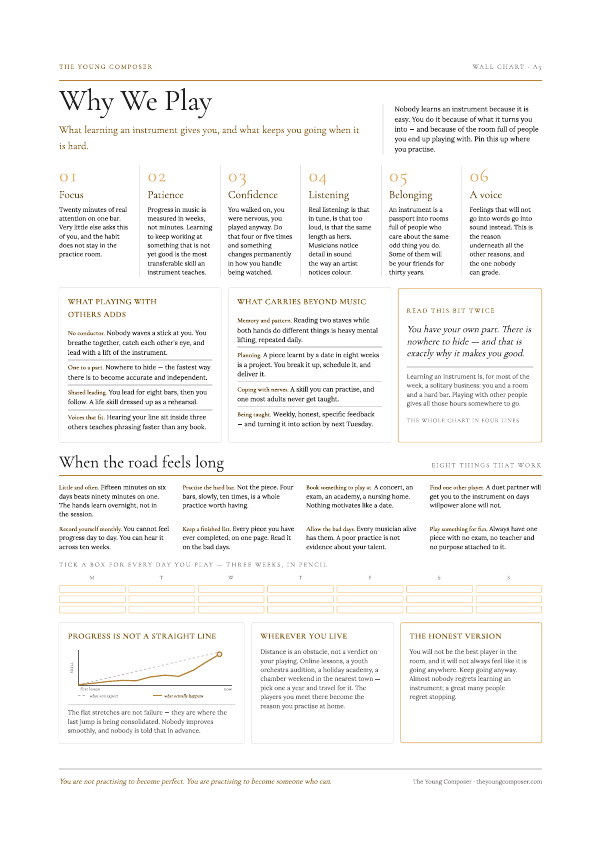
A wall chart on what learning an instrument actually gives you and what keeps you going when it's hard — six things it builds, what playing with others adds, and eight things that work when the road feels long, with a three-week tick chart.
You will not be the best player in the room, and it will not always feel like it is going anywhere. Keep going anyway. Almost nobody regrets learning an instrument; a great many people regret stopping.
You are not practising to become perfect. You are practising to become someone who can.Want the method, not just the motivation? Practise covers how to run a session. Ready to start? Composing has your first tips and pieces. Playing with others? Play Together covers joining a group. For everything else, there's Printables.