Modern · 1900–2000
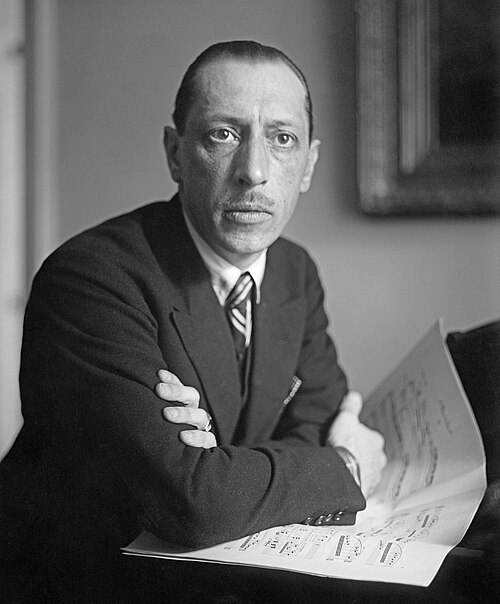
Igor Stravinsky
“The Shape-Shifter”
The Russian whose Rite of Spring caused a riot in Paris — then kept reinventing music for six more decades.
The Modern era (1900–2000): Rules are broken — new scales, wild rhythms and sounds nobody had ever imagined.
Amazing facts
- The 1913 premiere of The Rite of Spring caused a near-riot in Paris: the audience shouted, whistled and scuffled so loudly the dancers couldn't hear the orchestra.
- He became famous overnight at 28 when The Firebird premiered with the Ballets Russes in Paris.
- He reinvented himself constantly — Russian folk fireworks, cool 'neoclassical' elegance, and even twelve-tone music in his 70s.
- He lived in Russia, Switzerland, France and finally America — Los Angeles, where his neighbours included film stars and fellow exiles.
- His life stretched from tsarist Russia to the jet age: born before the light bulb was common, he watched the Moon landing on TV.
- He was a meticulous craftsman who composed at the piano daily, saying: 'I can only breathe when I am composing.'
A few pieces to start with
The Firebird
1910
Ballet
A Russian fairy tale of a magical glowing bird and an evil sorcerer — the ballet that made Stravinsky famous overnight, ending in a blazing hymn of victory.
The Rite of Spring
1913
Ballet
Pounding, off-balance rhythms depicting an ancient spring ritual — it caused a riot in 1913 and changed music forever.
Petrushka
1911
Ballet
The tale of a sad puppet who comes to life at a Russian fair — full of hurdy-gurdies, dancing bears and carnival crowds.
Life & times — what was happening in the world
1882Born near St Petersburg; his father is a star opera singer.
1902Becomes a private student of the great Rimsky-Korsakov while studying law.
1903The Wright brothers fly; Marie Curie wins her first Nobel Prize.
1910The Firebird premieres in Paris — overnight fame at 28.
1913The Rite of Spring premieres in Paris and the audience riots — modern music's most famous scandal.
1914World War I begins — Stravinsky is stranded in Switzerland.
1917The Russian Revolution cuts Stravinsky off from his homeland.
1920Exiled by war and revolution, settles in France and 'reinvents' the past with neoclassical works like Pulcinella.
1927The first 'talkie' film — and Lindbergh flies solo across the Atlantic.
1939Emigrates to the USA as World War II begins; settles in Los Angeles.
1945World War II ends; the atomic age begins.
1962Returns to Russia for the first time in nearly 50 years, welcomed as a legend.
1969Apollo 11 lands on the Moon — and 87-year-old Stravinsky is watching.
1971Dies in New York aged 88; buried in Venice near his great collaborator Diaghilev.