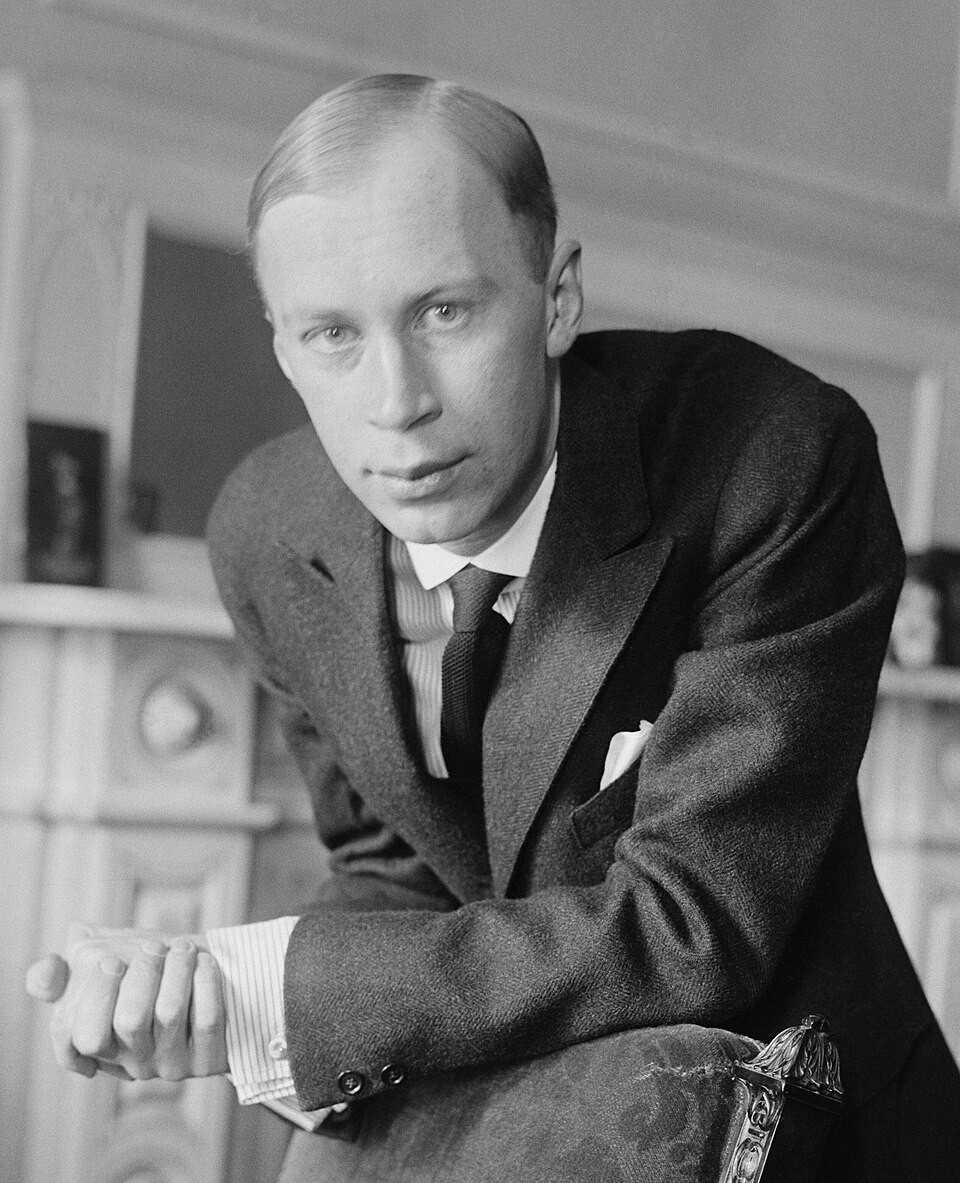
Modern · 1900–2000
Sergei Prokofiev
“The Musical Storyteller”
The mischievous Russian genius who taught the whole world the instruments of the orchestra — through a wolf, a duck, and a boy named Peter.
The Modern era (1900–2000): Rules are broken — new scales, wild rhythms and sounds nobody had ever imagined.
Amazing facts
- In 'Peter and the Wolf', he gives every character its own instrument — the bird a flute, the duck an oboe, the wolf three horns — teaching millions of children how an orchestra works.
- As a boy he was a chess fanatic, and once played a game against the reigning world champion.
- As a young man he was famous as a daring rebel whose spiky, modern music startled audiences — a real 'enfant terrible'.
- He left Russia after the revolution, lived in America and Paris, then made the risky choice to return home to the Soviet Union.
- He wrote the thundering 'Dance of the Knights' from Romeo and Juliet — heard today at football grounds and on talent shows.
- By an eerie coincidence he died on the very same day as the Soviet dictator Stalin, so his death went almost unnoticed at the time.
A few pieces to start with
Peter and the Wolf
1936
Musical tale
A story for narrator and orchestra where each character is a different instrument — the most beloved way ever invented to meet the orchestra.
Romeo and Juliet
1935
Ballet
Shakespeare's tragedy in dance, containing the crushing, iron-heavy 'Dance of the Knights' — one of the most recognisable tunes in all music.
Symphony No. 1 'Classical'
1917
Symphony
A witty, sparkling symphony imagining how Haydn might have written if he'd lived in Prokofiev's own day.
Life & times — what was happening in the world
1891Born in Sontsovka, in what is now Ukraine.
1904Enters the St Petersburg Conservatory as a boy prodigy.
1914The First World War begins.
1917The Russian Revolution overturns the old order.
1918Leaves Russia after the revolution for America, and later Paris.
1936Returns to the Soviet Union and writes Peter and the Wolf.
1939The Second World War begins.
1944Composes his triumphant Fifth Symphony as the war turns.
1945The Second World War ends.
1953Dies in Moscow on the same day as Stalin.