Renaissance · 1400–1600
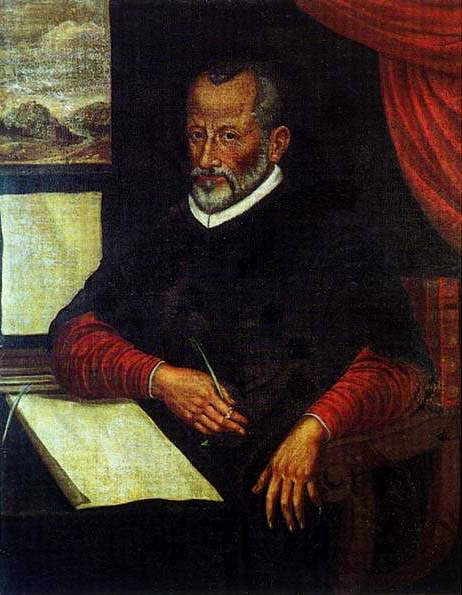
Giovanni Pierluigi da Palestrina
“The Prince of Music”
The choirmaster of Rome whose serene, floating voices are said to have saved church music itself.
The Renaissance era (1400–1600): Voices weave together like golden threads — the age of grand cathedral choirs, madrigals, and the very first printed music.
Amazing facts
- He's named after his hometown — a little hill town near Rome. His real name was Giovanni Pierluigi.
- Legend says that when church leaders at the Council of Trent wanted to ban complicated choir music, his Missa Papae Marcelli was so clear and beautiful it changed their minds.
- He was buried in St Peter's Basilica in a coffin engraved 'Musicae Princeps' — 'Prince of Music'.
- He wrote 104 masses and over 300 motets — nearly all for unaccompanied voices.
- After losing his wife to the plague, he nearly became a priest — then instead married a wealthy widow who owned a fur business, ran the business successfully, and kept composing masterpieces.
- Music students today still learn counterpoint by 'writing like Palestrina' — his style is literally the textbook.
A few pieces to start with
Missa Papae Marcelli
1562
Mass
The mass that (legend says) saved choir music — six voices weaving together so clearly that every sacred word shines through.
Sicut cervus
1584
Motet
'As the deer longs for streams of water…' — perhaps the most loved Renaissance motet of all, calm as still water.
Song of Songs motets
1584
Motet cycle
Twenty-nine motets on poetry from the Song of Songs — some of the warmest, most glowing music of the whole Renaissance.
Life & times — what was happening in the world
1525Born in the hill town of Palestrina, near Rome.
1537A choirboy in Rome, soaking up the sound of the great basilicas.
1543Copernicus publishes his sun-centred model of the universe.
1545The Council of Trent begins reforming the Catholic Church — including its music.
1551The Pope appoints him director of the Cappella Giulia at St Peter's Basilica.
1555Briefly joins the Sistine Chapel choir — until a new pope enforces the no-married-singers rule and dismisses him (with a pension).
1563The Council of Trent debates banning polyphony; legend credits his Missa Papae Marcelli with saving it.
1564Shakespeare and Galileo are born; Michelangelo dies — all within months.
1571Returns in triumph as director of music at St Peter's.
1581After plague takes his wife and sons, he marries a fur merchant's widow — and runs the business while composing.
1588England's navy defeats the Spanish Armada.
1590Shakespeare's first plays appear on London stages.
1594Dies in Rome; buried in St Peter's as the 'Prince of Music'.