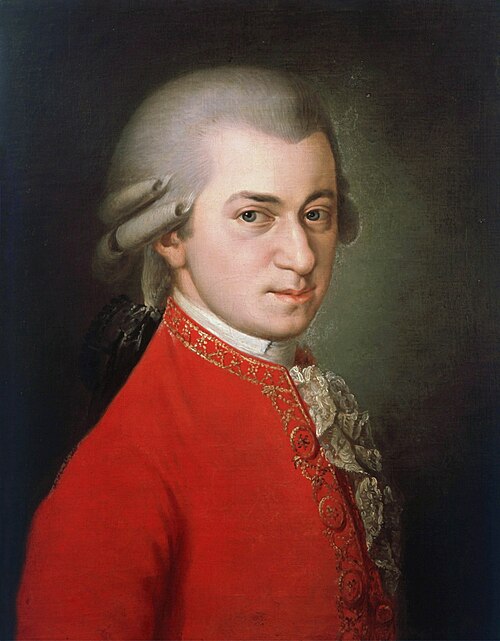
Classical · 1750–1820
Wolfgang Amadeus Mozart
“The Wonder Child”
History's most famous child prodigy — touring Europe's palaces at six, writing perfect music until his mysterious early death at 35.
The Classical era (1750–1820): Elegance, balance and clear melodies — the age of the symphony, sonata and string quartet.
Amazing facts
- He was composing by five and touring the royal courts of Europe by six, playing blindfolded party tricks on the harpsichord.
- At 14, he heard Allegri's closely guarded Miserere once in the Sistine Chapel — then wrote the whole thing out from memory.
- He could compose entire pieces in his head. Manuscripts show whole movements written down with barely a correction.
- He wrote over 600 works in his 35 years: 41 symphonies, 27 piano concertos, and operas like The Magic Flute and The Marriage of Figaro.
- He loved jokes, billiards, and his pet starling — which could sing the theme of his Piano Concerto No. 17 (Mozart bought it on the spot).
- He died at 35 while writing a Requiem (a mass for the dead) commissioned by a mysterious stranger — fuelling legends ever since.
A few pieces to start with
Eine kleine Nachtmusik
1787
Serenade for strings
'A Little Night Music' — the world's most famous serenade, written for evening entertainment. Its bold opening fanfare is instantly recognisable.
The Magic Flute
1791
Opera
A fairy-tale opera with a bird-catcher, a Queen of the Night who sings impossibly high notes, and a magic flute that charms wild beasts.
Requiem in D minor
1791
Choral
His final work, commissioned by a mysterious masked messenger and left unfinished at his death — completed by his student Süssmayr.
Life & times — what was happening in the world
1756Born in Salzburg; his father Leopold, a famous violin teacher, soon realises he has a prodigy on his hands.
1762Begins touring Europe's courts with his talented sister Nannerl, astonishing kings and empresses.
1770In Rome, aged 14, writes out Allegri's secret Miserere from memory after one hearing.
1770Captain Cook charts the east coast of Australia; Beethoven is born in Bonn.
1776America declares independence from Britain.
1781Quits his job with the Archbishop of Salzburg (dismissed 'with a kick') and moves to Vienna as a freelance musician — a daring move for the time.
1782Marries Constanze Weber against his father's wishes.
1783First manned hot-air balloon flight — Mozart's Vienna is abuzz with 'balloon fever'.
1786The Marriage of Figaro premieres in Vienna.
1787Don Giovanni premieres in Prague; his father Leopold dies.
1788The First Fleet lands at Sydney Cove, beginning European settlement of Australia.
1789The French Revolution begins — the world Mozart wrote operas about is being turned upside down.
1791The Magic Flute is a smash hit; months later Mozart dies at 35, leaving his Requiem unfinished.