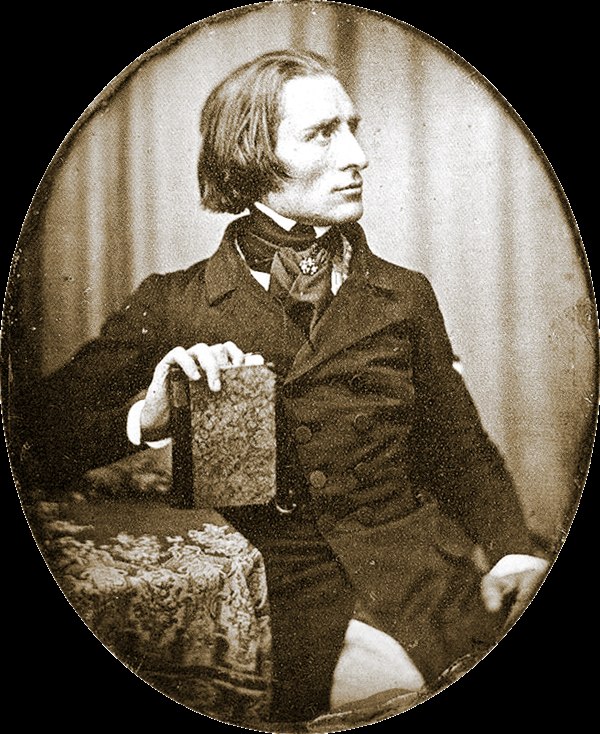
Romantic · 1820–1900
Franz Liszt
“The Rock Star of the Piano”
The greatest pianist of his age — a showman who sent audiences into a frenzy, then gave it all up to write strange, visionary new music.
The Romantic era (1820–1900): Big emotions, bigger orchestras — music about love, nature, nations and stormy hearts.
Amazing facts
- His playing drove audiences so wild that a writer coined the word 'Lisztomania' — fans fought over his broken piano strings and discarded gloves.
- He more or less invented the modern piano recital: one soloist, playing a whole concert alone and from memory, was his radical idea.
- His technique was so monstrous that composers wrote fiendishly difficult music just to see if he could play it. He always could.
- He gave away much of his fortune — to charity, to disaster victims and to young musicians — and taught hundreds of students for free.
- He invented the 'symphonic poem', a single sweep of orchestral music that tells a story or paints a scene.
- Late in life he took holy orders and became known as the 'Abbé Liszt', writing spare, eerie music that pointed far into the future.
A few pieces to start with
Hungarian Rhapsody No. 2
1847
Piano
A wild, virtuosic gypsy-style dance that starts brooding and ends in a headlong gallop — so famous it has starred in countless cartoons.
Piano Sonata in B minor
1853
Piano
A single huge movement of some thirty minutes — one of the mightiest and most daring works ever written for the piano.
Les Préludes
1854
Symphonic poem
The most famous of the 'symphonic poems' Liszt invented — one continuous orchestral movement painting the journey of a life.
Life & times — what was happening in the world
1811Born in Raiding, in the Kingdom of Hungary.
1824Dazzles Paris and London as a touring child prodigy.
1830Revolution in Paris topples one king for another.
1839Begins the years of touring that trigger 'Lisztomania' across Europe.
1848Settles in Weimar to conduct and champion bold new music, including Wagner's.
1848A wave of revolutions sweeps across Europe.
1859Charles Darwin publishes On the Origin of Species.
1865Takes minor holy orders in Rome, becoming the 'Abbé Liszt'.
1876Wagner opens his first festival at Bayreuth; the telephone is invented.
1886Dies in Bayreuth, the festival town of his son-in-law Wagner.