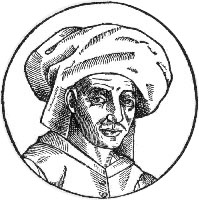
Renaissance · 1400–1600
Josquin des Prez
“The Master of the Notes”
Europe's first musical superstar — kings and dukes competed to hire him, and his songs were among the first music ever printed.
The Renaissance era (1400–1600): Voices weave together like golden threads — the age of grand cathedral choirs, madrigals, and the very first printed music.
Amazing facts
- Martin Luther said of him: 'He is the master of the notes — they must do as he wills; other composers must do as the notes will.'
- In 1502 the Venetian printer Petrucci devoted a whole printed book to Josquin's masses — the first time any composer got a book of their own. It sold so well that publishers started forging his name on other people's music!
- A carving reading 'JOSQUINJ' was found scratched into the wall of the Sistine Chapel's choir gallery — very possibly graffiti by the man himself, from his years singing there.
- A duke's talent scout warned against hiring him: 'Josquin composes when he wants to, not when you want him to — and he demands twice the salary.' The duke hired him anyway.
- He wrote a joke song about a cricket, 'El Grillo' — complete with chirping repeated notes. Choirs still love it 500 years later.
- He left money so that after his death, singers would stop outside his old house during processions and sing his motet for him.
A few pieces to start with
El Grillo
1500
Part song
'The Cricket is a good singer!' — a musical joke where the voices chirp, hop and buzz like the insect itself. Proof that great composers have always been allowed to be silly.
Ave Maria … virgo serena
1485
Motet
The most famous motet of its age — each voice enters in turn with the same soaring phrase, like ripples spreading across water.
Mille regretz
1520
Chanson
A heartbreakingly tender farewell song. Emperor Charles V loved it so much that it became known simply as 'the Emperor's song'.
Life & times — what was happening in the world
1450Born around this year in the county of Hainaut, in the Burgundian Netherlands.
1453Constantinople falls to the Ottomans; Greek scholars flee west, feeding the Renaissance.
1455Gutenberg finishes printing his famous Bible — the printed word begins to change the world.
1484In service of the mighty Sforza family in Milan — the same court Leonardo da Vinci worked for.
1489Joins the Pope's own choir in Rome, singing in the Sistine Chapel.
1492Columbus reaches the Americas; Lorenzo de' Medici, Florence's great art patron, dies.
1502Petrucci prints a whole book of Josquin's masses in Venice — a first in music history.
1503Becomes the highest-paid musician at the glittering court of Ferrara.
1503Leonardo da Vinci begins painting the Mona Lisa.
1504Leaves Ferrara (wisely — plague strikes soon after) to become provost at Condé-sur-l'Escaut.
1517Martin Luther posts his 95 Theses — the Reformation begins.
1521Dies at Condé, leaving instructions — and money — for singers to remember him in song.