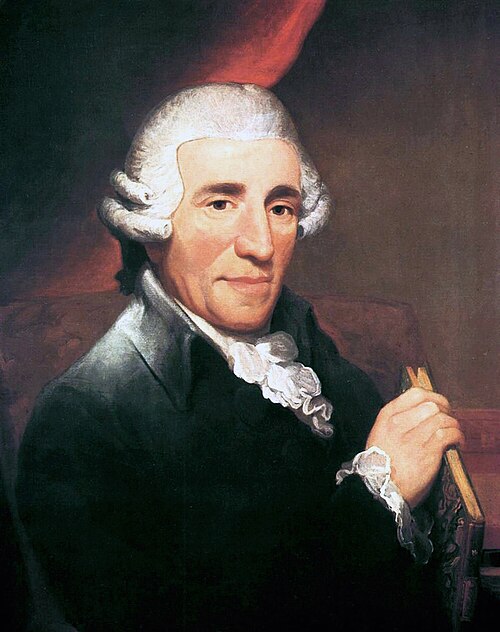
Classical · 1750–1820
Joseph Haydn
“Papa Haydn”
The cheerful 'father of the symphony' who worked for princes, mentored Mozart and taught Beethoven.
The Classical era (1750–1820): Elegance, balance and clear melodies — the age of the symphony, sonata and string quartet.
Amazing facts
- He wrote 104 numbered symphonies and 68 string quartets — more than almost anyone — and basically invented the shape both forms still use.
- His 'Surprise' Symphony contains a sudden fortissimo crash in a quiet melody — supposedly to jolt sleepy audience members awake.
- In his 'Farewell' Symphony, players snuff out their candles and leave the stage one by one — a musical hint to his prince that the orchestra needed a holiday. It worked!
- He spent nearly 30 years as court composer for the fabulously wealthy Esterházy princes, in a palace with its own opera house.
- Musicians called him 'Papa Haydn' because he looked after his orchestra like family. He and Mozart were genuine friends who played quartets together.
- As a choirboy he was expelled from St Stephen's Cathedral after snipping off another chorister's ponytail.
A few pieces to start with
Symphony No. 94 — 'Surprise'
1791
Symphony
A gentle, tiptoeing melody… then BANG! — a full-orchestra crash. Haydn's joke has made audiences jump for over 200 years.
The Creation
1798
Oratorio
An oratorio depicting the creation of the world, opening with a famous 'Representation of Chaos' that explodes into a blazing C major on the words 'and there was LIGHT'.
'Emperor' Quartet
1797
String quartet
Its slow movement melody, written as an anthem for the Austrian emperor, is now the tune of the German national anthem.
Life & times — what was happening in the world
1732Born in Rohrau, Austria, son of a wheelwright who loved folk songs.
1740Becomes a choirboy at St Stephen's Cathedral in Vienna.
1752Britain switches to the Gregorian calendar — 11 days vanish overnight.
1761Hired by the Esterházy princes — beginning nearly 30 years of composing in their grand palaces.
1776The American Declaration of Independence is signed.
1781Meets Mozart in Vienna; they become friends and admirers of each other's music.
1783The Montgolfier brothers launch the first hot-air balloon flights in Paris.
1789The French Revolution begins with the storming of the Bastille.
1791First triumphant trip to London — writes his 'London' symphonies for adoring English crowds.
1792Takes on a promising, stubborn student from Bonn named Ludwig van Beethoven.
1798Premieres his great oratorio The Creation.
1804Napoleon crowns himself Emperor of France.
1809Dies in Vienna while Napoleon's army occupies the city — Napoleon posts an honour guard at his door.