Modern · 1900–2000
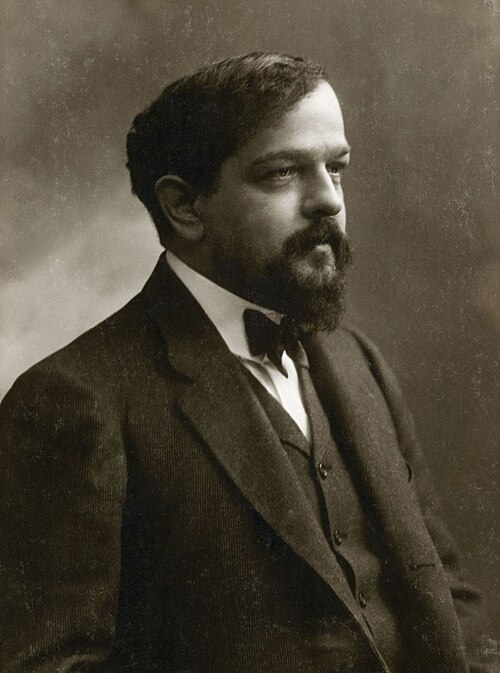
Claude Debussy
“The Painter of Sound”
The French rebel who painted with sound — moonlight, sunken cathedrals and the sea — and opened the door to modern music.
The Modern era (1900–2000): Rules are broken — new scales, wild rhythms and sounds nobody had ever imagined.
Amazing facts
- Critics called his music 'Impressionism', borrowing the label from painters like Monet. Debussy hated the term — but it stuck.
- At the 1889 Paris World's Fair (under the brand-new Eiffel Tower) he heard a Javanese gamelan orchestra — its shimmering bells changed his sound forever.
- He broke the classroom rules of harmony on purpose. When a professor demanded to know what rules he followed, he replied: 'My pleasure!'
- Clair de Lune means 'moonlight' — he named it after a poem by Paul Verlaine.
- His piano piece 'The Sunken Cathedral' makes the piano toll like underwater bells; 'La Mer' paints the sea in three orchestral movements.
- He composed 'Golliwogg's Cakewalk' and the Children's Corner suite for his adored little daughter, nicknamed Chouchou.
A few pieces to start with
Clair de Lune
1905
Piano
'Moonlight' — perhaps the most loved piano piece ever written, floating and weightless, named after a Verlaine poem.
La Mer
1905
Orchestral
'The Sea' in three movements — dawn to noon on the waves, the play of the waves, and the wind's dialogue with the sea.
Prélude à l'après-midi d'un faune
1894
Orchestral
A dreamy flute melody drifts in like an afternoon haze — the piece many say opened the door to twentieth-century music.
Life & times — what was happening in the world
1862Born near Paris above his parents' china shop.
1872Enters the Paris Conservatoire aged 10 — and soon starts questioning every rule.
1884Wins the Prix de Rome, France's top composition prize.
1889Hears Javanese gamelan music at the Paris World's Fair — a revelation.
1889The Eiffel Tower opens for the Paris World's Fair — where Debussy hears the gamelan.
1894Prélude à l'après-midi d'un faune premieres — many say modern music begins with its first flute notes.
1895The Lumière brothers hold the first public cinema screening, in Paris.
1902His dreamlike opera Pelléas et Mélisande divides Paris and makes him famous.
1903The Wright brothers achieve the first powered flight.
1905Completes La Mer, his orchestral portrait of the sea.
1905Einstein publishes his theory of special relativity.
1914World War I begins, shattering the Belle Époque world of Debussy's Paris.
1918Dies in Paris while German shells fall on the city in the last year of World War I.