Romantic · 1820–1900
Frédéric Chopin
“The Poet of the Piano”
Poland's national composer, who poured his homesick heart into the piano — and wrote almost nothing else.
The Romantic era (1820–1900): Big emotions, bigger orchestras — music about love, nature, nations and stormy hearts.
Amazing facts
- Nearly everything he wrote is for solo piano — nocturnes, waltzes, mazurkas, polonaises, études — and pianists have adored them ever since.
- He left Poland at 20, just before an uprising against Russian rule; he never returned, and his music aches with longing for home.
- Friends gave him a silver cup of Polish soil when he left. It was sprinkled on his grave in Paris — and his heart was smuggled back to Warsaw in a jar, where it rests in a church pillar today.
- He hated giving big public concerts (he gave only about 30 in his life), preferring candlelit salons for friends.
- His études turned finger exercises into breathtaking art — the 'Revolutionary' étude storms like the fall of Warsaw.
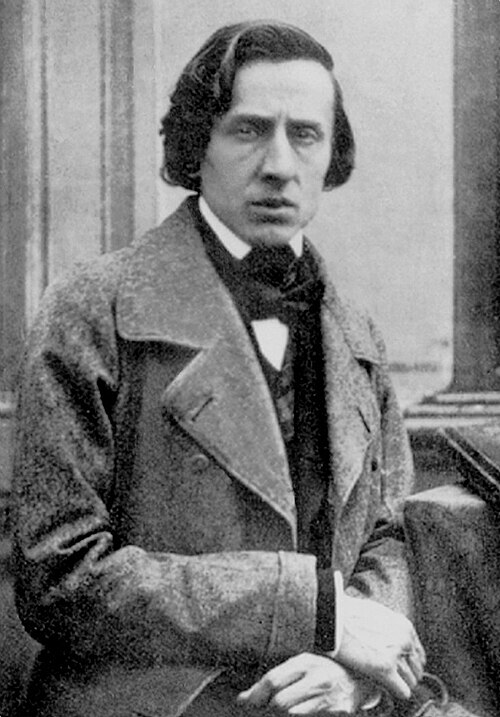
- One of the rare photographs of any great composer shows Chopin in 1849 — a haunting image taken in the last year of his life.
A few pieces to start with
Nocturne in E-flat, Op. 9 No. 2
1832
Piano nocturne
A 'night piece' — the piano sings like an opera star over a gently rocking accompaniment. Probably the most famous nocturne ever written.
'Revolutionary' Étude
1831
Piano étude
Legend says he wrote it on hearing that Warsaw had fallen to Russian armies — the left hand rages up and down the keyboard like a storm.
'Heroic' Polonaise
1842
Piano polonaise
A proud Polish dance turned into a thundering declaration of national spirit — Poland's unofficial second anthem.
Life & times — what was happening in the world
1810Born near Warsaw to a French father and Polish mother; a piano prodigy compared to young Mozart.
1817His first published composition appears — aged seven.
1830Leaves Poland to seek his fortune, weeks before the November Uprising against Russia breaks out.
1830Revolutions sweep Europe: Paris rises in July, Warsaw in November — Chopin is caught between both.
1831Settles in Paris, joining a dazzling circle of artists — Liszt, Berlioz, Delacroix, Hugo.
1837Victoria becomes Queen of Britain; Samuel Morse demonstrates the telegraph.
1838Winters on Majorca with the novelist George Sand; ill and rain-soaked, he completes his 24 Preludes.
1839Photography is announced to the world (the daguerreotype) — Chopin will be among the first composers ever photographed.
1840The world's first postage stamp, the Penny Black, is issued in Britain.
1848Gives his last concert, in London, already gravely ill with tuberculosis.
1848The 'Year of Revolutions' convulses Europe; gold is discovered in California.
1849Dies in Paris aged 39; Mozart's Requiem is sung at his funeral, and his heart returns to Warsaw.