Renaissance · 1400–1600
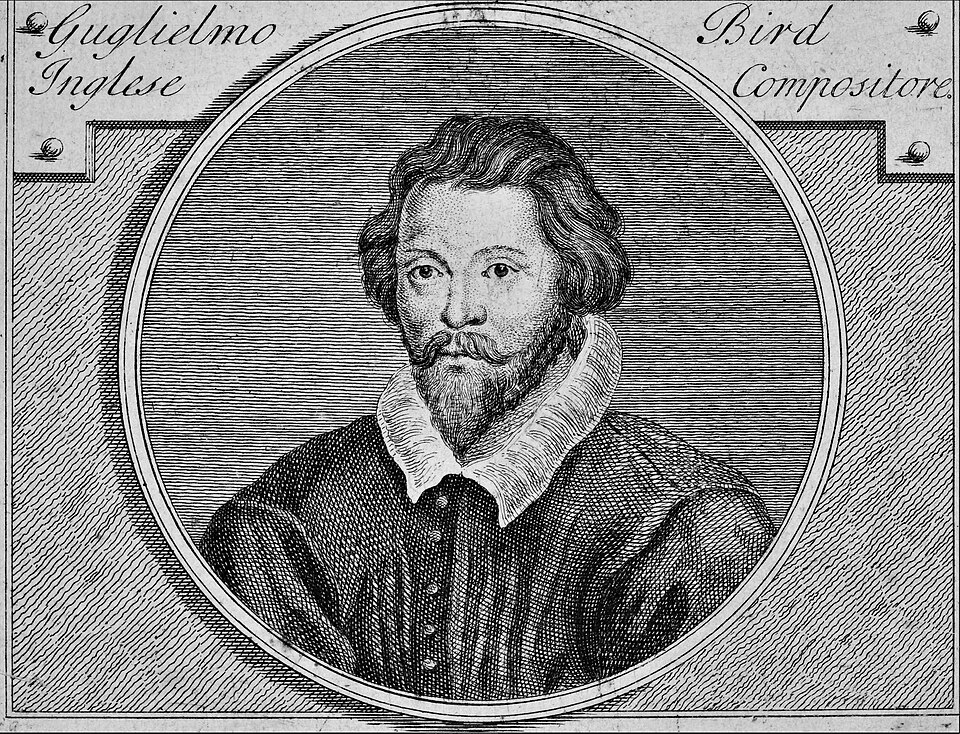
William Byrd
“The Father of British Music”
A devout Catholic who wrote glorious music for a Protestant queen — and became the founding father of English music.
The Renaissance era (1400–1600): Voices weave together like golden threads — the age of grand cathedral choirs, madrigals, and the very first printed music.
Amazing facts
- Queen Elizabeth I gave Byrd and his teacher Thomas Tallis a royal monopoly to print all music in England — the first licence of its kind anywhere.
- He was a Catholic living in Protestant England, and was fined again and again for skipping Anglican church — yet the queen protected her favourite composer.
- He cleverly wrote for both sides: grand English anthems for the royal chapel, and secret Latin Masses that Catholic families could sing quietly at home.
- He was a master of the 'virginals', a small keyboard instrument, and helped invent the very idea of dazzling music written just for keyboard.
- His fellow musicians honoured him with the Latin title 'Britannicae Musicae Parens' — the Father of British Music.
A few pieces to start with
Ave verum corpus
1605
Motet
A short, aching prayer for four voices — gentle clashes between the parts make the harmony seem to sigh. A favourite of choirs everywhere.
Mass for Four Voices
1593
Mass
One of three Masses Byrd printed secretly for Catholic families to sing at home — intimate, heartfelt, and quietly daring in its day.
The Bells
1590
Keyboard (virginals)
A playful keyboard piece built over two notes rung again and again like church bells, with sparkling variations dancing on top.
Life & times — what was happening in the world
1543Born around this year, probably in London (his exact birth year is uncertain).
1558Elizabeth I becomes Queen of England, beginning a golden age of the arts.
1563Becomes organist and choirmaster at Lincoln Cathedral, still only about twenty.
1564William Shakespeare and Galileo are both born.
1572Joins the Chapel Royal in London alongside his old teacher Thomas Tallis.
1575The queen grants Byrd and Tallis the sole right to print music in England.
1588England's navy defeats the mighty Spanish Armada.
1593Moves to the quiet village of Stondon Massey and writes his secret Latin Masses for Catholic worship.
1603Elizabeth I dies; James I unites the crowns of England and Scotland.
1605The Gunpowder Plot to blow up Parliament is discovered.
1623Dies at about eighty, calling himself in his will 'a Father of Musick'.