Romantic · 1820–1900
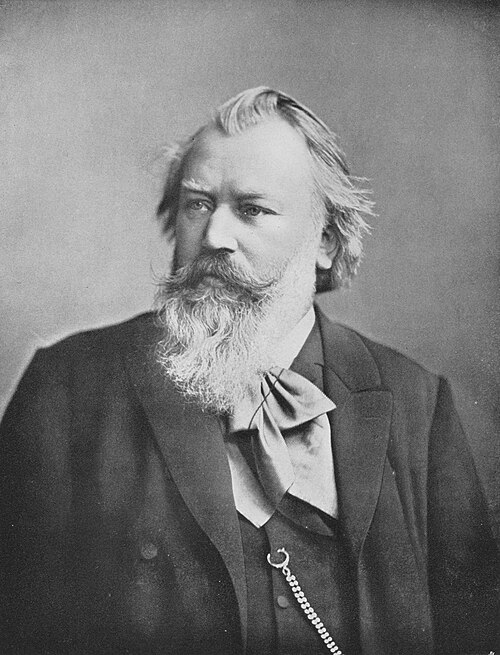
Johannes Brahms
“The Keeper of the Flame”
A gruff perfectionist with a giant beard who carried Beethoven's torch — and wrote the world's most famous lullaby.
The Romantic era (1820–1900): Big emotions, bigger orchestras — music about love, nature, nations and stormy hearts.
Amazing facts
- As a teenager he played piano in the rough dockside taverns of Hamburg to help support his family.
- He was so haunted by Beethoven's shadow that he took 21 years to finish his First Symphony. Critics instantly called it 'Beethoven's Tenth'.
- His famous Lullaby ('Wiegenlied') was a gift for a friend's newborn baby — it may now be the most-sung melody on Earth.
- He was a perfectionist who burned dozens of works he judged not good enough — we'll never know what was lost.
- Gruff on the outside, generous underneath: he quietly sent money to friends and loved children, keeping sweets in his pockets for them.
- He adored strong coffee, hedgehogs (his tavern nickname), and long countryside walks where he composed in his head.
A few pieces to start with
Lullaby (Wiegenlied)
1868
Song
Written for a friend's new baby. Parents have sung it every night since — quite possibly the most-performed melody in the world.
Symphony No. 1
1876
Symphony
Twenty-one years in the making, because 'you have no idea how it feels to hear behind you the tramp of a giant like Beethoven'.
Hungarian Dances
1869
Orchestral / piano duets
Fiery, foot-stomping dances based on Hungarian tunes — his best-selling works by far.
Life & times — what was happening in the world
1833Born in Hamburg to a poor double-bass player; plays in dockside taverns as a boy.
1853Aged 20, knocks on Robert and Clara Schumann's door; Robert hails him in print as music's chosen one.
1859Darwin publishes On the Origin of Species.
1862Moves to Vienna — the city of Haydn, Mozart, Beethoven and Schubert.
1866The transatlantic telegraph cable permanently links Europe and America.
1868A German Requiem premieres, making him famous across Europe; writes the Lullaby the same year.
1871Germany is unified under Kaiser Wilhelm I — Brahms, a proud German, celebrates with a 'Triumphlied'.
1876Finally completes his First Symphony after 21 years of work.
1879Edison demonstrates his electric light bulb.
1885Completes his Fourth (and final) Symphony.
1889The Eiffel Tower opens in Paris. Brahms makes a wax-cylinder recording — his actual piano playing survives!
1897Dies in Vienna, a month after his last public appearance — at a performance of his own Fourth Symphony.