Classical · 1750–1820
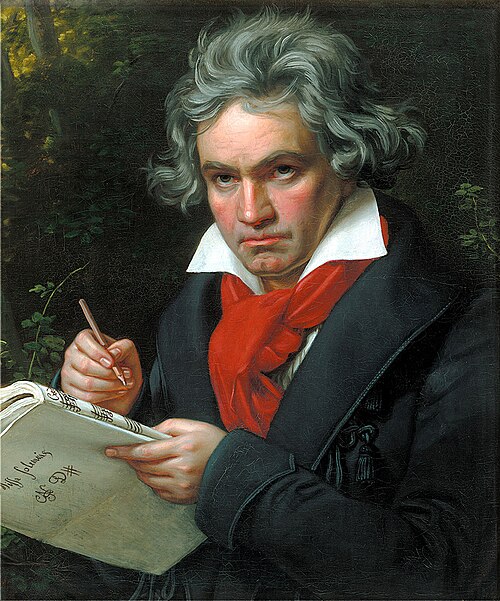
Ludwig van Beethoven
“The Titan”
The revolutionary who kept composing masterpieces even after going completely deaf — changing music forever.
The Classical era (1750–1820): Elegance, balance and clear melodies — the age of the symphony, sonata and string quartet.
Amazing facts
- He began losing his hearing around age 28 and was almost totally deaf by his mid-40s — yet wrote his greatest works, including the Ninth Symphony, when he could barely hear at all.
- To 'hear' the piano, he sawed the legs off one so he could feel its vibrations through the floor, and clenched a rod between his teeth against the soundboard.
- He originally dedicated his 'Eroica' Symphony to Napoleon — then furiously scratched out the name when Napoleon declared himself Emperor, tearing the title page.
- At the premiere of his Ninth Symphony he was so deaf he had to be turned around to see the audience's thunderous applause.
- He was famously messy and grumpy: he moved house around 60 times in Vienna and once threw a plate of stew at a waiter.
- His notebooks show him wrestling with melodies for years — unlike Mozart, he revised endlessly until every note was right.
A few pieces to start with
Symphony No. 5
1808
Symphony
Da-da-da-DUM! The most famous four notes in music — 'fate knocking at the door'. The whole symphony grows from this tiny seed of rhythm.
Symphony No. 9 — 'Ode to Joy'
1824
Choral symphony
The first great symphony to add singers — a choir proclaiming that all people become brothers and sisters. Written when Beethoven was almost totally deaf; now the anthem of the European Union.
'Moonlight' Sonata
1801
Piano sonata
A dreamy, mysterious piano sonata. Beethoven never called it 'Moonlight' — a poet later said it reminded him of moonlight on a lake, and the name stuck.
Life & times — what was happening in the world
1770Born in Bonn; his father, hoping for a 'new Mozart', drills him at the keyboard, sometimes late into the night.
1787Visits Vienna at 16 — legend says Mozart heard him improvise and predicted great things.
1789The French Revolution begins — its ideals of liberty and brotherhood echo through Beethoven's music.
1792Moves to Vienna for good; studies with Haydn.
1802Writes the heartbreaking Heiligenstadt Testament, confessing his growing deafness — and resolving to live for his art.
1804Napoleon crowns himself Emperor — Beethoven angrily un-dedicates the 'Eroica'.
1805The 'Eroica' Symphony premieres — twice as long and wild as any symphony before it.
1808The Fifth and Sixth Symphonies premiere in a single freezing four-hour concert.
1814George Stephenson builds his first steam locomotive; the Congress of Vienna redraws Europe's map in Beethoven's own city.
1815Napoleon is finally defeated at Waterloo.
1818Mary Shelley publishes Frankenstein.
1824Premieres the Ninth Symphony, with its 'Ode to Joy' finale, while almost completely deaf.
1827Dies in Vienna during a thunderstorm; 20,000 people line the streets for his funeral.