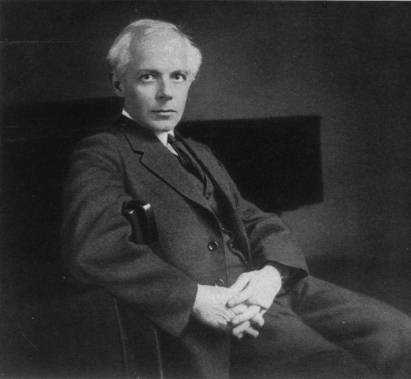
Modern · 1900–2000
Béla Bartók
“The Folk-Song Detective”
A composer who trekked across the countryside with a recording machine, saving thousands of ancient folk songs — then wove their wild rhythms into thrilling new music.
The Modern era (1900–2000): Rules are broken — new scales, wild rhythms and sounds nobody had ever imagined.
Amazing facts
- He was a pioneer of 'ethnomusicology': he travelled to remote villages with an Edison phonograph, recording peasant folk songs before they could be forgotten.
- He gathered around 10,000 folk melodies from Hungary, Romania, Slovakia and beyond, and built his own modern music from their wild rhythms and scales.
- He was a brilliant concert pianist too, and wrote 'Mikrokosmos', a set of 153 piano pieces that climb from beginner to virtuoso.
- His music can sound spiky, pounding and fierce — he sometimes treated the piano like a drum.
- He refused to perform in countries allied with the Nazis, and fled Europe for America in 1940 in protest and danger.
- He died in New York in 1945, poor and not yet famous — the world recognised his greatness only just afterwards.
A few pieces to start with
Concerto for Orchestra
1943
Orchestral
Written in America near the end of his life — a dazzling showpiece that lets every section of the orchestra shine like a soloist.
Romanian Folk Dances
1915
Orchestral / piano
Six short, foot-stamping village dances Bartók collected on his travels, set glowing and alive for the concert hall.
Mikrokosmos
1939
Piano
153 piano pieces climbing from the very first lesson to fiendish virtuoso studies — a whole musical world in miniature.
Life & times — what was happening in the world
1881Born in Nagyszentmiklós, in the Kingdom of Hungary.
1903The Wright brothers make the first powered flight.
1904Begins collecting and recording folk songs in the countryside.
1907Becomes a piano professor at the Budapest Academy of Music.
1914The First World War begins.
1929The Wall Street Crash triggers the Great Depression.
1936Writes his hypnotic Music for Strings, Percussion and Celesta.
1939The Second World War begins.
1940Flees the coming war in Europe for the United States.
1945Dies in New York; his Concerto for Orchestra soon makes him famous.